

Centuries of bone discoveries from the River Thames now tell a darker story than previously imagined. Recent scientific analysis of hundreds of human remains pulled from Britain’s most famous waterway reveals deliberate patterns stretching back thousands of years, long before Roman legions ever set foot on British soil. Radiocarbon dating has transformed scattered skeletal fragments into a coherent timeline of ritualistic activity. Nichola Arthur from London’s Natural History Museum spearheaded research that anchored individual bones to specific time periods, creating an unprecedented view of prehistoric life along the river corridor. Arthur’s team produced 30 fresh radiocarbon dates while incorporating earlier findings to build a robust chronological framework. Their results point unmistakably toward the Bronze Age and Iron Age periods, spanning roughly from 2300 BC through the Roman arrival in 43 AD. “The big question for these human bones is how they came to be in the river,” Arthur explained. Two distinct peaks emerge from the data: one between 2300 to 800 BC, another from 800 BC to AD 43. Most bones originated from upstream locations rather than tidal zones, suggesting communities made conscious decisions about where human remains entered the water. Previous skull studies hinted at intentional patterns rather than random accumulation. Those findings challenged earlier theories about battlefield casualties or accidental drownings, pointing instead toward organized activity with specific timing and placement. Archaeologists employ the term “votive deposition” when describing deliberate placement of valuable items or human remains in water bodies. Similar practices appear throughout northwest Europe during late prehistory, involving metalwork, animal bones, and occasionally human remains. Northern Europe’s bog bodies provide compelling parallels, often displaying forensic evidence of unusual deaths. Tollund Man exemplifies how waterlogged conditions preserve skin and soft tissue, allowing researchers to reconstruct first millennium BC life and death while illustrating ritual wetland usage. Radiocarbon dating measures radioactive carbon decay in bone collagen to estimate age. Through meticulous laboratory preparation and calibration against tree ring records, scientists position remains along reliable temporal axes. “We can now say with confidence that these don’t appear to just be bones that have steadily accumulated in the river through time,” Arthur noted. Combined dating results revealed concentrated periods of deposition rather than steady accumulation over centuries. Distinguishing ritual from accident requires examining location, associated artifacts, and bone trauma patterns. Skeletal injuries reveal blows, cuts, or projectile wounds, while weathering indicates whether bodies decomposed on land before water entry. Upstream concentrations and temporal clustering provide clues without definitive answers. These patterns eliminate certain explanations while encouraging focused testing to separate ceremonial practices from conflict or natural erosion. Communities likely selected specific river locations for repeated activities across generations. Local geography, current patterns, and ford crossings influenced these choices, with particular bends or islands serving as recurring ceremonial sites. Should these remains represent ritual offerings, the Thames functioned as a stage for public ceremonies tied to belief systems, legal practices, or collective memory. This perspective reframes Britain’s primary waterway as a social space millennia before becoming an imperial trade route. Violence may have contributed to the bone deposits, making the river a record of territorial conflicts and competition for water access rights. Regardless of specific causes, the chronological framework transforms isolated discoveries into coherent historical narrative. “Exploring exactly how the Thames human remains might fit into these practices is one of the next exciting steps of the project,” Arthur stated. Ongoing trauma analysis will determine whether injuries match ritual killing, interpersonal violence, or accidents. Future research incorporating isotope analysis will track movement and dietary patterns, revealing whether victims originated from local communities or distant regions. Detailed findspot mapping against ancient channel systems may show preferences for shallow crossings, eddies, or tributary confluences. Ceremony and conflict need not be mutually exclusive categories. Communities often combined punishment, sacrifice, and public display in single acts producing similar archaeological traces in water environments. Arthur’s timeline narrows investigative focus while raising more precise questions about prehistoric Thames communities. Good questions generate testable hypotheses that distinguish evidence from speculation, moving archaeology closer to understanding Britain’s ancient ritualistic practices. The complete study appears in Antiquity journal. Featured image: The first Westminster Bridge as painted by Canaletto in 1746 (Public Domain)
Ancient Smoke-Dried Mummies Discovered Across Asia Predate Egyptian Methods by Millennia
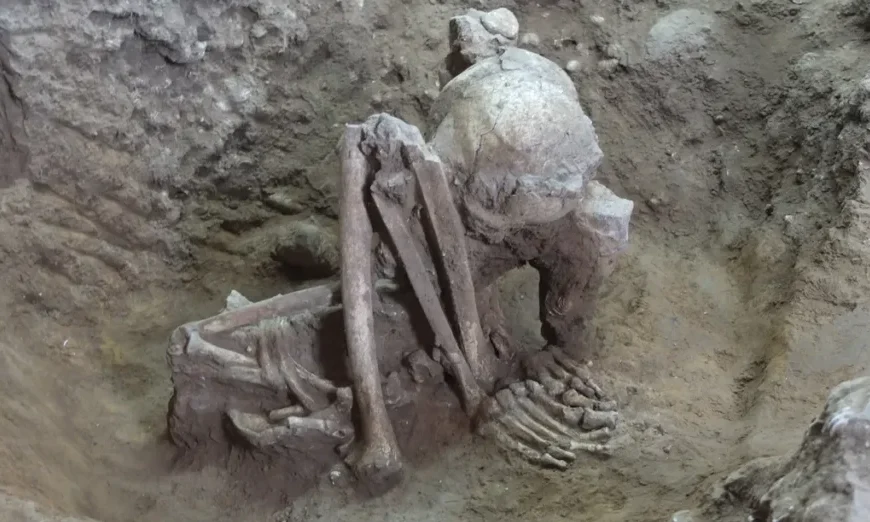
Scientists have uncovered evidence that ancient communities in China and Southeast Asia were creating mummies through smoke-drying techniques as early as 10,000 years ago. This discovery pushes back the timeline of deliberate mummification practices by thousands of years, predating the famous methods used in Chile and Egypt. Burial sites scattered across six countries revealed this groundbreaking finding. China, Philippines, Laos, Thailand, Malaysia, and Indonesia all contained dozens of ancient graves with skeletons positioned in extremely tight, fetal-like positions. Published Monday in the journal PNAS, researchers examined what archaeologists call “hyperflexed” poses – bodies contorted beyond what would be naturally possible. Hsiao-chun Hung leads the study as senior research fellow at Australian National University. She explained that smoking held deeper significance than simple preservation. “Smoking likely carried spiritual, religious, or cultural meanings that went far beyond simply slowing decay,” Hung told Live Science. Archaeologists had puzzled over these tightly crouched burials for years. Dating from 4,000 to 12,000 years ago, they appeared throughout the region with unusual frequency. A similar skeleton found in Portugal in 2022 was interpreted as evidence of mummification due to its hyperflexed state, which gave researchers a clue. Asian burials showed something different, however. Burn marks appeared directly on skeletal remains rather than within burial sites themselves. Scientists discovered evidence of controlled burning on the bones, suggesting specific ritual treatment involving fire and smoke applied before burial. Advanced scientific techniques confirmed their hypothesis. X-ray diffraction and infrared spectroscopy allowed analysis of bone microstructure without damaging ancient remains. Results showed clear signs of low-intensity heating and soot discoloration rather than intense burning from cremation. Contemporary mummification practices provided crucial insights during a 2019 expedition to Papua, Indonesia. Researchers witnessed Dani and Pumo peoples creating mummies of deceased relatives using remarkably similar techniques to those suggested by archaeological evidence. Modern practitioners tightly bind corpses before suspending them over controlled fires. Smoking continues until bodies turn completely black, requiring careful temperature control and extended exposure over long periods. Ancient hunter-gatherer communities likely employed similar methods thousands of years ago, binding bodies immediately after death and subjecting them to prolonged smoking over low-temperature fires. Egyptian mummies sealed in protective containers were designed for eternity. Asian smoke-dried remains served a different purpose entirely. Ancient mummies typically maintained their form for only decades to a few centuries before decomposing completely. “The key difference from the mummies we typically imagine is that these ancient smoked bodies were not sealed in containers after the process, and therefore, their preservation generally lasted only a few decades to a few hundred years,” Hung explained. Hot, humid Southeast Asian environments made smoking the most practical preservation method available. Early communities could maintain physical connections with deceased relatives for extended periods, even if not permanently. Origins of smoke-drying remain mysterious. Hung acknowledged that researchers cannot determine with certainty whether ancient peoples initially developed techniques specifically for preservation or discovered them accidentally through other practices. Discovery might have occurred through experimentation with smoking animal meat for food preservation, later adapted for human remains. Alternatively, it could have emerged as an unintended consequence of ritual practices involving fire and smoke. “What is clear is that the practice prolonged the visible presence of the deceased, allowing ancestors to remain among the living in a tangible way, a poignant reflection of enduring human love, memory, and devotion,” Hung noted. Beyond cultural significance, these findings support the “two-layer” migration model of early Southeast Asian settlement. Hunter-gatherer populations arrived as early as 65,000 years ago, establishing distinct cultural practices before agricultural communities arrived around 4,000 years ago. Smoke-drying burial traditions may represent cultural continuity linking ancient hunter-gatherers to modern Southeast Asian populations. Dani and Pumo peoples still maintain similar funeral rituals today. Ivy Hui-Yuan Yeh, a biological anthropologist at Nanyang Technological University, wasn’t involved in this research but confirmed the findings align with established migration patterns. She told Live Science that discoveries “are consistent with the patterns of early human migration, distribution, and interaction in Asia.” Implications extend far beyond a single discovery. Hyperflexed burials identified throughout Southeast Asia as evidence of smoke-drying practices suggest mummification techniques were far more widespread and ancient than previously recognized. Authors noted that “smoked mummification might have originated earlier, and been more widespread, than is currently identified in the archaeological record.” Practice might extend back to earliest expansion of modern humans from Africa into Southeast Asia, potentially reaching 42,000 years ago. Such a timeline would demonstrate remarkable “deep and enduring biological and cultural continuity” across tens of thousands of years of human history. Featured image: The remains of a middle-aged man who was mummified and buried more than 9,000 years ago in Guangxi, China. (Image credit: Yousuke Kaifu and Hirofumi Matsumura)

Drought Reveals Tombs in Northern Iraq Dating Back Over 2,000 Years
Archaeologists in northern Iraq have uncovered a remarkable collection of ancient tombs, recently exposed by the country’s prolonged drought. Located along the edges of the Mosul Dam reservoir in Duhok province, these tombs are believed to date back more than 2,300 years to the Hellenistic or Hellenistic-Seleucid period. The discovery was announced by Bekas Brefkany, director of antiquities in Duhok and head of the excavation team. “So far, we have discovered approximately 40 tombs,” he said, noting that initial surveys in 2023 had only revealed fragments of a few tombs. The site became fully accessible this year after water levels in the reservoir dropped to their lowest in recent memory. In recent years, drought conditions across Iraq have unintentionally aided archaeologists. While the prolonged dry spells have affected agriculture, electricity, and daily life, they have also exposed sites buried beneath silt and water for centuries. “The droughts have a significant impact on many aspects, like agriculture and electricity,” Brefkany explained, “but for us archaeologists, it allows us to do excavation work.” The newly unearthed tombs show signs of Hellenistic design, a style introduced to the region during the era following Alexander the Great’s conquests. Some researchers suggest that the Seleucid dynasty, which controlled parts of Mesopotamia after Alexander’s death, may have been responsible for the construction of these burial sites. Brefkany’s team is carefully excavating the tombs with the goal of transferring them to the Duhok Museum for detailed study and conservation. He added that his team is working to excavate the tombs to transfer them to the Duhok Museum for further study and preservation, before the area is submerged again. Iraq has been increasingly vulnerable to climate change, facing rising temperatures, chronic water shortages, and recurring droughts. Authorities have reported that this year’s rainfall has been among the lowest since 1933, leaving water reserves at only 8 percent of full capacity. Complicating matters, dams built upstream in Iran and Turkey have significantly reduced the flow of the Tigris and Euphrates rivers—lifelines that have irrigated Mesopotamia for millennia. These changes have not only affected agriculture and daily life but have also had unexpected consequences for archaeology, revealing long-hidden historical sites. The recent discovery underscores Iraq’s rich and layered history, preserved beneath centuries of river sediment and now brought to light by environmental change. Archaeologists hope that careful study of the tombs will provide fresh insights into life and death during the Hellenistic era in northern Mesopotamia. Featured image: The alleged Abraham house in Ur (CC BY 4.0)

Jurassic Park Dinosaurs & Their Connections with Indigenous Undead Spirits
Michael Crichton’s Jurassic Park is far more than a tale of resurrected dinosaurs running amok. This sci-fi thriller carries deeper cultural threads that connect paleontology, indigenous mythology and ethical warnings about humanity’s unchecked ambition. By linking myth with science, the novel reveals our age-old habit of explaining the unknown through traditional legends. Among the most intriguing connections is the subtle intertwining of Crichton’s fictional dinosaurs with the undead Hupia—faceless nocturnal spirits from Taíno mythology. This article explores how these two elements converge, adding a chilling layer of meaning to Jurassic Park. The Taíno People and the Undead Hupia Spirits The Taíno are an indigenous people who once thrived across the Caribbean islands, which includes modern-day Puerto Rico, Cuba, Jamaica, Haiti and the Dominican Republic. Their worldview has deep roots in the Caribbean spirit realm, encompassing both benevolent and malevolent entities. Among these are the Hupia — mysterious and faceless spirits believed to prowl during the night. Tales of these undead creatures warned of disappearances, illness and the dangers lurking in darkness. The Hupia were also associated with guava trees, as the spirits were thought to dwell among their fruit. The Hupia embodied the Taíno’s fears of the unknown, serving as both cultural memory and cautionary tale. These legends resonated with the universal human instinct to personify the inexplicable through stories. The Hupia’s Role in Jurassic Park Crichton’s novel captures this theme by introducing the Hupia as a folkloric explanation for the plot’s mysterious incidents. In an early scene from the novel, villagers attribute deep lacerations on a mortally wounded 18-year old boy to the Hupia, only for the narrative to later reveal the true nature of the attacker: a Velociraptor. Similarly, the nightmarish attack on a young girl by another dinosaur called the Procompsognathus is initially blamed on these spirits. Although fleeting scenes in the overall storyline, these specific references create an eerie juxtaposition between science and superstition. By invoking the Hupia, Crichton illustrates how traditional beliefs offer familiarity and language to explain the unexplainable. This creative twist roots the novel’s horror in both cultural lore and modern science. Carnivorous Dinosaurs: Inspirations and Adaptations Velociraptors in Jurassic Park are iconic but largely fictionalized. While their intelligence and social behavior captivate audiences, the real-life Velociraptor was much smaller—closer in size to a Thanksgiving turkey—and also covered in feathers. Crichton blended traits from the larger Deinonychus, a cousin of the Velociraptor and closer in size to the film’s raptors, to create a more formidable predator. As for Procompsognathus, these were small scavengers about the size of chickens, but reimagined by Crichton into swarming lizard-like predatory threats. In the novel, he amplified their menace by inventing venomous traits, a significant departure from paleontology. These liberties reflect Crichton’s genius in fusing scientific fact with speculative fiction, crafting creatures that evoke primal fear. Shared Symbolism: Primal Dinosaurs and Indigenous Spirits The parallels between Velociraptors and the indigenous undead Hupia extend beyond physical terror. Both thrive in shadows, strike unexpectedly and embody the “facelessness” of relentless forces beyond human control. The Procompsognathus’ child-stealing nature further mirrors the legends surrounding the folkloric Hupia. By blending myth with science, Crichton blurs the lines between ancient fears and modern ones. The Hupia symbolize humanity’s deep-seated psychological anxieties about the unseen, while the dinosaurs bring those fears to life in terrifying physical form. The Lingering Impact & Warning of Jurassic Park Since the book and movie’s release, Velociraptors have transcended scientific discussion to become cultural symbols of cunning terror. Crichton’s imaginative leap turned obscure dinosaurs into modern-day boogeymen. In doing so, he also gave new visibility to indigenous Caribbean myths like the Hupia spirits even if indirectly. By reviving the legend of the Hupia in a modern thriller, Jurassic Park and the recent incarnation of Jurassic World reminds us that myths are never just stories. They are echoes of real fears. In Crichton’s world, resurrected predatory dinosaurs and fear-inducing ghosts are two sides of the same coin: warnings of forces we don’t fully understand and should not attempt to control. Crichton’s Jurassic Park is a meditation on fear, myth and the dark side of scientific vanity. The Hupia and the dinosaurs, though worlds apart in origin, converge in the narrative to remind us of one timeless truth: when we awaken ancient forces—be they spiritual or prehistoric—we may not be ready to face what emerges from the shadows. Note: Our crew of writers here at AllThatHistory are also fans of Ali Awada’s creative videos and interpretations of Jurassic Park lore. His fan videos of Jurassic Park, which includes his own video adaptations or re-imaginings of some of Michael Crichton’s novel scenes (like the Hupia video above) are utterly amazing. Definitely a visual treat for all Jurassic Park lovers. Be sure to check Ali and his crew’s Youtube channel, give their videos a Like and a Subscribe, and tell them AllThatHistory.com sent you in their video comments! Thank you for reading! Top image: The Prop Store of London – LA – Vampire from Priest by The Pop Culture Geek Network, CC BY-NC 2.0) Jurassic Waterloo: Echo by Michael Garnett, CC BY-NC-SA 2.0 References:

When Zeus ‘Ate’ The Creator to Become Supreme God
Zeus’s rise to ultimate power wasn’t just forged by thunderbolts and battles with Titans—it was an act of divine transcendence, rooted in an ancient Orphic tradition often overshadowed by Hesiod’s Theogony. Hesiod’s genesis account gives us a divine family tree of order and rebellion—a genesis filled with clashes and conquests. However, Hesiod’s genesis isn’t the only origin story that was told in Ancient Greece, for there’s another tradition: the Orphic cosmology. The Orphic tradition, in a nutshell, is an Ancient Greek mystical belief system centered around the teachings of the mythical bard-prophet Orpheus. The tradition explores themes such as the soul’s divine origin and cosmic unity. It reimagines creation myths and divine hierarchies, offering a spiritual lens for understanding the universe’s mysteries. In the Orphic version of the creation myth, Zeus’s ultimate ascension does not come through severe war alone. Zeus’s ascendancy comes through the consumption of a primordial god far older and more luminous than any Titan. That god’s name was Phanes—and this, dear readers, is the creator deity’s story. Phanes: The Light That Brought the World Into Being In the beginning, there exists only a boundless and churning void. This state is known as Chaos, yes, but not the chaos of war or noise. This state was silent and unshaped. From this empty void of Chaos came forth two abstract powers: Chronos (Time) and Ananke (Necessity). Together, the abstract couple brought forth a gleaming, swirling Orphic Egg—a symbol of infinite potential coiled and humming with future galaxies. Then, that egg cracked. From within the egg burst forth a radiant primal being: Phanes. The name Phanes means “the Revealer” or “He Who Shines Forth.” Phanes was no warrior, but was a deity of illumination, order, and creative lifeforce. This primal god had four eyes, gold angelic wings and a radiant humanoid body coiled by a giant serpent. Phanes’s form showed great paradox as the god was androgynous which symbolized cosmic balance; thus was both male and female, light and dark, stillness and vibration. Where Hesiod gives us the family lineage from Gaia, Ouranos, and the Titans, the Orphics give us the roots from Phanes—who precedes all these aforesaid deities according to their beliefs. In the Orphic tales, Phanes was the first principle of becoming and growing. The World Through Phanes’s Eyes Phanes sang reality into existence—singing out sacred geometry that formed space, organized the stars to celestial rhythms, and fuelled the universe with harmony and purpose. From Phanes’s song came: Though other deities emerged to rule parts of existence, Phanes remained the source—not a king with a throne, but a cosmic fire—a living map of the universe’s secret architecture containing the blueprints for all creation. Certain Orphic interpretations suggest Nyx is depicted as an older cosmic force who either succeeds Phanes in authority or shares a complex, intertwined relationship, varying across traditions. This is because the Orphic tradition lacks a unified structure, as its myths were preserved through fragmented texts and varied interpretations by followers over time. This decentralization leads to inconsistencies, like Nyx being portrayed alternately as Phanes’s daughter, wife or even a much older force existing beforehand, depending on the source. The Torch Gets Passed Despite the conflicting sources and narratives within the Orphic tradition, the next tidbit of Orpheus’s genesis account tells us that Phanes eventually yielded cosmic authority to Nyx. She in turn, passed authority to Ouranos, which was then taken by Kronos, and ultimately to Zeus. This chain of divine succession is crucial. It represents not just royal inheritance, but also the passing of cosmic knowledge. Each god taking on more than political control—they become vessels of cosmic design. Zeus: The Hungry Sovereign Zeus, son of Kronos and Rhea, had already made a name for himself by overthrowing the Titans. The Titanomachy shook the heavens, and Zeus emerged triumphant. Zeus was awarded lordship over thunderbolts, mastery over other gods and ownership of the Olympian throne. Yet Zeus knew something was missing. His dominion was vast, but not absolute. For though he ruled the present, the very design of the cosmos—its code, its logic, its possibilities—still echoed with the light of Phanes. Thus Zeus sought out the ancient deity. Not to worship. Not to consult. To consume. The Cosmic Consumption Here the myth becomes something stranger and more awe-filled than anything Hesiod described. In a realm beyond realms, beyond the stars and silence, Zeus confronted Phanes. The god of the sky met the god of first light. Some say Phanes willingly merged with Zeus, surrendering his cosmic burden like an old flame lighting another new torch. Others envision Zeus consuming Phanes, not as an act of mindless destruction but as a sacred act of absorption. This absorption of divine creative essence ignited within Zeus an infinite wellspring of cosmic power as a result. By Zeus “eating” Phanes, the Lord of Olympus didn’t just inherit a grander throne—Zeus inherited the foundation of reality itself. What Zeus Became The moment Phanes entered him, Zeus changed. Zeus now embodied the essence of Phanes, holding within himself the primal light that first shaped the cosmos and harmonized existence. This transformation united opposites—male and female, chaos and order, creation and destruction—granting Zeus the boundless vision to perceive and command all that was, is, and could ever be. This transformation reflects the Orphic view of divinity as a dynamic and transcendent force, where the divine merges and progresses into new forms rather than remaining static. In absorbing Phanes, Zeus bridges the finite and infinite, embodying the Orphic ideal of cosmic unity—an eternal interplay of creation and consciousness. Zeus did not simply govern Olympus. He contained the cosmos too. Orphic hymns even describe Zeus after this event with language rarely used for other Olympian gods. He is no longer merely “thunderer,” but: “Zeus of the flashing bolt was the first to be born and the latest, Zeus is the head and the middle; of Zeus were all things created; Zeus is the stay of the earth and the stay of the

140,000-Year-Old Fossils Unearthed in Indonesia’s Madura Strait
Near Indonesia’s shores, in the deep Madura Strait, researchers have found evidence of an ancient civilization. Among the fragments of Homo erectus are also the bones of Komodo dragons, buffalo, deer and Stegodon. The find of these fossils near Surabaya is the first indication we have of Sundaland which linked Southeast Asia together in a large tropical plain long in the past. Evidence going back over 140,000 years means these findings add new understandings of that period and show what was once a lively ecosystem, now covered by the sea. The first signs were found in 2011 when sand mining near Java and Madura Strait yielded more than 6,000 vertebrate fossils, among them two skull fragments—a frontal and a parietal bone, both Homo erectus. Only after Harold Berghuis and his team from the University of Leiden reviewed the fossils have researchers confirmed their age and significance. Using OSL on quartz grains, the researchers showed that the sediment layers date to between 162,000 and 119,000 years ago, agreeing with late Middle Pleistocene findings. “There is a strong showing of different hominin species, as well as movements of hominins in this period,” according to Berghuis, who spoke about the richness of the fossils for understanding early man’s migration. The fossils from the Madura Strait show the remains of a buried system of valleys made by the ancient Solo River flowing across the Sunda Shelf. Using data from sedimentary layers, researchers demonstrated that the area was rich with animal and human life thanks to a thriving river. The presence of fossils here challenges earlier assumptions about where Homo erectus lived, making this the first known underwater hominin site in Sundaland. These skull remnants, a close match to Homo erectus from Java’s Sambungmacan site, prove that early humans once lived in areas that sea levels later covered. The melting of glaciers between 14,000 and 7,000 years ago raised the sea level by more than 120 meters, covering part of Sundaland’s valley region. The inland communities may have all fled, so there are now no visible remains of what they left behind in the sea. Underwater archaeology is more important than ever for revealing information about human history. Thanks to new technology, researchers expect to learn a lot more about the lives and tools used by the ancient people of Sundaland, providing valuable details about human evolution and movements across Southeast Asia. Header image: Underwater image. Source: Pixabay

The Gods of Greece, the Autocrats of the Ancient World (Part Four)
We’re almost at the end of the list of the twelve Olympian gods of ancient Greece. We’ve covered almost all the famous ones by now, but in the ones that remain we see perhaps a gap in between what the Greeks saw as important, and what we see as important today. We have covered the gods of the sky and the sea, clearly vital parts of a functional ecosystem. Alongside them we have noted that the land was for mortals, a kind of neutral territory where all deities could meddle equally (or complain to Zeus if they weren’t getting their way, which happened a deal more than you might think, for gods). We have even thrown in the god of the underworld and the afterlife, who is technically not an Olympian but rather off doing his own thing. We have covered the god of war and the goddess of beauty. We have seen the goddess of motherhood, who was almost always annoyed, and we have seen the goddess of wisdom, who was always right about everything in a way the Greeks found deeply attractive. We have seen the wild goddess of the hunt and her twin, the blonde musclebound (and faintly boring) god of being Greek. Who is left in the pantheon with roles as important as these, which other aspects of the world as the Bronze Age Greeks saw it were represented by these final gods. What was an important as wisdom, as beauty, as creation itself? Some of these may be, at first, surprising to the modern reader. Of the four remaining gods we have two goddesses, of hearth and home and of the harvest, and two gods, one of the forge and one of announcing things. Important jobs, for sure? But interesting for their inclusion nonetheless. These were gods who personified the most important aspects of Greek life, after all. It makes sense for the harvest to be important, but the herald of the gods? Was Hermes just hanging around because Zeus was too busy and too important to make his own proclamations? Similarly, it is pretty easy to understand who any people of the Bronze Age might see the forge as some kind of magic. Metals were the hot new thing, changing the world more rapidly than ever before. He who had command of bronze could rule an empire, so of course this power came with its own god. But a goddess of hearth and home, an area pretty much covered already by Zeus’s wife Hera? What was it about the family unit which merited a second goddess, especially devoted to its safekeeping? And finally, there is the secret god. The thirteenth of the twelve, a younger and a far wilder god than the rest. This last god was the god of wine, or getting completely wrecked in the Greek sunshine and dancing with total abandon and a total lack of care. People died in his orgies, he was that out of control. So these gods may not be, in the end, as important as the gods already covered. But, in their personalities and in the things that differentiate them from the others, they may be the most interesting gods of all. Header Image: Dionysus, a god of resurrection in the same vein as Jesus and the thirteenth of the twelve gods of Olympus. Source: Carole Raddato / CC BY-SA 2.0.

Green Sahara Mummies Reveal a People Who Stood Apart
The Sahara is the largest desert in the world, a vast arid wilderness stretching across north Africa. For millennia it has been a near insurmountable barrier separating the Mediterranean from the rest of the African continent. The ancient Egyptians, clustering along the shores of the Nile, depended on the desert for their defense. For them the lands were divided into the black, life-giving soils watered by their sacred river, and the endless red hell which lay beyond. But the deserts of north Africa were not always there. 7,000 years ago, this was a verdant landscape, teeming with life. Humans lived here, and now a new study has uncovered exactly who these people of the “Green Sahara” were. The research, published in Nature, focuses on the ancient rock shelter of Takarkori in the mountains of southwestern Libya. Extremely inaccessible even today and surrounded by sand, this place was once very different. Between 14,500 and 5,000 years ago during what is known as the “African Humid Period” this was a lush, forested area with rivers, lakes, and large animals. People also lived here, an isolated community of livestock farmers separate from the rest of the world. The remains of the people and their community have been preserved by the subsequent desiccated environment. Usually such hot environments with wild temperature swings between day and night would quickly destroy DNA traces. However the new research concentrates on two skeletal mummies in an exceptional state of preservation, and the team have been able to extract legible DNA and map the entire genome of these people. The results are surprising: it was known the pastoralists of Takarkori were isolated, but their genes reveal for just now long they lived separated from the rest of the world. For tens of thousands of years these people lived an isolated existence among their goats and sheep. This is interesting. It had been theorized that the era of a Green Sahara would have turned the area around Takarkori into a corridor for migration out of the heart of Africa into the lands to the north. This does not seem to be the case: although the terrain would have been much easier to traverse than it is today, these people were not a part of that great human expansion. How did they learn to farm, then? They are not genetically linked to the humans of the Near East, where farming was first innovated. The best guess for now is that they learned the techniques from the people with whom they traded, via cultural exchange. Remains of pottery found at Takarkori and their cave paintings show these people were isolated genetically, but not culturally. However the lack of evidence of inbreeding suggests that these isolated people were also not small in number. There must have been a significant population here, trading with their neighbors but otherwise remaining isolated for millennia. Where did they come from? That, in truth, is the final mystery: these people are not closely linked to any of the other populations in the ancient world. They are from a previously unknown ancient African lineage. There is some Neanderthal in the mix, more than sub-Saharan Africans yet ten times less than the Levantine farmers who must have taught them to tend their livestock. We have to reach far back into the Pleistocene, more than 11,000 years ago, in our search for the origins of these new people. They came from places unknown, lived in splendid isolation for longer than all of human history, and then died in this place, forgotten until now. Header Image: The DNA came from mummies at Takarkori during the “Green Sahara” period. Source: Museum for Prehistory and Early History / CC BY-SA 4.0.

The Gods of Greece, the Autocrats of the Ancient World (Part Three)
There were twelve “core” gods of the ancient Greek pantheon. In the first of these articles we looked at the Big Three, that is Zeus, Poseidon and Hades, and in the second we looked at the main goddesses. Now we get into the really interesting stuff: the specialists. The greater gods may have had responsibilities, but they acted rather as a beneficiary of a charity might: showing an interest, bestowing patronage and holding ultimate responsibility, but not actually doing that much work. The other gods though, they had jobs to do. The twelve Olympian gods include Hermes, for example, forever zipping between gods and mortals and delivering (usually) Zeus’s messages when the latter was too busy elsewhere to attend in person. Demeter, goddess of agriculture is responsible for the harvest, Hephaestus the god of the hearth is constantly making stuff. These gods are occupied, they like to keep busy. There is also a tiny amendment for those keeping track of these twelve gods. While there are twelve Olympians this number does not include Hades, who was separate as king of the underworld and considered a “Chthonic Deity” unlike his siblings. He was included before because no story of the gods of Olympus would be complete without him but in truth he is not one of their number. It is worth the diversion to explore why. Sure, he had his own kingdom (or rather set of kingdoms) but then both Zeus and Poseidon had their own domains, the sea and the sky, and yet they lived on Olympus. What was it that made Hades different? The division between Hades and, say, his brother Zeus is not one of lands divided between the two. The difference comes from the people they rule: Zeus and the Olympians rule over the lands of the living, Hades over the lands of the dead. Hades is even known as “Chthonic Zeus” in some sources, and has his own pantheon of subterranean gods over whom he rules much as Zeus does. Anything that dies belongs to them, but also anything that grows: if it comes from the ground it is Hades, ultimately, that you have to thank. But for most the gods of Greece are those musclebound half naked figures atop their mountain, bronzed and idealized. At least, idealized in their outward appearance: as we have noted with Zeus, their physique may be flawless but their behavior is very flawed indeed. Header Image: Apollo, prettiest of the gods of Greece, hanging out with Hyacinthus and Ciparis. Source: Alexander Ivanov / Public Domain.

The Anglo Saxon Kings of England: The History of the Before (Part Four)
For centuries, after the Romans left, Britain was ruled by the seven kings of the Heptarchy. This was a time of rival realms and rival claimants, a time of petty kingdoms and tribute extracted at the point of a sword. This was a time where might made right, where the most powerful of the kings earned the right to be called the Bretwalda, and where power was gained and wielded through battle. This was a time where kingdoms were overthrown, only to rise again. Somewhere in this ill-documented mess it was also the time of King Arthur, with a heavy emphasis on “maybe”. Not the fictionalized Arthur of the later medieval romances, nor an Arthur like any of the modern versions, each of which offers a gloss only on the accumulated characterization that came before, none ever approaching the reality. As we have noted before, searching for King Arthur is a pyre on which more than one promising historian has burned their career to ash. For the problem is not that we can’t find Arthur for lack of detail. The problem is we know pretty much what happened through these decades and centuries, and nowhere in what we know is there space for this king. Any one of the Bretwalda of the Anglo Saxon centuries could be Arthur. All of them could be, but none of them are. If you need closure as to who this great king really was, when he really existed, then you must understand him as a later creation, taking all that was great from the Bretwaldas (and the Romano-British that came before) and merging them into one character. Header Image: Eighteenth century depiction of Alfred the Great, the last and greatest Bretwald of Anglo Saxon Britain and the first true king over all Anglo Saxons. Source: Samuel Woodforde / Public Domain.

The Bronze Age Collapse: A Sudden, Violent Plunge into Darkness (Part Three)
The Bronze Age Collapse was, definitively, the end of the Bronze Age. By the time the ancient civilizations had picked up the pieces and rediscovered how to write and interact with each other again they had an entirely new and exciting discovery to work with: iron. Iron can be made into harder and more durable materials than bronze, for only a modest increase in smelting temperature. Iron-equipped armies had a decided advantage over their bronze-equipped opponents, and there is even an argument to be made that the discovery of iron might be a major cause of the collapse. Iron can be seen as something of a great leveler, too. Unlike the scarce ingredients which make up bronze, iron ore is found pretty much everywhere. And, unlike the scarce ingredients which make up bronze, there is only a single ingredient in iron. It is known as “iron”. Iron-equipped armies were therefore not only better armed and armored, they were larger. The limiting factor was suddenly not the raw materials, it was the forges and the foundries, and without this limitation an entirely new weapons industry could be created in a generation. Swords for everyone, and all that. Could this sudden change be a root cause of the collapse? Given every man, woman and child in your civilization the latest in (literally) cutting edge technology and you’re going to end up with a bellicose population, despite what the NRA will tell you. Who needs trade when you can take what you want. We were taught in school that history should be about what happened, not what could have happened. But for all that, the Hittite discovery of iron smelting was one of the great “what-ifs” of history. The Hittites (most probably) took this great leap into the future first, and they could have conquered the world with it were they not so busy destroying themselves. Header Image: Although the empires may have survived, much of the old world of the Bronze Age was lost in the Collapse. Source: John William Waterhouse / Public Domain.

The Anglo Saxon Kings of England: The History of the Before (Part Three)
For the six centuries between the end of Roman occupation and the Battle of Hastings in 1066, Britain was not a united kingdom. It was, instead, a mishmash of tribal domains, petty kings and infighting. Chief amongst these were the seven Anglo Saxon kingdoms of the Heptarchy. Five of them crowded round the south east of the island: Anglia, Essex, Kent, Sussex and Wessex. The other two, Mercia and the enormous kingdom of Northumbria, were further west and further north, each as large as the five smaller kingdoms in its own right. The story of these seven kingdoms is the story of Anglo Saxon Britain. Their struggles for power, imperium in the old Roman form, are the backdrop for six hundred years of history. Out of these conflicts arose a series of High Kings of Britain, so called Bretwaldas (Britain rulers) of the Anglo Saxons. These kings, from Kent, Anglia and then for half a century from Northumbria, were elevated almost entirely by their strength in arms. They were, in reality, warlords. Our guide to these less documented times has been the monk Bede, who lived in the seventh and eighth centuries. His Ecclesiastical History of the English People is the clearest and most detailed account of the Bretwaldas, even if Bede himself did not invent the term. Header Image: The Heptarchy of Anglo Saxon England. The kings of Mercia are represented by the central shield with the red saltire cross. Source: John Speed / Public Domain.