
Ancient Smoke-Dried Mummies Discovered Across Asia Predate Egyptian Methods by Millennia
Researchers discover 10,000-year-old smoke-dried mummies across Asia, revealing ancient preservation techniques that predate Egyptian mummification by thousands of years.

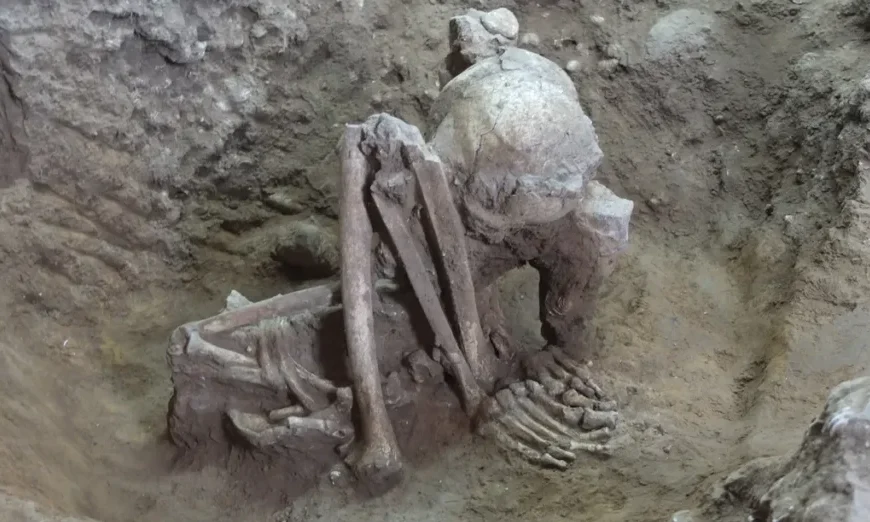
Scientists have uncovered evidence that ancient communities in China and Southeast Asia were creating mummies through smoke-drying techniques as early as 10,000 years ago. This discovery pushes back the timeline of deliberate mummification practices by thousands of years, predating the famous methods used in Chile and Egypt.
Burial sites scattered across six countries revealed this groundbreaking finding. China, Philippines, Laos, Thailand, Malaysia, and Indonesia all contained dozens of ancient graves with skeletons positioned in extremely tight, fetal-like positions. Published Monday in the journal PNAS, researchers examined what archaeologists call “hyperflexed” poses – bodies contorted beyond what would be naturally possible.
Hsiao-chun Hung leads the study as senior research fellow at Australian National University. She explained that smoking held deeper significance than simple preservation. “Smoking likely carried spiritual, religious, or cultural meanings that went far beyond simply slowing decay,” Hung told Live Science.
Archaeologists had puzzled over these tightly crouched burials for years. Dating from 4,000 to 12,000 years ago, they appeared throughout the region with unusual frequency. A similar skeleton found in Portugal in 2022 was interpreted as evidence of mummification due to its hyperflexed state, which gave researchers a clue.
Asian burials showed something different, however. Burn marks appeared directly on skeletal remains rather than within burial sites themselves. Scientists discovered evidence of controlled burning on the bones, suggesting specific ritual treatment involving fire and smoke applied before burial.
Advanced scientific techniques confirmed their hypothesis. X-ray diffraction and infrared spectroscopy allowed analysis of bone microstructure without damaging ancient remains. Results showed clear signs of low-intensity heating and soot discoloration rather than intense burning from cremation.
Contemporary mummification practices provided crucial insights during a 2019 expedition to Papua, Indonesia. Researchers witnessed Dani and Pumo peoples creating mummies of deceased relatives using remarkably similar techniques to those suggested by archaeological evidence.
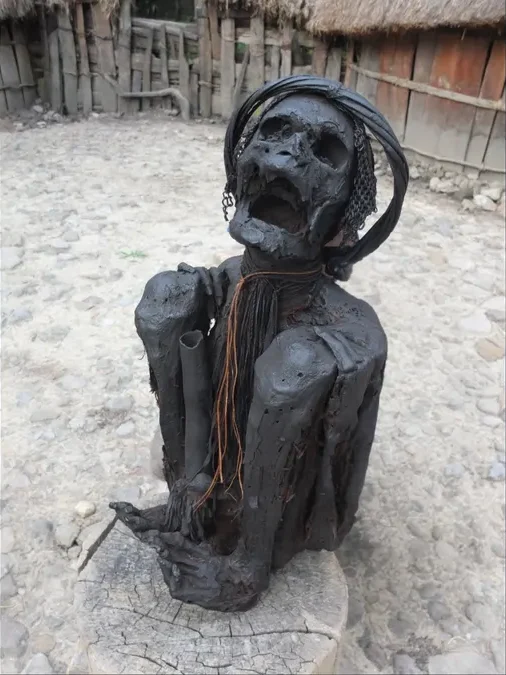
Modern practitioners tightly bind corpses before suspending them over controlled fires. Smoking continues until bodies turn completely black, requiring careful temperature control and extended exposure over long periods. Ancient hunter-gatherer communities likely employed similar methods thousands of years ago, binding bodies immediately after death and subjecting them to prolonged smoking over low-temperature fires.
Egyptian mummies sealed in protective containers were designed for eternity. Asian smoke-dried remains served a different purpose entirely. Ancient mummies typically maintained their form for only decades to a few centuries before decomposing completely.
“The key difference from the mummies we typically imagine is that these ancient smoked bodies were not sealed in containers after the process, and therefore, their preservation generally lasted only a few decades to a few hundred years,” Hung explained.
Hot, humid Southeast Asian environments made smoking the most practical preservation method available. Early communities could maintain physical connections with deceased relatives for extended periods, even if not permanently.
Origins of smoke-drying remain mysterious. Hung acknowledged that researchers cannot determine with certainty whether ancient peoples initially developed techniques specifically for preservation or discovered them accidentally through other practices.
Discovery might have occurred through experimentation with smoking animal meat for food preservation, later adapted for human remains. Alternatively, it could have emerged as an unintended consequence of ritual practices involving fire and smoke.
“What is clear is that the practice prolonged the visible presence of the deceased, allowing ancestors to remain among the living in a tangible way, a poignant reflection of enduring human love, memory, and devotion,” Hung noted.
Beyond cultural significance, these findings support the “two-layer” migration model of early Southeast Asian settlement. Hunter-gatherer populations arrived as early as 65,000 years ago, establishing distinct cultural practices before agricultural communities arrived around 4,000 years ago.
Smoke-drying burial traditions may represent cultural continuity linking ancient hunter-gatherers to modern Southeast Asian populations. Dani and Pumo peoples still maintain similar funeral rituals today.
Ivy Hui-Yuan Yeh, a biological anthropologist at Nanyang Technological University, wasn’t involved in this research but confirmed the findings align with established migration patterns. She told Live Science that discoveries “are consistent with the patterns of early human migration, distribution, and interaction in Asia.”
Implications extend far beyond a single discovery. Hyperflexed burials identified throughout Southeast Asia as evidence of smoke-drying practices suggest mummification techniques were far more widespread and ancient than previously recognized. Authors noted that “smoked mummification might have originated earlier, and been more widespread, than is currently identified in the archaeological record.”
Practice might extend back to earliest expansion of modern humans from Africa into Southeast Asia, potentially reaching 42,000 years ago. Such a timeline would demonstrate remarkable “deep and enduring biological and cultural continuity” across tens of thousands of years of human history.
Featured image: The remains of a middle-aged man who was mummified and buried more than 9,000 years ago in Guangxi, China. (Image credit: Yousuke Kaifu and Hirofumi Matsumura)


