
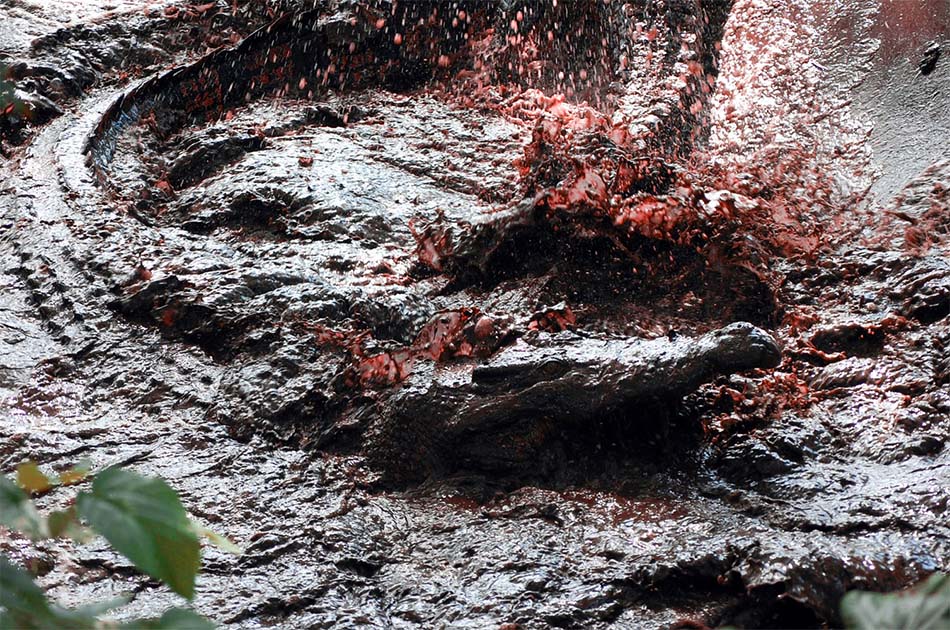
It was February 1945 in the mangrove morasses of Ramree Island along the coast of Burma. It was here where a dark page of World War II was written. When Japanese soldiers withdrew from a losing fight with Allied soldiers, they trudged into a labyrinth of mud and water that would spell doom into their lives. Turns out this muddy waterway is infested with saltwater crocodiles. The Battle of Ramree Island was a lesser battle of the Burma Campaign, and is remembered not for its implications on the battlefield but for a macabre anecdote: hundreds of Japanese soldiers reportedly were eaten by crocodiles in one evening. While this story was glamorized by the vivid prose of a Canadian naturalist, the modern legend has fascinated imaginations for decades; even though its authenticity is as murky as the wetlands themselves. This is the story of Ramree—where war, wildlife and myth meet. The Burma Campaign and Ramree’s Strategic Significance To fully comprehend the terror of Ramree, we must first turn back the clock to 1945 during which time the Pacific theater of World War II was a seething cauldron of desperation. The Burma Campaign, overshadowed by the wars in Europe and the Pacific Islands, was a brutal struggle to drive the Japanese from their grip on Burma (Myanmar). Ramree Island is a 520-square-mile spot in the chain of the Andaman and Nicobar Islands, and was strategically valuable in its location. Its low-lying terrain was appropriate for an airfield to support Allied action against the mainland, and it was a target that General William Slim’s Fourteenth Army wished to seize. The British XV Indian Corps carried out Operation Matador—a landing operation to take Ramree—during January 1945. The estimated 2,700-man Japanese garrison under General Toshinari Noda had occupied the island since 1942. Encircled and cut off from supplies, the Japanese fought bravely, using the dense jungles of the island and coastal defenses to slow the Allied advance. Intensive naval bombardment and ground assaults by early February shattered their lines. Between 900–1,000 Japanese soldiers, aware of their impending defeat, retreated eastward, with the hope of fighting their way through the mangrove swamps of the island to a more sizable force on the mainland. Little did they know, the Japanese forces would be moving into one of nature’s deadliest traps. Into the Mangroves: A Desperate Retreat Ramree is an environment of twisted roots where every step is in gooey, knee-deep mud. The air is heavily swarmed with mosquitoes that are also carriers of malaria and dengue. Scorpions and venomous snakes have their sanctuaries in the swamps, and the brackish water harbors a far more dangerous enemy. Saltwater crocodiles (Crocodylus porosus) lay dominion over Ramree’s waters, and are the largest modern-day reptiles on Earth growing up to 23 feet long (approx. 7 meters) with bone-crushing jaws. For the Japanese soldiers—exhausted, starving, and weighed down with guns and scarce ammunition—the swamps were a journey into doom. On February 19, 1945, the evening that the retreating Japanese charged through the darkness, the Allies closed in on them. British motor launches roamed up and down the coastal waterways, cutting off escape channels, while ground troops encircled the swamps, shooting stragglers. The soldiers, some of them injured, others dysentery-stricken, had a gauntlet to get through. Hunger clawed at them; the mud grabbed at their boots.. and then, as one version has it, the crocodiles struck. The Crocodile Massacre: Bruce Wright’s Account The most vivid account of the night was given by Bruce Stanley Wright, who was a Canadian naturalist and Royal Canadian Navy officer attached to the Burma Campaign. In his book Wildlife Sketches Near and Far, published in 1962, Wright recorded the terrible account through his following passage: “That night was the most horrible that any member of the M. L. [motor launch] crews ever experienced. The scattered rifle shots in the pitch-black swamp punctured by the screams of wounded men crushed in the jaws of huge reptiles, and the blurred worrying sound of spinning crocodiles made a cacophony of hell that has rarely been duplicated on earth. At dawn the vultures arrived to clean up what the crocodiles had left… Of about one thousand Japanese soldiers that entered the swamps of Ramree, only about twenty were found alive.” Wright’s vivid account, later echoed by conservationist Roger Caras and once featured in the Guinness Book of World Records, helped cement Ramree’s place in popular lore—even though his version was based on secondhand reports rather than direct observation. His description suggests a massacre on horrific scales: scores of men, stunned and caged, being torn limb from limb by crocodiles in a feeding frenzy. British soldiers on the motor launches, stationed at the perimeters of the swamps, heard cries and gunfire throughout the night. However, Wright was not part of the soldiers in the swamps. His evidence was hearsay from motor launch crews, hearing rather than seeing the chaos. The question arises here: did the Japanese really get massacred by crocodiles, or has time been subject to war inflation? Unraveling the Truth: Crocodiles or Pandemonium? Modern scholarship raises a healthy skepticism about how far the crocodile attacks went. In 2000, herpetologist Steven Platt interviewed several of the older Ramree Island residents who lived through the war. Their account, plus military records, shows a far less sensational truth. Platt estimated that only 10–15 soldiers likely died from being attacked by crocodiles, primarily as scavengers gnawed on bodies or isolated stragglers. Most of the Japanese dead—hundreds of the 900–1,000 who had entered the swamps—fell victim to more mundane but no less fatal processes. These included bullets from the Allies, drowning, starvation, malaria, dysentery, or snake and scorpion bites. Saltwater crocodiles are known to be strong, but some researchers and historians feel that the Ramree account had been exaggerated. Furthermore, the swamps themselves were a death sentence. The Japanese, cut off by Allied soldiers, had no access to food or fresh water. Some died in tidal creeks or were trapped in mud, unable to move.
Origins of the Cold War & Its Shadows on Modern Geopolitics
The Cold War was a tactical battle between two superpowers with bold ambitions of the globe’s future. Born out of World War II, this decades-long tension between the United States and the Soviet Union was not your average war—no direct battle between the two powerhouses took place. Rather, it was a war of ideologies that was fought through proxy wars, spy games and the very real possibility of nuclear showdown. Though the Cold War officially ended with the collapse of the Soviet Union in 1991, its heritage continues to haunt current world politics. Most recently its echoes reverberated in the ongoing Russo-Ukraine war. Birth of the Cold War The conflict’s genesis was created in the final years of World War II, in the Yalta and Potsdam Conferences (1945) where visions for post-war Europe differed, and this led to tension between the USA and the Soviet Union. It was born out of ideological differences from the time of the Bolshevik Revolution of 1917, as the USA promoted democracy and free enterprise whilst the Soviet Union sought to expand its influence through socialist regimes in Eastern Europe. The USA and its Western allies wanted to extend democratic government and economic partnership while also building a world based on open markets with collective security. Meanwhile, the Soviet Union (under Joseph Stalin) desired a buffer zone in Eastern Europe and thus established socialist-oriented governments in order to protect themselves against future possible invasions. This move was fueled thanks to a fear compounded by the sheer devastation which the Soviet Union had suffered during World War II. This ideological divide led to the descent of the Iron Curtain over Europe that segregated the East from West, and set the stage for an international power struggle. The Marshall Plan, or the American attempt to rebuild post-war Europe, was both a humanitarian effort and a strategic measure to stem the tide of communist expansion. Meanwhile, the Soviet Union solidified its control over Eastern Europe, creating a bloc of pro-Moscow satellite nations. This division of Germany into East and West, and thus the construction of the Berlin Wall in 1961, were the most publicized reminders of the Cold War’s unwelcoming divide. The Arms Race and Nuclear Brinkmanship The arms race was the most defining feature of the Cold War, during which the USA and the Soviet Union built vast nuclear weapons that could annihilate the entire globe. Mutually Assured Destruction (MAD) held the superpowers in check so that open conflict wouldn’t spread like a rampaging wildfire. Otherwise had both nuclear-armed superpowers gone out of control, they would’ve inflicted wide-scaling catastrophes with horrific consequences. This fine balance of power was most severely tested in the 1962 Cuban Missile Crisis when the world teetered on the brink of nuclear war. On the other hand, the Cold War years were also marked by tremendous economic and technological transformation. The massive spending on defense and military technology gave rise to the Military-Industrial Complex, something which defined American economic policy for decades. Furthermore, Cold War competition also caused technological innovation (especially during the Space Race). The Soviet’s launching of Sputnik in 1957 marked the race’s start, as each of the superpowers registered milestones such as the first man in space by the Soviet Union (Yuri Gagarin, 1961) and the USA’s memorable Apollo 11 mission to the moon in 1969. Investments towards space technology not just established military capability but also generated innovations with wide civilian uses. Among these innovations include the invention of the internet and satellite technology. Proxy Wars: The Cold War Gets Hot Though the USA and the Soviet Union never came face-to-face in battle, they supported opposite sides of numerous proxy wars throughout the world. Such wars were often used as arenas for communism versus capitalism ideologies. The Korean War during 1950 to 1953 was the first significant proxy war which ended in a stalemate that divided Korea into North and South. The Vietnam War (which had major US involvement from the early 1960s to 1973) culminated in the fall of Saigon in 1975. The fall united all of Vietnam under communist rule backed by the Soviet Union and China. Elsewhere in the Middle East and Africa as well as Latin America, the Cold War was lived through in the form of coups, revolutions and insurgencies that more often than not lead to retraction of democratic ideals in the pursuit of broader strategic interests. These wars left lasting scars as numerous countries grappled with the legacies of Cold War intervention to this day. The Fall of the Soviet Union and the End of the Cold War The 1980s were a turning point when Soviet leader Mikhail Gorbachev introduced reforms like Glasnost (openness) and Perestroika (restructuring). Gorbachev’s efforts tried to activate the Soviet economy as well as reverse tension with the West, but unveiled deep rooted internal problems in the Soviet system. This eventually led to a domino effect that culminated in the collapse of the Soviet Union. As developments within went forward, the external Cold War tensions receded. The fall of the Berlin Wall in 1989 (a longstanding symbol of division) was a turning point as East and West Germany began the reunification process. In 1991, the Soviet Union dissolved, ending the Cold War through a combination of socio-economic instability, political reforms, nationalist movements and external pressures. USA became the world’s leading superpower as a result where numerous people had hopes of a new era of peace and cooperation. However, the heritage of the Cold War was far from being over. Lasting Influence on Modern Geopolitics The Cold War’s influence on modern geopolitics is extremely deep and widespread. The position of the USA as the world’s leading superpower is a direct result of having emerged victorious from the Cold War. Alliances and institutions formed during the Cold War (like NATO) continue to shape international politics even. NATO was established in the first place to counter the threat of Soviet expansion, and is now a primary political instrument for making
How One War Rewrote the English Language
On the crisp autumn day of October 14, 1066, a pivotal war unfolded in southern England. One that forever altered the course of English history, and also language. Picture this scene: William the Conqueror, the audacious Duke of Normandy, locking horns with Harold Godwinson, the last Anglo-Saxon king. Their conflict, known as the Battle of Hastings, was about who could claim the throne of England and have dominion over its people. Both men—certain of their divine right to rule—clashed with unyielding conviction. The outcome? A decisive Norman victory after Harold was killed, likely by an arrow to the eye or a fatal blow from Norman knights. This event toppled the Anglo-Saxon reign and set the stage for a linguistic revolution. Just who were the Normans, and how did their culture reforge the English language as we know it? Raiders to Royals to Shapers of English See, the Normans weren’t just French. They were also descendants of Vikings who had once ravaged France. After much political maneuvering from the French side and securing allegiances, these Vikings settled in French soil for good. They then adopted French customs while also converting from Norse Paganism to Christianity. This blend gave rise to the Normans—a fascinating mix of Norse Viking heritage and French culture. The Norman tongue was a dialect of Old French, enriched by both Old Norse and Latin influences. This was William’s mother-tongue, which he brought into England with sheer impact. After William’s victory, Norman French became the official language of the government and elite; while Latin remained the language of the church and scholars. However, Old English did not vanish overnight. It continued to live in the common folks’ lips while gradually evolving. Over time, the continuous blending of languages gave rise to Middle English. Norman French, along with its Latin roots, introduced a wealth of vocabulary, particularly in areas such as governance, art, literature, and cuisine. Words such as “court,” “judge,” “marriage,” “government,” “dinner,” “pork,” and “beef” became part of everyday language. Meanwhile, Old Norse already flavored Old English with gems such as “sky,” “law,” “cake,” “egg,” “knife,” and “husband.” The Past and Future of the English Language The aftermath of the Battle of Hastings created a rich linguistic tapestry, blending Anglo-Saxon roots with Viking vigor, French flair, and Latin influences. This vibrant mix laid the groundwork for Modern English, transforming it into the eclectic language we enjoy today. Just as Old English evolved from a blend of different tongues, Modern English continues to evolve, incorporating words and expressions from a variety of cultures. This ongoing evolution gives rise to unique dialects and sounds, from the hip phrases of urban slang to the hybrid languages of Pidgin. The Battle of Hastings wasn’t just a historic clash of swords; it was a monumental cultural showdown that sparked a revolution in language. This epic fusion of voices and civilizations created a dynamic, ever-changing mosaic of English that reflects the diverse influences shaping our world today. Whether through memes, trending hashtags, or the latest linguistic trends, English remains a living testament to our global and cultural interconnectedness. For the newer generations, this rich history adds depth to the everyday words and expressions we use. Celebrating a language that’s as manifold and evolving as we are. Top Image: Painting of “The Battle of Hastings in 1066” by François-Hyppolite Debon, Musee des Beaux-Arts, Caen (France). Source: Public Domain References
This Place Near Iran Affects World Oil Prices – From History to Consequences
There’s this narrow but vital place of water near Iran that has witnessed millennia of world maritime trade, diplomatic gambits and geopolitical rivalries. Stretching between the Persian Gulf and the Gulf of Oman, this specific waterway connects (and affects) major oil-exporting nations to world markets – influencing oil prices big time. This waterway is the Strait of Hormuz; known for having earned the title as the planet’s most important choke point for crude oil and liquefied natural gas. More info on current events later, but first.. let’s take a brief time travel to ancient history to start things up. A Strait of Ancient Empires The Strait of Hormuz’s history is just as ancient as the civilizations that bordered it. From the seafaring empires of Mesopotamia to the strategic maneuvers during the Age of Sail, the strait’s significance has evolved side by side with world trade dynamics. The Strait of Hormuz first gained prominence in the ancient world as a key route for spice and silk trade, connecting East Asia to Continental Europe. Persian empires, like that of Cyrus the Great’s, recognized the waterway’s strategic value and fortified its surrounding areas. Fast forward to the 20th century, the strait emerged as a focal point during the discovery of oil in the Gulf region. This newfound resource transformed its surrounding nations into global energy giants. The shipping lanes brimming with crude oil tankers became a lifeline for economies worldwide as a result. The “Tanker Wars” of the Iran-Iraq Conflict (1980–1988) The Iran-Iraq War brought unprecedented attention to the Strait of Hormuz. Attacks on oil tankers and merchant vessels—known as the “Tanker Wars“—became a grim reality as both nations sought to cripple each other’s oil-dependent economies. Despite the targeted strikes, the strait never saw a full closure, thanks to international naval interventions.Politicians like US President Ronald Reagan championed Operation Earnest Will to escort vessels, highlighting the strait’s global importance. Meanwhile, Iranian leaders like Ayatollah Khomeini viewed the waterway as a bargaining chip in their regional aspirations. Threats, Tensions & Oil Price Hikes in the Early 21st Century The early 2000s marked the resurgence of threats to close the Strait of Hormuz, often as a reaction to American-imposed sanctions on Iran. In 2012, during heightened tensions over Iran’s nuclear program, President Mahmoud Ahmadinejad hinted at leveraging the strait as a countermeasure against Western pressures. While these threats caused temporary spikes in oil prices, military coalitions ensured the continuation of maritime traffic. The Strait Today In 2025: On the Brink of Escalation The strait at present is a flashpoint of regional and international rivalries. In June 2025, tensions soared after US President Donald J. Trump ordered airstrikes on Iran’s nuclear facilities. Iran’s parliament responded by approving a motion to close the Strait of Hormuz—though it awaits final approval from the Supreme National Security Council and Supreme Leader Ayatollah Khamenei himself. International leaders, including the British Prime Minister and the Saudi Crown Prince, as well as Russian President Vladimir Putin and China’s President Xi Jinping have urged de-escalation and warned about serious consequences should the closure take place. US Vice President JD Vance has also chimed in saying that the closure of the Strait of Hormuz would be self-destructive to the economy of Iran overall. Meanwhile, the UN Secretary-General has called for diplomatic resolution in response to avoid such massive world-changing repercussions. The Consequences of the Strait’s Closure IF Iran were to block the Strait of Hormuz, its consequences would spread out like seismic ripples in a vast ocean, touching every corner of the world: A Story of Unresolved Tensions One could see the Strait of Hormuz as being the very heartbeat of global energy—its every pulse sending waves across the planet. This strait remains a pivotal stage for age-old rivalries and present-day power struggles. Meanwhile, its history serves as a testament to the delicate balance between cooperation and conflict; as well as trade and turmoil of numerous nations – even livelihoods. As the world watches the current escalation taking place, leaders must learn from history’s lessons—ensuring that this lifeline of global trade remains open and secure for generations to come. Header Image: Aerial view of the Strait of Hormuz – taken near Iran with its oil-shipping route. By NASA. Source: Public Domain. References:
Not Only Trump: History of President F-Bombs & Profanity – From Lincoln to Biden
WARNING: This article contains strong vulgarity and unbiased facts. We strongly advise to either turn away if you’re sensitive, or to enjoy with amusement if you don’t mind. For those who don’t mind, we bid you welcome. Please sit back, relax and keep reading: On June 24 2025, as Donald J. Trump, current President of the USA, prepared to board Marine One, he paused before a crowd of excited reporters. And thus he spoke, “We basically have two countries that have been fighting so long and so hard that they don’t know what the f*ck they’re doing.” You heard him, alright…this unexpected profanity burst through the usual political polish; going viral throughout social media in an instant. Some people condemned Trump’s profanity as unbecoming of the Oval Office, while many others hailed Trump’s attitude as refreshing and honest. Either way, Trump’s candid use of the F-Bomb sparked a rising question: Has a president ever sworn (the vulgar kind) in public before—and was Trump truly the first? A Playful Take: Why the F-Bomb Feels So Impactful There’s something about an unscripted curse that grabs our immediate attention. Imagine Lincoln delivering the Gettysburg Address… and then blurting “sh*t” on “the fields of… uh, you know.” That kind of incongruity jolts us out of reverence and into raw uncensored humanity. Trump’s F-bomb carries that very same jolt. It feels like overhearing an office boss gripe about a broken computer rather than hearing a scripted defense policy. When leaders drop the veil of formal diction, we glimpse into their unvarnished selves—raw emotions, frustration, and all their true colors. By leaning on a four-letter word, presidents risk criticism for crude language, but they also court a sense of authenticity. In this current age of highly controlled media and sophisticated mannerisms, a live slip-up becomes a magnetic moment—and spreads even faster than any other talking point. Trump’s F-Word in Context For clarity’s sake, Trump’s earlier quoted remark was about Israel and Iran’s extended conflict. To be even more specific, Trump was rather pissed off at the Israeli government at the time for provoking further conflict with Iran right after an already agreed ceasefire. He thrust the “f*ck” into an unscripted sound bite, saying: > “We basically have two countries that have been fighting so long and so hard that they don’t know what the f*ck they’re doing.” The incident highlighted several trends: Yet even this ostentatious moment wasn’t unprecedented. American presidents have long peppered speeches, interviews and private conversations with imperious oaths and salty expletives—revealing that blunt language and high office have coexisted since the republic’s early days. Profanity & Presidents: A Brief Overview Before diving into individual examples, it helps to understand why US presidents curse at all. Profanity can: Across eras, presidents have balanced the risk of offending decorum against the communicative power of a well-thrown F-Bomb. Here are some notable examples of presidents beyond just Trump who have used profanity during, before, and after their times in office. The 19th Century: Lincoln’s Fiery D-Word Profanity Abraham Lincoln was renowned for his sharp tongue and coarse sense of humor. Nonetheless, he took the effort to avoid using curse words in public during formal speeches, and it was also known that Lincoln would not tolerate profanity during meetings. However, anecdotes show that Lincoln would react with outbursts of furious profanity when under severe stress. Lincoln would label political opponents as “damned rascals” and would use the word “damn” with great furor when confronted by conflict or when his patience was tested. His passionate usage of the word “damn” would even make Lincoln himself feel uneasy once he regained his calm. After excoriating a politician with the d-word for instance, he once stated with personal shock, “God knows I do not know when I have sworn before.” Mid-Century Tirades: Truman and LBJ Harry S. Truman: “Dumb Son of a Bitch” In April 1951, President Harry S. Truman dismissed General Douglas MacArthur after MacArthur openly challenged White House policy on the Korean War. In interviews conducted and later published in the American writer Merle Miller’s 1973 biography Plain Speaking: An Oral Biography of Harry S. Truman, the president deadpanned under his breath: “I fired him because he wouldn’t respect the authority of the President. I didn’t fire him because he was a dumb son of a bitch, although he was, but that’s not against the law for generals. If it was, half to three-quarters of them would be in jail.” That muted, off-the-record barb perfectly captures Truman’s blunt, no-bullsh*t style—yet they also revealed the toll of global crises on a president who preferred plain‐spoken candor to diplomatic euphemisms. Lyndon B. Johnson: From “Piss” to Peril In early April 1965, shortly after Canadian Prime Minister Lester B. Pearson publicly denounced the US bombing of North Vietnam at a Philadelphia lecture, President Johnson invited him to Camp David for a private day‐long meeting. According to multiple firsthand recollections, LBJ greeted Pearson with unfiltered fury—shoving him back against a porch railing, gripping his lapels, and snapping, “Don’t come into my living room and piss on my rug!” Though no official record of that exchange survives, everyone agrees Johnson’s outburst reflected his intense pride in US policy. When they emerged the next morning for their joint press briefing, Pearson offered only measured remarks and, mindful of diplomatic decorum, refrained from repeating his earlier criticism. LBJ and the FBI Director at the time, J. Edgar Hoover, often clashed over the Bureau’s reach and Hoover’s secretive style. Still, Johnson decided it was wiser to retain Hoover than risk him turning against the administration—hence his oft-quoted line, “Better to have him inside the tent pissing out than outside the tent pissing in.” This blunt metaphor perfectly captures the cautious treatment that defined their uneasy alliance. Lyndon B. Johnson used his style of profanity to intimidate aides and foreign leaders alike. His swearing blended political theater with blunt negotiation tactics, underscoring his belief that colorful language could convey meaning faster than measured prose. Watergate
Of War & Hope: Lessons From History For Israel & Iran
Once again history repeats itself. The Middle East finds itself in the grip of a catastrophic conflict, with recent missile exchanges between Israel and Iran inflicting devastating losses. Recent missile strikes, including one targeting Israel’s Soroka Hospital in Be’er Sheva, and retaliatory airstrikes on Iran’s Arak heavy water reactor, have left devastation in their wake. These events further stress the deepening humanitarian crisis, as civilians on both sides bear the brunt of intensifying hostilities. In the face of such turmoil, the international community—led by figures such as US President Donald Trump, French President Emmanuel Macron, German Chancellor Friedrich Merz, British Prime Minister Keir Starmer and even Russian President Vladimir Putin—strives to mediate and de-escalate the situation, though challenges abound. President Trump has taken a balanced approach, advocating for peaceful solutions through diplomacy while firmly insisting on Iran’s unconditional nuclear disarmament. President Trump’s reluctance toward direct military action highlights his preference for resolution without war, though he has signaled preparedness for decisive measures if deemed necessary. Meanwhile, Supreme Leader Ayatollah Ali Khamenei’s leadership frames the conflict as a defense of Iranian sovereignty and resistance against external interference. The Ayatollah’s steadfast and commanding rhetoric has aroused domestic support while shaping Iran’s approach to military and diplomatic engagements. Iranian President Masoud Pezeshkian and Israeli Prime Minister Benjamin Netanyahu remain rigid and deep-seated in their stances, thus further complicating diplomatic efforts. Yet, amidst these modern tensions, history offers a much different narrative—one where coexistence between these lands fostered mutual respect and collaboration. This stark difference in narratives between ancient and modern times is akin to that of day and night. You see, the legacy of the Persian Empire and the ancient Israelite Kingdoms provides an important lens through which today’s leaders might glean inspirations and lessons from. Cyrus the Great: A Visionary of Tolerance Cyrus the Great, founder of the Achaemenid Empire, is remembered for his military conquests as well as his revolutionary governance. After conquering Babylon in 539 BCE, Cyrus issued a decree allowing displaced peoples, including the Jewish exiles, to return to their homelands and rebuild their temples. This policy, preserved in biblical accounts and corroborated by the Cyrus Cylinder, marked a significant departure from the practices of previous empires that often suppressed conquered cultures. For the Jewish community, Cyrus’s actions were transformative. His decree allowed for the rebuilding of the Second Temple in Jerusalem, symbolizing a restoration of spiritual and cultural identity. By providing resources and safeguarding their religious practices, Cyrus earned a place of reverence in Jewish history as a liberator and a model of enlightened leadership. His legacy reminds us that even amidst imperial ambitions, policies rooted in respect and inclusion can foster enduring goodwill. Ezra and Nehemiah: Architects of Renewal The stories of Ezra and Nehemiah unfold against the backdrop of the Persian Empire’s support for Jewish restoration. The scribe and priest Ezra played a pivotal role in re-establishing the Torah as the foundation of Jewish religious and social life. Tasked with teaching the law and fostering a sense of unity, Ezra’s leadership was crucial in reviving the spiritual heart of the Jewish people. Meanwhile, Nehemiah served as King Artaxerxes I of Persia’s cupbearer before leading a mission to rebuild Jerusalem’s walls. His determination and strategic acumen not only restored the city’s defenses but also reinvigorated its community. Together, Ezra and Nehemiah represent how visionary leadership, supported by a broader network of tolerance, can spark renewal even in the face of adversity. Mutual Benefits in the History of Israel and Iran Ezra and Nehemiah’s efforts produced significant advantages to the Persian Empire in both practice and strategy. By helping the repair of Jerusalem’s spiritual and municipal foundations, Persia secured stability in a region crucial to its vast dominion. A well-organized and peaceful Jerusalem minimized the risk of rebellion whilst also ensuring loyalty from its citizens. Plus, Jerusalem’s restored stability reinforced Persia’s dominance over vital trade routes connecting the empire’s eastern and western regions. The city’s fortified infrastructure made commerce much safer, fostering economic growth and strengthening Persia’s role as a hub of integration across diverse lands. This prosperity reflected the empire’s ability to harmonize tolerance with strategic governance, promoting broader prosperity for the empire’s melting pot of cultures. Persia’s policies of religious tolerance and support for restoration earned the empire a reputation as an enlightened ruler over its diverse populations. This approach deterred unrest while fostering cooperation, with Jewish communities expressing gratitude for Persia’s role in their renewal. The symbolic achievements of Ezra and Nehemiah illustrate Persia’s diplomatic successes even beyond practical benefits. By grounding governance in respect for local identities, Persia solidified its imperial influence while enriching relations with its subjects—a testament to the power of inclusive leadership. The Tale of Queen Esther Even the renowned legend of Queen Esther reflects the profound potential of diplomatic endurance within complex cultural environments. Her ability to navigate the intricacies of the Persian court, leveraging her influence to save her people, highlights the power of diplomacy and courage in fostering coexistence. While debated for its historical accuracy, the queen’s story still serves as an ageless reminder of building trust and advocating effectively for minority rights guided by thoughtful leadership—a principle vital for modern leaders grappling with global challenges of cultural and political complexity. Bridging the Past with the Present Today’s political leaders might draw lessons from these historical chapters. The collaborative relationship between Ancient Israelite society and Persia stands in stark contrast to the discord that we witness today. Efforts like the Abraham Accords, which sought to normalize relations between Israel and neighboring nations, reflect the enduring need for dialogue and understanding. As today’s world leaders navigate the complexities of modern diplomacy, the legacy of the relations between the Persian Empire and the Ancient Israelite Kingdoms offers a timeless reminder: peace is not just the absence of war but a deliberate act of will tempered by wisdom—a choice to prioritize humanity over hostility. Header Image: “The Fall of Babylon” by English painter John Martin depicting Cyrus the Great’s forces
Something Hiding in the Jungle? The Rock Apes of Vietnam
Generally speaking, cryptids are easily disproven. Such fantasy creatures belong entirely in the imagination of the more creative sections of humanity, but such secret, unknown species do not exist. There is no giant forgotten ape hiding in the forests of north America, nor is there something similar in the Himalayas. There is no relic population of dinosaurs in Africa nor Plesiosaurs in Scotland, nor are there giant sharks in the oceans. Such creatures are easily disproven, for several reasons. For example, those who advocate for the Loch Ness Monster do not suggest Nessie is immortal, that being the preserve of an entirely different sort of fantasy. But Loch Ness itself is clearly too small to sustain a single monster, let alone a breeding population which would necessarily number in the thousands and which is required for this creature to survive. Ditto Bigfoot, ditto Chupacabra. It is no coincidence either that such fanciful creatures are massive, dangerous, imposing and impressive. One never hears of a cryptid ant, or a lost remnant of ancient krill. These monsters are only interesting if they are monstrous, and so in the imaginings of those that believe they become so. This is before we even get to the more supernatural cryptids. We are not talking about ghosts and goblins here, but those which are never suggested to be a remnant population of a lost species, but rather something else. Werewolves, or vampires, things which require additional leaps of faith regarding religion, or magic. Things like the Jersey Devil or Mothman belong in this category, but these are so ridiculous to stretch credulity beyond breaking point. Such sightings are almost always from the United States, almost always in the relatively recent past, and almost always easily explained. But sometimes things are seen which, just possibly, can be true. Sometimes the story is just plausible enough, and the evidence so overwhelming, that there may be a truth at the heart of the legend. So it is with the Rock Apes of the Vietnam War. How Much Proof is Enough? Firstly, a few facts about these creatures. They were unknown until the Vietnam War, when unprecedented incursions into the jungle by the combatants caused them to turn aggressive. They were seen by both sides, and they were described in detail by many eyewitness accounts. Standing some six feet tall and covered in reddish brown hair, they were known as “Rock Apes” by the US forces and “batututs” by the Vietnamese. And these creatures were not seen fleetingly, but would regularly attack soldiers in the deep forests. One particular US encampment in a hill was so plagued by attacks from the creatures that is was nicknamed “Monkey Mountain” by the troops stationed there. In 1974 there was even an expedition, officially organized by the NVA, to hunt down and capture one of these creatures, so that the military might know what they were facing. Because these creatures, disturbed by the destruction brought into their world, were unknown to the people of Vietnam. They could not be monkeys, as they were far too large and aggressive. Nor could they be a known species of ape, as the only known ape to live in these areas, the orangutan, had not been seen there for a thousand years. No bodies of this Rock Ape were ever recovered. No clear photos exist of the creatures: they would tend to attack sporadically and without warning, charging at entrenched positions or patrols in a group. The only evidence we have are plaster casts of unknown, ape-like footprints recovered in 1970. Nor has anything new come to light in the years after the end of the Vietnam War. These creatures apparently disappeared back into their deep jungles, never to be seen again. Perhaps they were some manifestation of the fears of battle. Perhaps they were a tale that grew in the telling, with every startled soldier in an unfamiliar environment claiming to have encountered a Rock Ape out there in the jungle. But this does not scan, either. They were encountered at close range many times. They did not behave like anything else out there, showing no fear of humans and attacking without warning. Multiple incidents were witnessed by groups of soldiers, all of whom offered the same story, not least from the encampment which saw so many attacks that they named there hill for the monkeys. It seems there really was something out there. And if this is considered in a cold, dispassionate light, it is not so impossible to believe. The forests of Vietnam are largely unknown, extremely impassable in places and potentially large enough to house unknown species. A new species of orangutan was discovered in Indonesia as late as 2018, and some believe other large ape species to be out there, known only from anecdotal encounters. This is dangerously close to straying down the path which leads to Bigfoot, but the North American ape would have to exist on a continent empty of such creatures for tens of thousands of years. In Vietnam the Rock Ape would have many cousins, and an environment in which it could conceivably thrive. Nor is it particularly surprising that it was first seen in the Vietnam War. Nothing like this had ever happened in the region in the entirely of history. The scars left by the conflict on the landscape will remain far into the future, and it should come as no surprise that the ravaged land of Vietnam gave up whatever secrets it had in the violence. Could there be a Rock Ape in Vietnam? Not a misidentified monkey or a soldier’s excuse but a real, unknown great ape out there in the deepest, darkest parts of the forests? Most, sadly believe not: there are simply too many such stories across the world for this one to be deemed credible. But, barring conclusive evidence, we can never know for sure. Top image: Both sides in the Vietnam War became convinced that they had found something


