
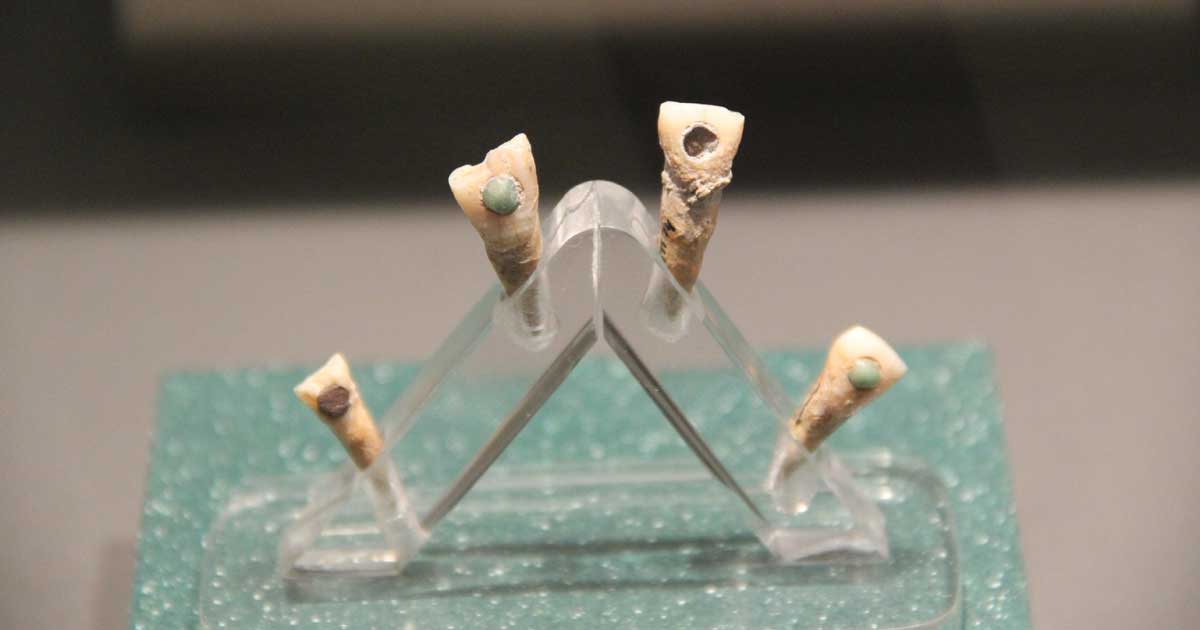
7-Year-Old Maya Child Wore Jade “Tooth Gem” in Ancient Ritual Practice
Maya children as young as seven years old received elaborate jade dental inlays centuries ago, marking what researchers believe was a significant social milestone or coming-of-age ceremony. The discovery challenges previous assumptions about when these ornamental dental modifications began in Maya society.
Archaeologists have long documented tooth inlays among adult Maya populations, but new research published in the November 2025 Journal of Archaeological Science: Reports reveals the practice extended to much younger individuals. The study examined three isolated teeth with jade inlays from the Popol Vuh Museum in Guatemala, determining through root formation analysis that each belonged to children between ages 7 and 10.
The decorated teeth included an upper central left incisor, a right upper canine, and a lower incisor. Researchers cannot confirm whether all three came from the same child due to the absence of associated skeletal remains. The teeth date to the Maya Classic period (A.D. 250-900) and Postclassic period (900-1550), when dental modifications flourished across southern Mexico and Central America.
During these eras, Maya artisans used stone tools to carve precise holes into prominent teeth, inserting jade, obsidian, or pyrite gems secured with organic adhesives. More than half of all adults during the Classic period received these dental decorations, which both men and women wore as symbols of status or identity.
Previous archaeological evidence showed that Maya adolescents between 10 and 15 often had their teeth filed or engraved, but rarely received inlays. Few individuals between 15 and 20 possessed dental inlays, suggesting the practice typically began in full adulthood. The new findings dramatically lower that age threshold.

X-ray analysis of the three child teeth revealed that the dental pulp remained undamaged and showed no natural cavities. The inlays were installed while the children lived, not as posthumous burial decorations. This distinguishes the find from controversial discoveries in Belize, where jade inlays in a possible 3-year-old’s teeth may have been added after death.
The researchers propose several explanations for childhood dental inlays. The modifications might have marked the beginning of adult responsibilities like household duties or labor. Alternatively, they could represent a regional tradition not practiced throughout the broader Maya world.
The team acknowledges that invasive dental procedures on young children carried risks to developing teeth, making the practice potentially dangerous. However, the successful installations in these three cases suggest skilled practitioners could perform the modifications safely.
Until archaeologists uncover additional examples of childhood dental inlays, the precise meaning behind these early modifications remains unclear. The researchers emphasize that broader patterns cannot be established from three isolated teeth, leaving the cultural significance open to speculation.
Featured image: Examples of dental inlays found in the teeth of ancient Maya individuals. These are not the teeth examined in the new study. (CC0)


Leave a Reply