
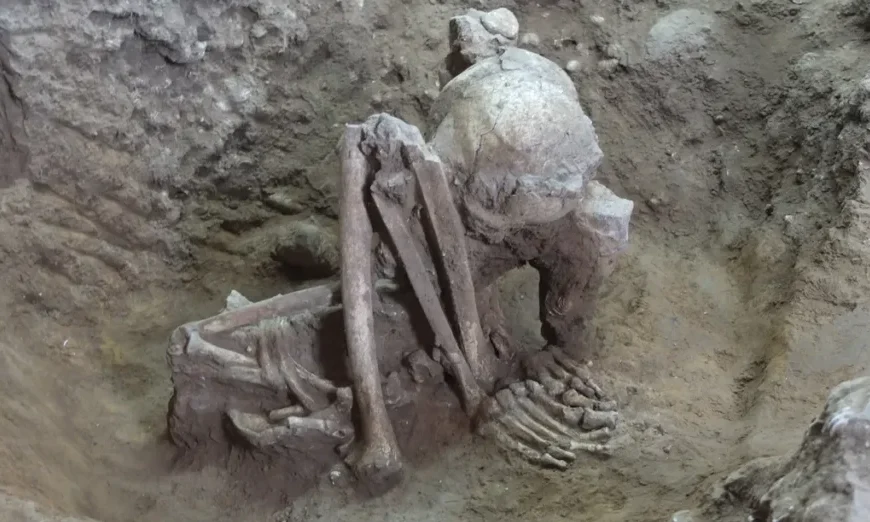
Scientists have uncovered evidence that ancient communities in China and Southeast Asia were creating mummies through smoke-drying techniques as early as 10,000 years ago. This discovery pushes back the timeline of deliberate mummification practices by thousands of years, predating the famous methods used in Chile and Egypt. Burial sites scattered across six countries revealed this groundbreaking finding. China, Philippines, Laos, Thailand, Malaysia, and Indonesia all contained dozens of ancient graves with skeletons positioned in extremely tight, fetal-like positions. Published Monday in the journal PNAS, researchers examined what archaeologists call “hyperflexed” poses – bodies contorted beyond what would be naturally possible. Hsiao-chun Hung leads the study as senior research fellow at Australian National University. She explained that smoking held deeper significance than simple preservation. “Smoking likely carried spiritual, religious, or cultural meanings that went far beyond simply slowing decay,” Hung told Live Science. Archaeologists had puzzled over these tightly crouched burials for years. Dating from 4,000 to 12,000 years ago, they appeared throughout the region with unusual frequency. A similar skeleton found in Portugal in 2022 was interpreted as evidence of mummification due to its hyperflexed state, which gave researchers a clue. Asian burials showed something different, however. Burn marks appeared directly on skeletal remains rather than within burial sites themselves. Scientists discovered evidence of controlled burning on the bones, suggesting specific ritual treatment involving fire and smoke applied before burial. Advanced scientific techniques confirmed their hypothesis. X-ray diffraction and infrared spectroscopy allowed analysis of bone microstructure without damaging ancient remains. Results showed clear signs of low-intensity heating and soot discoloration rather than intense burning from cremation. Contemporary mummification practices provided crucial insights during a 2019 expedition to Papua, Indonesia. Researchers witnessed Dani and Pumo peoples creating mummies of deceased relatives using remarkably similar techniques to those suggested by archaeological evidence. Modern practitioners tightly bind corpses before suspending them over controlled fires. Smoking continues until bodies turn completely black, requiring careful temperature control and extended exposure over long periods. Ancient hunter-gatherer communities likely employed similar methods thousands of years ago, binding bodies immediately after death and subjecting them to prolonged smoking over low-temperature fires. Egyptian mummies sealed in protective containers were designed for eternity. Asian smoke-dried remains served a different purpose entirely. Ancient mummies typically maintained their form for only decades to a few centuries before decomposing completely. “The key difference from the mummies we typically imagine is that these ancient smoked bodies were not sealed in containers after the process, and therefore, their preservation generally lasted only a few decades to a few hundred years,” Hung explained. Hot, humid Southeast Asian environments made smoking the most practical preservation method available. Early communities could maintain physical connections with deceased relatives for extended periods, even if not permanently. Origins of smoke-drying remain mysterious. Hung acknowledged that researchers cannot determine with certainty whether ancient peoples initially developed techniques specifically for preservation or discovered them accidentally through other practices. Discovery might have occurred through experimentation with smoking animal meat for food preservation, later adapted for human remains. Alternatively, it could have emerged as an unintended consequence of ritual practices involving fire and smoke. “What is clear is that the practice prolonged the visible presence of the deceased, allowing ancestors to remain among the living in a tangible way, a poignant reflection of enduring human love, memory, and devotion,” Hung noted. Beyond cultural significance, these findings support the “two-layer” migration model of early Southeast Asian settlement. Hunter-gatherer populations arrived as early as 65,000 years ago, establishing distinct cultural practices before agricultural communities arrived around 4,000 years ago. Smoke-drying burial traditions may represent cultural continuity linking ancient hunter-gatherers to modern Southeast Asian populations. Dani and Pumo peoples still maintain similar funeral rituals today. Ivy Hui-Yuan Yeh, a biological anthropologist at Nanyang Technological University, wasn’t involved in this research but confirmed the findings align with established migration patterns. She told Live Science that discoveries “are consistent with the patterns of early human migration, distribution, and interaction in Asia.” Implications extend far beyond a single discovery. Hyperflexed burials identified throughout Southeast Asia as evidence of smoke-drying practices suggest mummification techniques were far more widespread and ancient than previously recognized. Authors noted that “smoked mummification might have originated earlier, and been more widespread, than is currently identified in the archaeological record.” Practice might extend back to earliest expansion of modern humans from Africa into Southeast Asia, potentially reaching 42,000 years ago. Such a timeline would demonstrate remarkable “deep and enduring biological and cultural continuity” across tens of thousands of years of human history. Featured image: The remains of a middle-aged man who was mummified and buried more than 9,000 years ago in Guangxi, China. (Image credit: Yousuke Kaifu and Hirofumi Matsumura)
Mysterious Egyptian Tomb May Be From Lost “Abydos” Dynasty
It never rains but it pours when it comes to the tombs of ancient Egyptian pharaohs, said nobody ever, but the metaphor certainly seems appropriate at the moment. A month ago we reported on the first discovery of an Egyptian Royal tomb (from a period of united Egypt) in a century, then a hoped-for second a week later. And now there’s a third tomb. This one is a little different, though. The first two discoveries are thought to be associated with Pharaoh Thutmose II, an eighteenth dynasty who ruled during the so called New Kingdom (still very old) of ancient Egypt, during the 15th century BC. The New Kingdom was ancient Egypt’s last golden age, a time of monolithic monuments, walls covered in hieroglyphs, and lots and lots of depictions of people in profile. But the new find, as reported by Egypt’s Ministry of Tourism and Antiquities, was from an altogether murkier period of Egyptian history. It is generally agreed that Egyptian history can be split into sections: three periods of a united Egypt, the Old, Middle and New Kingdoms, separated by two “intermediate” periods of dynastic infighting, fractured loyalties, rival pharaohs and general skullduggery. This new find is believed to be from one of the most interesting moments of the Second Intermediate Period, which ran from 1700 to 1550 BC. During this time Egypt split into multiple rival states, with the upper (southern) Nile lost to the Kush and the fifteenth and sixteenth dynasties vying for control over the northern stretch of the river and the Nile Delta. Two rival dynasties, or maybe three. Since the 1990s a theory has been floating around that there may have been a third dynasty, contemporaneous with the other two for about a century. This mysterious dynasty from a time of few records is known now as the “Abydos Dynasty” for the disappointingly prosaic reason that these pharaohs lived and died in Abydos. And it is in Abydos, in the Mount Anubis Acropolis, that the new “royal” tomb has been found. Dr. Joseph Wagner, head of the Egyptian-American mission working in Abydos, describes the tomb: “the royal tomb was found at a depth of approximately 7 meters below ground level. It consists of a limestone burial chamber covered with mudbrick vaults originally reaching a height of approximately 5 meters. Remains of inscriptions are found on either side of the entrance leading to the burial chamber for the goddesses Isis and Nephthys, along with yellow inscription bands that once bore the king’s name in hieroglyphs.” Is this an Abydos pharaoh? Is it proof that the Abydos pharaohs were even real, a question which remains far from answered? And if not, why is there the tomb of a pharaoh in Abydos? Actually, this is the second royal tomb found here. In 2014 the tomb of Pharaoh Senebkay, also believed to be an Abydos pharaoh, was found at Mount Anubis, as were a further eight tombs belonging to the royal family. But the tomb of Senebkay and the others were relatively modest, whereas this new discovery is much larger and more grand. Not everyone is convinced that Senebkay is an Abydos pharaoh, just as not everyone is convinced that the Abydos pharaohs existed at all. But this new, much grander discovery seriously strengthens the likelihood that the Abydos pharaohs were real. We don’t have an authoritative list of pharaohs of the Abydos dynasty, obviously, but there are several fragmentary sources which may provide us with a partial list of names. It has been theorized that Senebkay was one of the earlier pharaohs of this line, but the only thing we can say about the pharaoh of the newly discovered tomb is that he came even earlier. It is hoped that, as more details come to light from this new discovery, we may learn more about this lost but powerful pharaoh, and that maybe we will definitively solve the mystery of the Abydos pharaohs. Header Image: The excavated royal tomb at Abydos, and (inset) the burial chamber). Source: Egyptian Ministry of Tourism and Antiquities.
The Origin of the Huns: Revealing the Truth Behind a Legend
The Huns, according to ancient sources, came out of nowhere. But then, these ancient sources were largely Roman and, as far as the Romans were concerned, the Huns really did. They first appear around the middle of the 4th century AD, harassing the northeastern frontiers of the Roman Empire. In 370 AD they suddenly appeared on the banks of the Volga in vast numbers, and over the next 50 years they established a huge empire, a new eastern front for Rome. They reached their peak under their great and feared leader Attila, who led enormous war parties on raids first into Roman Gaul (modern France) and then the Italian peninsula itself. It was only the sudden and unexpected death of Attila the Hun on his wedding night that stopped them. There are several competing theories as to where the Huns came from, even today. The Romans and Greeks had no idea, but over the years something like a “best guess” consensus has emerged based on an 18th century theory. The Huns are thought to be the same people as the Xiongnu mentioned in Chinese sources. These nomadic peoples had for centuries lived in the eastern Eurasian steppe on the Mongolian plateau, before suffering a devastating defeat by the Chinese Han dynasty in the 4th century. It is thought the retreating remnants of these people formed the Huns of European history. The problem is a 300 year gap between the defeat of the Xiongnu and the rise of the Huns. And now a genetic analysis of Hunnish remains published in PNAS may throw new light on whether this gap can be bridged. In the study a team of archaeologists, geneticists and historians led by Guido Alberto Gnecchi-Ruscone from the Max Planck Institute for Evolutionary Anthropology looked at hundreds of ancient genomes spanning an 800 year period from 200 BC to 600 AD. The genomes studied came from burials stretching from the Eurasian steppe all the way west to the Carpathian basin: the route the Xiongnu must have taken if they became the Huns. Do the genes from these burials suggest a link to both the Xiongnu and the Huns? Are these the tombs of a people slowly heading westwards from China to Europe? The answer is “sort of”. There is some evidence in the more opulent burials, both from the genes and the design of the tombs, that a core of elites may have fled westwards following the Xiongnu defeat, but there is no evidence of a wider link between the Xiongnu people and the Huns. Instead it is possible this elite gathered a coalition as they went, arriving in Europe with an army they built on a road centuries long. The Hun genetic lineage is diverse and includes many different steppe peoples, suggesting that they may have travelled and arrived independently before finding common cause against the Romans. It could also explain why the Hunnish empire collapsed so quickly once its charismatic and successful leader Attila died. Furthermore it seems that the Xiongnu core lost much of their cultural individuality on the road. Very few burials were found in Europe’s Hunnish empire completed in the Xiongnu fashion: their genes may have made the journey but their traditions did not. In fact, various new traditions appear to have appeared and died out amongst the people who would become the Huns during this time. However there was something special about the Xiongnu who made the journey. Genetic analysis suggests a link with the very highest echelons of imperial society, and a connection to the finest Xiongnu burials back in China and Mongolia. So, are Attila’s people the Xiongnu? Yes, and no. It seems that a Xjongnu elite did flee Han China and make it as far as Europe hundreds of years later. But these were only one of many peoples who collectively were not the Xiongnu. They were the Hun. Header Image: The Huns, Georges Rochegrosse, 1910. Source: Georges Rochegrosse / Public Domain.
Team Behind the Discovery of Egyptian Royal Tomb May Have Found Another
Remember last week when we reported that the first Egyptian Royal Tomb in a century had been discovered? Well, the team who found the tomb of Thutmose II may just have done it again. Last week Piers Litherland, leader of a team of archaeologists exploring the mountains near the famous Valley of the Kings close to modern Luxor, announced the discovery of the first tomb since that of Tutankhamun himself in 1922. Now, they think they are on the verge of finding a second royal tomb nearby. According to a report in the Guardian, Litherland has focused on a suspiciously large pile of rocks and debris near to the first discovery. Some 23 meters of rubble, ash and mud plaster has been piled on top of something, a monumental effort by all accounts. “There are 23 metres of a pile of man-made layers sitting above a point in the landscape where we believe – and we have other confirmatory evidence – there is a monument concealed beneath,” he said. “The best candidate for what is hidden underneath this enormously expensive, in terms of effort, pile is the second tomb of Thutmose II.” Yes, you heard it right, this tomb could also be that of Thutmose II. We know that the first tomb, built near a waterfall and flooded within a decade of its completion, was emptied of the pharaoh’s mummy and most of the grave goods. The pharaoh was taken elsewhere. But why here? Well, during the initial excavation Litherland’s team found a sacrificial pit containing a dead cow alongside an inscription. The inscription suggests that the king’s wife and half-sister Hatshepsut (one of the greatest pharaohs of ancient Egypt herself, by the way) may have moved the contents of the first tomb to a second tomb nearby. According to the Guardian, Litherland even hopes to find the boy king himself in the second tomb, surrounded by his grave goods. We at ATH will admit we are a little thrown by this, as we already know where the mummy of Thutmose II is, having discovered it in a cache of dead pharaohs in 1881. Maybe we’ve been wrong, all this time. Still, there is definitely something intriguing about this enormous pile of rubble. The main problem now lies in how to get into whatever is hiding underneath it. At the surface of the mound, flakes of limestone the size of dining room tables rub shoulders with car-sized boulders from when the ancient stoneworkers collapsed a cliff on top of the site. The result is a highly dangerous, potentially unstable deathtrap. And Litherland wants to tunnel underneath. Or at least, he did. The new plan is to remove the pile in its entirety, which should allow the team to get at what in underneath safely. Work has already begun, and is expected to take roughly another month to complete. Watch this space. Header Image: The Valley of the Kings, near where the suspicious pile of rubble is located. Could there be an Egyptian royal tomb underneath? Source: © Vyacheslav Argenberg / http://www.vascoplanet.com/ / CC BY 4.0.
Tomb of Thutmose II: First Egyptian Royal Tomb Found in 100 Years
The 18th Dynasty of Egypt was the start of its last golden age as a superpower. Its founder, Ahmose I, rose to control the whole of the Nile, expelling the mysterious semitic Hyksos rulers in the north and freeing Egypt from their rule for the first time in generations. The pharaohs of the 18th Dynasty, first rulers of the so-called Egyptian New Kingdom, are among the most famous in history. Akhenaten, the heretic pharaoh and husband to the beautiful otherworldly Nefertiti, was from this line of kings, as was his eventual successor Tutankhamun. Also amongst these kings is Thutmose II, a relatively unknown king and the fourth of the dynasty. It is the tomb of this king which, according to an announcement from the Egyptian Ministry of Tourism and Antiquities, has just been uncovered. The find, made near the ancient ruins of Luxor by a joint Egyptian-British archaeological mission, is the first discovery of an Egyptian Royal tomb since the discovery of Tutankhamun in 1922. Broken alabaster vessels within the tomb leave no doubt, referring to its occupant as the “dead king” Thutmose II. The tomb was originally discovered in 2022, but at first there was confusion as to who it was for. Given its location near the tombs of the wives of Thutmose III, it had been theorized that this also was the tomb of a wife of an 18th Dynasty pharaoh. The tomb had been heavily damaged relatively soon after its creation by flooding, with its floor apparently raised so its contents could be recovered and moved elsewhere. This left the interior in a very poor state of preservation, although painstaking work by the archaeological team has managed to piece together something of what it was like. Fragments of mortar in the tomb reveal the walls were painted with yellow stars and inscriptions in a blue text, whole paragraphs copied from the ancient Egyptian text known as “Im-Duat.” This religious text has a particular association with the tombs of Egyptian kings. The orientation of the tomb itself is also important, and in its correct context Egyptologists can see how it fits into the lineage of 18th Dynasty tomb design. Thutmose II’s tomb with its simple architecture seems to have acted as a nucleus for later tombs, which copied this layout. Thutmose’s body has been known to modern archaeology since 1881. But the tomb of this mysterious pharaoh, almost wiped from the record by his wife and successor, has now finally been found. Header Image: The alabaster remnants found in the tomb with the royal name of Thutmose II highlighted. Source: Egyptian Ministry of Tourism and Antiquities.
Ancient Necropolis Discovery in Trento Dates to the Founding of Rome
Archaeologists working in the Santa Croce area of Trento in northern Italy have found something exceptional beneath the city streets. An ancient necropolis has been discovered, some eight meters beneath the surface. Some 200 tombs have been discovered, as reported by the Provincia Autonoma di Trento. The tombs date to the early Iron Age, between the 9th and the 6th centuries BC. The discovery may well rewrite the entire history of the city. The necropolis was found beneath the historical, medieval, and Roman archaeological layers and predates them all. Sealed and preserved by redirecting the local river to ensure floods were carried away from the graves, the all-important context for these burials has remained intact across the millennia. The Fersina river at the time the necropolis was built was a wide, fast flowing river separated into multiple channels which interlinked and were separated by temporary sandbars. It was in one of these areas of the riverbed, subject to temporary flooding, that the necropolis was situated. The team think that two channels dug either side of the site would have acted to channel water around the tombs. In later periods when the necropolis was no longer in use floods over the top would have preserved the tombs in their correct place and protected them from tomb robbers. This means that the layout of the necropolis has been preserved in exceptional detail. “An incredible discovery, which shows us a new history of the city of Trento, no longer just as a Roman city.” said the vice-president and provincial councilor for culture Francesca Gerosa. “We know how important the commitment to research and protection of the heritage of our roots is, and this is foreseen by the laws and the Constitution, but regardless of this we do not want to shy away and here we are working intensely to bring to light a piece of unknown history for the city.” “The work is progressing, but there is still an entire area to be monitored in order to then evaluate what actions to take, also with regard to the many objects found and which are already being restored, as will be subsequent discoveries. We are working remembering that a balance is always needed to reconcile the interests of protecting the archaeological heritage with the understandable interests of urban development”. This necropolis is extremely unusual in an Alpine context such as Trento. This was a period before the Romans became the dominant power in Europe, and the necropolis was created at the same time as the founding of Rome, traditionally in 735 BC. The people in Trento at this time would have traded with the precursors to the Romans, the Etruscans. It is not yet known who is buried in the tombs but it is hoped that the site contains the elite burials from that era. The site consists of a series of funerary stele, ancient massive gravestones some two and a half meters high, each standing at the western end of a stone box made of pink limestone. Around these centra tombs it appears that lesser burials were sited over time. Inside the stone boxes at the base of the stele is burned earth, charred bones and other funerary offerings reduced to ash. Only the metal discoveries, weapons and elaborate ornamental objects, have survived. Header Image: The necropolis discovered beneath Trento. Source: Archivio Ufficio Stampa PAT.
Cache of Royal Treasures Rediscovered in Vilnius Crypt
The Old Cathedral of Vilnius, capital of Lithuania, has given up one of her enduring secrets. The burial regalia of monarchs of the Polish-Lithuanian Commonwealth has been rediscovered, hidden behind a wall in a crypt. The treasure, which includes crowns, chains, medallions and rings, was originally hidden during the Second World War to prevent the items from being looted, reports TVP World. However the exact location of the cache was lost after the war, and the treasures were only rediscovered in December 2024. The Polish-Lithuanian Commonwealth was a federative union that existed between 1569 to 1795 and joined the Kingdom of Poland and the Grand Duchy of Lithuania. The commonwealth may no longer exist but was one of the largest and most powerful countries in Europe in the 16th and 17th centuries. The regalia includes the funeral crown of King of Poland and Grand Duke of Lithuania Alexander Jagiellon, as well as additional items belonging to Elisabeth of Austria (Elżbieta Habsburżanka), the first wife of King of Poland and Grand Duke of Lithuania Sigismund II Augustus. There are also items belonging to Sigismund’s second wife Barbara, including another crown as well as a royal orb and scepter. Gintaras Grušas, the Archbishop Metropolitan of Vilnius, helped explain the discovery. “On December 16, 2024, a secret hiding place was opened in the crypts, where the royal regalia was hidden at the outbreak of the Second World War in 1939 […] These crowns were not worn while the rulers were alive but were made after their deaths and were intended to be part of their tombs. The discovered insignia are priceless historical treasures, symbols of Lithuania’s long tradition of statehood, symbols of Vilnius as the capital city, and magnificent works of goldsmithing and jewelry.” The search for the lost treasures had been ongoing for decades, fueled by rumors from the outbreak of the Second World War as well as sketches made of the cathedral’s subterranean levels. The hiding place was initially discovered in 1985, but it was only in October 2024 that a survey with an endoscopic camera revealed the hidden regalia. But these are not the only lost treasures that are being hunted. The real goal of the search is the tomb of Vytautas the Great, Grand Duke of Lithuania. But the site of his burial has never been found, and the search continues. Original Source: https://tvpworld.com/84394276/burial-crowns-of-polish-lithuanian-monarchs-unearthed-in-vilnius-cathedral. Header Image: The burial crowns found, which form part of the royal treasures uncovered in Vilnius cathedral. Source: PAP/Valdemar Doveiko.
“But No Living Man Am I”: Unique 10th Century Burial Contains a Warrior Woman
A research team led by Dr. Balázs Tihanyi has found something never before seen in Hungary’s Carpathian Basin. The grave, dating to the 10th century, is of a woman and her weapons. Such burials of warrior women are extremely rare across the archaeological records, and this is a first for Hungary. The discovery, published in PLOS ONE, comes with all sorts of questions as to who this woman was. The burial, from a cemetery first explored in the 1980s, contains both jewelry and archery equipment, alongside the heavily degraded bones which are generally agreed to be female. Some 262 graves were known from the cemetery, which dates from the Hungarian Conquest period which saw the Magyars, ancestors of modern Hungarians, establish themselves in Europe for the first time. The cemetery contained both male and female graves, the rest of which seem to have been buried with grave goods along gender lines. The men were buried with equipment for horses and a variety of weapons, the women with home goods and jewelry. But this single grave, designated No. 63, seemingly contains both. The grave good consist of a silver hair ring along with three bell buttons and a string of beads, alongside an “armor piercing” arrowhead, the remains of a quiver and the remains of a bow. The orientation of the bow suggests it was placed in or near the woman’s hand as she was laid to rest. It is very unusual to include weaponry in a grave unless the individual buried there is a warrior. This seems to be backed up by the remains themselves, which suggest that the woman buried there had a hard life in the saddle. Other skeletal evidence such as the shape and thickness of certain bones suggests the woman was indeed an archer, and trauma to the bones, apparently from falling off her horse, suggests she was a warrior too. The team focused on confirming that this body was indeed that of a woman, and while the evidence falls short of being conclusive key points like the presence of osteoporosis in the skeleton is highly suggestive that the remains are female. Of course, if it did turn out to be a male this would simply replace one mystery with another, namely why a male had female grave goods. Sadly much of the cemetery has since been destroyed by agriculture in the area. However the detailed records gathered at the time have allowed the team to examine the burial in detail, and if their conclusions are correct, if indeed this is a warrior woman, then it is the first ever found in Hungary. Original study: https://journals.plos.org/plosone/article?id=10.1371/journal.pone.0313963. Header Image: The woman was buried holding a bow, and with evidence of a violent life: she appears to have been a warrior. Source: PLOS ONE / Dr. Balázs Tihanyi et al.
Ben Franklin, and All Those Bodies They Dug Out of his Basement
Benjamin Franklin is a figure of historic importance. He is what used to be called a “man of letters” and a polymath, but this only goes so far in explaining how important he was during his life, and how important he remains after his death. Franklin is a founding father of the United States, for a start. He was one of the writers of the Declaration of Independence, and his signature appears at the bottom of the document. Putting aside his political contributions, he was also a prolific inventor. Fascinated with electricity, he constructed a lightning rod to harness the energy in thunderstorms, and came up with a crude battery fully fifty years ahead of Alessandro Volta and his pile. He invented bifocal glasses, and a special “Franklin” stove designed to reduce smoke and promote efficient heat generation. None of his inventions were patented, all were free for anyone to use who so wished. He was fascinated with population growth both within the fledgeling United States and elsewhere, feeling that an understanding of population trends was essential to good governance. He turned his hand to oceanography, naming the Gulf Stream across the Atlantic. He was a successful newspaper publisher by the age of 23, and would serve the United States as her first postmaster general. He even invented a way of making decision by writing out a list of pros and cons and weighing them up, something which seems commonplace and obvious today. He travelled extensively, living for a time in London while America was still a colony of Great Britain. It was here that workmen stumbled across fifteen dead bodies that had been buried in his basement, all while he had lived there. Wait, What? It is a troubling detail to attach to the great man’s life, isn’t it? What does it mean? The bones certainly come from Franklin’s time as occupant of the house, situated at 36 Craven Street, near the Strand in the heart of London. It was not just adult bodies which were found, either. The bodies of at least six children were found in the relatively loose clay earth which makes up the floor of the basement. And ironically, it was Franklin himself who caused the discovery. Not in his lifetime, to be sure. The first body was not unearthed until 1998, when the building was undergoing restoration as the only surviving house in which Franklin had lived. It was to be opened as a museum to the great man. The find was entirely unexpected and raised many questions as to a potential hidden part of Franklin’s life. Could he have been a serial killer, stalking the streets of London before making good his escape? Sadly, the reality is likely to be much more prosaic. Although Franklin himself was not particularly interested in matters medical, he had an associate who was, named William Hewson. Hewson is remembered today as the “father of haematology” for his isolation of the protein fibrin in blood and his work on coagulation. He was a close acquaintance of Franklin, living in the same house for two years and marrying Franklin’s friend Mary Stevenson. Hewson also ran a small private anatomy school from the back rooms of 36 Craven Street, which is believed to be the reason for the bodies. It is thought that he would take receipt of cadavers for his classes and then, once they were too far gone to be useful as test subjects, he disposed on them by burying them downstairs. This is supported by the bodies themselves, several of which show evidence of dissection. It seems beyond belief today that human corpses would be buried in a house amongst the living, but for Hewson it was done simply for convenience’s sake. Franklin, of course, must have known of the bodies beneath his feet but for some reason this prodigious man of letters never thought to mention it in any of his copious correspondence, much of which survives. An odd omission, that even in passing. Was there something untoward about Hewson leaving the bodies down there? Had he come into possession of them through underhand means? Graverobbers and unscrupulous mortuary attendants could make good money passing on corpses to medical students. And, of course, this is only the explanation which most readily fits the facts. We do not know for sure why there are dead bodies buried in Benjamin Franklin’s basement, and although it does look like they were anatomy subjects all we can truly say is that when Franklin left the house to return to the colonies he left behind fifteen more dead people than were there when he arrived. Header Image: When Benjamin Franklin moved out of his digs in London, he left behind fifteen bodies buried in his basement. Source: Joyofmuseums / CC BY-SA 4.0.
Intact Egyptian Tomb Found in Luxor is 4,000 Years Old
A new and unknown Egyptian tomb has been found in Luxor in Egypt. What makes this discovery so exciting is that, while most tombs are empty or partially destroyed, this one contains intact burials. The Egyptians viewed the afterlife as the start of a journey for which life was only the prelude. As a result Egyptian tombs are often packed with treasures, and while this certainly made them appealing to tomb raiders it also means that finding an intact one can be very special indeed. The tomb contains as many as 11 sealed burials, according to the South Asasif Conservation Project which announced the discovery. This is the first time that a tomb from Egypt’s Middle Kingdom has been found in the area. Egypt’s Middle Kingdom is the second of three periods of Egyptian dominance in the region. Where a single pharaoh ruled both the lower and upper Nile. Running from 2000 to 1700 BC, this was a golden age for Egypt, and the treasures found in the intact tomb certainly reflect this. The tomb was uncovered while clearing detritus from the tomb of a much later 25th dynasty pharaoh, Karabasken. Jewelry made from Egyptian faience and precious stones such as amethyst were found intermingled with the bodies. While many of the more perishable items had been destroyed by flooding the jewels are as bright as the day they were sealed up. Scarab rings, hippo and snake heads and hawk statues were also found, similarly made of precious metals and gems. There are also two copper mirrors with delicately carved ivory handles, but the greatest find has to be the fertility goddess. Fashioned from blue green faience and richly decorated with geometric designs, this bejeweled figure has some interesting features. Her legs are unusually shortened and her head is covered in shallow impressions, which would once have held her hair. More than 4,000 mud beads surrounding the figure are all that remains of this hair. The jewelry is largely associated with the adult females buried in the chambers.; so far five women, two men and three children have been identified in the tomb. It is believed that the tomb for used for several generations of a single family, spanning the Egyptian 12th and 13th dynasties. Header Image: Finds from the tomb include jewelry, two intact copper mirrors and (inset) a fertility idol in blue green faience. Source: South Asasif Conservation Project / Egyptian Ministry of Tourism.
Hidden Chamber Found in Ransacked Egyptian Tomb
Something new has been discovered in an ancient Egyptian tomb. A hidden chamber set into the rock wall has been uncovered, seemingly entirely by accident. The burial chamber was found during cleaning work on the tomb, undertaken by a joint team from Sohag University and the Free University of Berlin, according to the Egyptian Ministry of Tourism and Antiquities. And inside the chamber, some 50 meters deep into the tomb, were two coffins. The coffins, nested one inside the other, are said to be for the lady Edi, daughter of a prominent Egyptian official named Djefaihapi, for whom the wider tomb was built. Djefaihapi was the governor of the Egyptian Asyut region during the Egyptian 12th Dynasty, and it is in the Asyut Necropolis that the tomb can be found. The 12 th dynasty, which lasted for two centuries from 1991 to 1802 BC, is considered to be the greatest of the dynasties of the Egyptian Middle Kingdom, a period of relative unity and peace. Djefaihapi served the Pharaoh Senusret I, as reported by Archaeology News. Senusret was one of the longest reigning pharaohs of the 12th dynasty, reigning from 1961 to 1915 BC. This makes the chamber some 3,900 years old. Sadly this is not the first time the tomb has been opened, however. Grave robbers have already looted the chamber for its treasures, scattering Edi’s remains and smashing the canopic jars containing her organs. However much remains that is of value, not least the two magnificent coffins adorned with texts which tell of the ancient Egyptian journey to the afterlife. Edi’s bones and the remains of the canopic jars, along with the coffins themselves, will be removed for further study. Header Image: The coffins of Edi, found in the hidden burial chamber. Source: Ministry of Tourism and Antiquities.
Roman Chariot found in Ancient Varna Necropolis
Archaeologists in Bulgaria have uncovered something they did not expect while excavating a necropolis mound in the Varna Province. The site has previously revealed only Bronze Age finds, but the new mound is far later, dating to the Roman period around the 2nd or 3rd century AD. Chief among the finds from the new excavation is a magnificent Roman chariot, a sporty two-wheeled vehicle known as a biga. This is the first such discovery in the entire region, reports Heritage Daily. The mound, which was built up in successive stages as successive generations were interred within, is filled with cremation pits. Once the deceased had been cremated the hollow was filled with earth as they took their place in the afterlife. There are so many pits in this mound that archaeologists believe it may have served as a burial site for the entire community, not just a single family. Nonetheless the chariot suggests that at least one high status individual was interred here. Other finds at the site include Roman glassware and coins. No gold has yet been found there, although excavation work is ongoing ahead of the site being destroyed to make way for a gas pipeline. Featured image: The remains of the chariot in the Roman burial mound in Varna (Heritage Daily / BTA)


