
So, What Exactly is Hidden Inside the Great Pyramid?
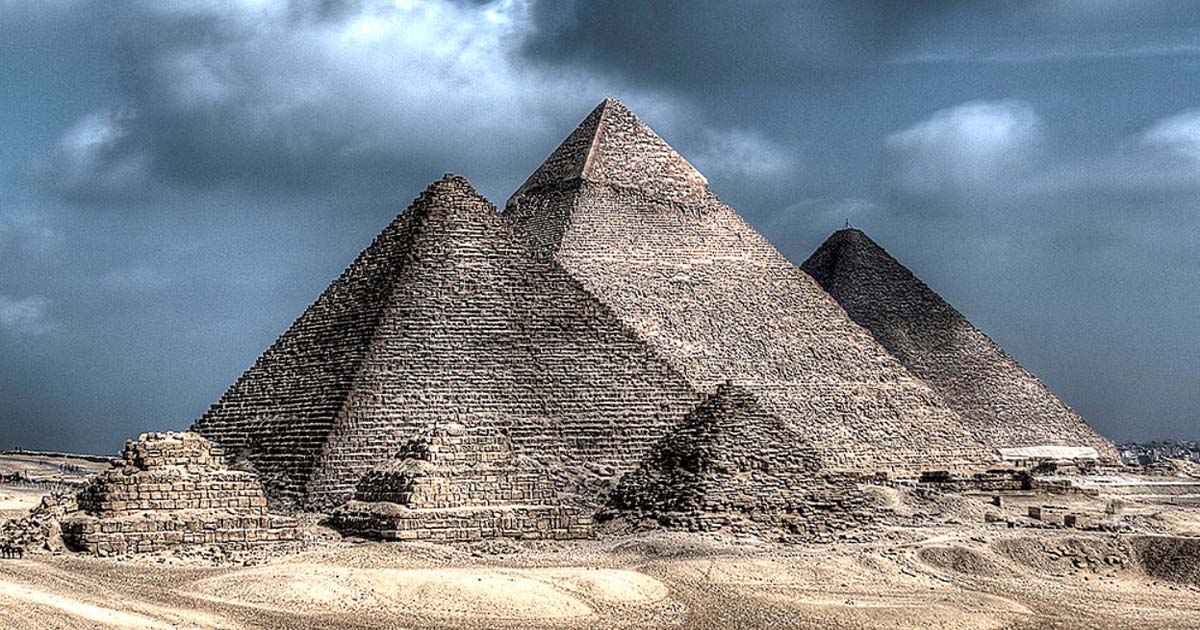
There is no site more emblematic and obviously ancient Egyptian than the pyramids at Giza. The only wonder of the ancient world still standing, these three enormous pyramids and their attendant sphinx and necropolis are instantly recognizable.
The site is dominated by the great Fourth Dynasty pyramid of Khufu, which dwarfs even the other two massive pyramids alongside. Over the years many stories have come to be told about this most massive of structures.
Some say it more than a tomb for a dead pharaoh. Some say that it houses an astrological secret, with hidden chambers and channels which pass through the entire pyramid, looking at the stars.
Others say that it is a deadly trap, designed to keep the pharaoh within safe in his “house of eternity”. Some even suggest that he walks the hidden halls of his pyramid still.
Such stuff is largely nonsense, but that is not to say that the Great Pyramid of Khufu holds no secrets. Here are some of the most interesting, little known facts about this enormous tomb.
Hidden Chambers and Buried Treasures
For a start, what we see in the desert on the edge of modern Cairo is not even the pyramid as it was designed. What remains after four and a half millennia is only the stone core of the great pyramid.

Originally this enormous structure was even larger. When new it would have been covered in a white limestone shell, which would have shone brightly and been visible for miles.
To help with the construction, the pyramid itself was not built on flat ground but on a raised hill. This natural feature provides some of the internal structure and would have saved on construction materials and time, but building such a precise structure would have been far more difficult on uneven land. The exacting symmetry of the final pyramid is truly a testament to the ancient architects who built it.
It is within this hill under the pyramid that we find another mystery. When the pyramid was first constructed it seems that a focal point of the interior was to be a large chamber, not within the pyramid but beneath it.
This chamber, sunk into the bedrock under the center of the pyramid, was never finished and so we cannot be sure what it was for. Nor do we have any of that evocative wall art that is so associated with ancient Egypt to offer a hint: that came two centuries later than this ancient, massive tomb.
We are pretty sure that this chamber was not to be the tomb of a king: two other chambers, also deep within the pyramid but technically above ground, each contain a grey granite sarcophagus. These chambers, tentatively called the “King’s” and “Queen’s” chambers, are where the bodies would be found.
In the absence of wall decorations there is no official confirmation of whose pyramid this even is. We only really can be sure this is Khufu’s tomb because of the graffiti hidden in other chambers above the King’s tomb, not for storage or use but to guard against a collapse by removing weight above this large space.
We do not even know if we have found all such chambers. It is even possible that other major chambers may survive undiscovered in the heart of the pyramid. It is made of solid rock which makes it extremely hard to survey.
The most impressive part of the interior is not to be found in these chambers, however. This would be the Great Gallery, a long and narrow sloping passageway with an impossibly high ceiling, ascends towards what is called the “King’s Chamber”, truly a route grand enough to lead to your god.
Above lies what is known as “the Great Void”, perhaps the most mysterious thing in the whole structure. A long open space as large as any of the other known chambers, nobody knows what purpose it serves, what is inside, or how to get in. Work is ongoing.
There are shafts in the pyramid which have been conjectured to point to specific stars the Egyptians knew about in the night sky. But such shafts point to Egyptian astrology, and are not anything to do with communication from those stars: we can understand the pyramid perfectly without the need for an advanced, alien race helping out.
It is not clear how such shafts were used after the tomb was sealed, if they were at all. But the pyramid was evidently meant to serve a function beyond a final resting place for Khufu: with attendant buildings and entrances both from the landward side of the pyramid and from the Nile, this was somewhere people would visit, regularly and in numbers.

But what of the pharaoh put to rest here? Sadly, there is nothing much to be seen of this sort inside the pyramid any more. It may have been first looted as early as the First Intermediate Period of Egyptian history.
This destructive and chaotic period at the end of the third millennium BC saw several rival dynasties arise and untied Egypt fragmented under their warfare. The treasures in the great pyramid would have seemed a prize too valuable to spare.
It is believed that the pyramid may have been resealed and rededicated in the New Kingdom, that last and greatest flourish of Egpytian splendor, but by them the original treasure was long gone. Stories survive of more recent finds, and as late as the medieval Islamic period we hear of discoveries such as a sarcophagus filled with gold, a magnificent sword and a ruby as large as an egg being found there.
Sadly these must remain tall tales. We know some, but not all, of the secrets of the great pyramid after more than a century of detailed and careful exploration. But the original appearance of this greatest and oldest of enduring structures, is lost both outside and in.
Top Image: The Great Pyramids of Giza are the last of the Seven Wonders of the Ancient World (Yasser Nazmi / CC BY-SA 3.0)


Leave a Reply