Ancient Rock Carvings Uncovered in Ecuador Point to Shared Amazonian Cultural Traditions
Archaeologists discover approximately 30 petroglyphs in Méndez, Ecuador, showing similarities to other Amazonian rock art and shared cultural traditions.

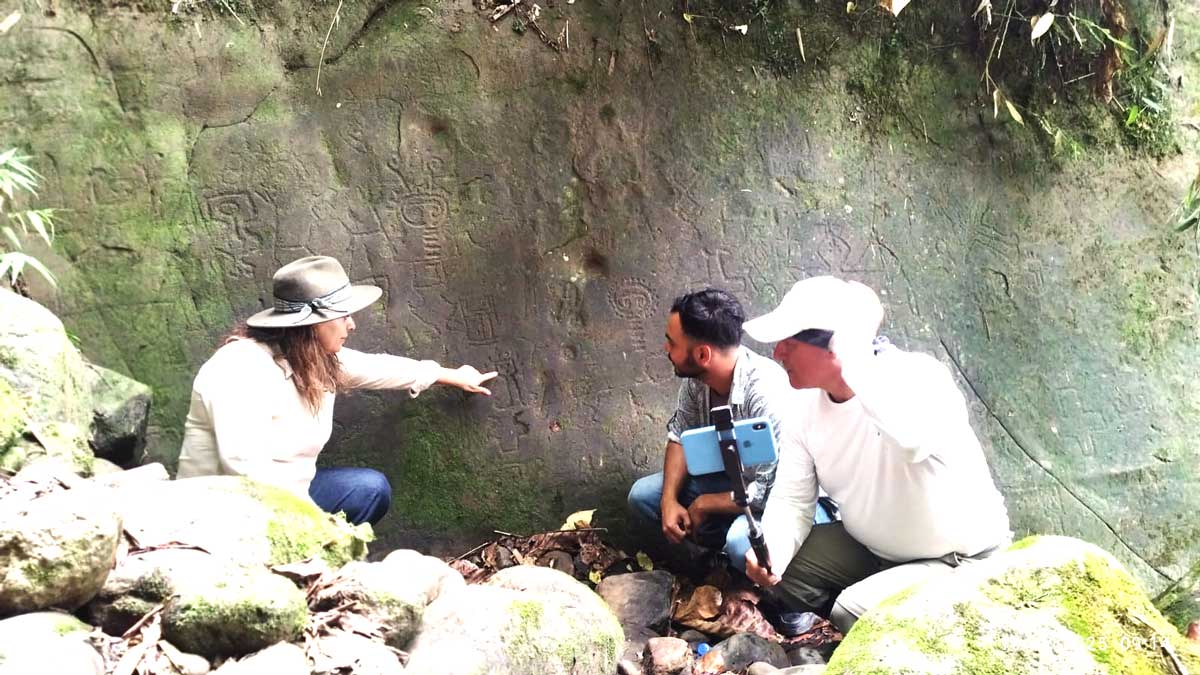
Archaeologists have identified a panel containing approximately 30 ancient rock carvings in Santiago de Méndez canton, Morona Santiago province, marking a new discovery in Ecuador’s Amazonian archaeological record. Officials from the National Institute of Cultural Heritage (INPC) Zone 6 announced the find following field inspections conducted December 9-10, 2025.
The petroglyphs were documented during routine archaeological site inspections in Sucúa and training sessions with local autonomous governments in Morona and Limón Indanza. Local guide Wilbor Cueva, familiar with the region’s terrain, assisted researchers in locating the panel. His knowledge of the area proved essential to the discovery, which occurred in a zone known for pre-Hispanic settlements.
Ruth Ordóñez, Zone 6 director of INPC, indicated that the carved motifs share distinct similarities with petroglyphs at the Catazho sector in Limón Indanza. A 2010 systematic inventory funded by the Catholic University of Ecuador documented 122 petroglyphs in the Catazho watershed. Ordóñez stated the similarities point to shared graphic traditions and cultural processes across the region. Morona Santiago holds a significant concentration of petroglyph sites, establishing it as a territory of considerable importance for prehispanic cultural studies.
“This registration represents an important advance for the study of national rock heritage and provides fundamental inputs for implementing research and preservation actions consistent with international principles of cultural heritage protection promoted by UNESCO,” Ordóñez said.
The panel has already been entered into Ecuador’s Cultural Heritage Information System (SIPCE). INPC announced plans to develop an emergency conservation strategy alongside academic investigations to guarantee preservation and enhance public access.

Rock art across Ecuador reflects diverse prehispanic cultures that inhabited the region for millennia. Petroglyphs—rock engravings created by removing the stone’s oxidized surface layer—appear throughout the country from coastal regions to Amazonian territories. These carved images typically feature geometric patterns, zoomorphic representations of animals, and anthropomorphic human figures.
The Méndez canton sits in Ecuador’s eastern Amazon basin at the foothills of the Andes mountains. Shuar indigenous communities have inhabited these lands since time immemorial, developing sophisticated knowledge of the rainforest environment. While the age and cultural attribution of the newly discovered panel remain under investigation, the region’s archaeological record extends back centuries before Spanish contact.
Morona Santiago province hosts numerous documented petroglyph locations beyond Catazho and the recent Méndez find. Archaeological investigations across Ecuador’s Amazon have accelerated in recent years. A 2024 study published in Science revealed massive pre-Hispanic settlements in the nearby Upano Valley using lidar technology, documenting roughly 6,000 earthen mounds and an intricate road system dating from 500 BCE to 600 CE.
The discovery contributes to Ecuador’s growing archaeological inventory as researchers work to document and protect heritage sites. Local governments in Morona and Limón Indanza, working with INPC, now face the responsibility of implementing protection measures under Ecuador’s cultural heritage laws. Conservation plans must balance preservation with community access and potential educational or tourism development.
Previous petroglyph discoveries in Ecuador have faced threats from environmental degradation, livestock, graffiti, and inadequate protection measures. Training programs for local communities emphasize the importance of reporting new finds and preventing damage from natural and human sources. The collaboration between local guides like Cueva and institutional archaeologists demonstrates the value of community knowledge in archaeological research.
INPC coordinates with municipal governments under Ecuador’s Organic Law of Culture, which assigns joint management responsibilities for archaeological areas. Once sites enter SIPCE, local authorities must generate protection, conservation, and social use plans under INPC’s technical direction and control. The emergency conservation strategy for the Méndez petroglyphs will need to address immediate threats while researchers conduct detailed documentation and analysis.
Archaeological evidence suggests complex cultural exchanges occurred throughout Ecuador’s Amazon long before European contact. The graphic similarities between the Méndez and Catazho panels may indicate connected communities or shared symbolic systems across the region’s river valleys and forested highlands. Further research will examine the motifs, carving techniques, and spatial distribution to understand the cultural context behind these ancient engravings.
The petroglyphs join a broader pattern of rock art documentation across South America. Venezuela’s Orinoco River petroglyphs and Brazil’s Amazon discoveries reveal extensive rock art traditions throughout Amazonian cultures. International attention to rock art preservation has increased, with multiple sites receiving UNESCO World Heritage status in 2024-2025, including Australia’s Murujuga petroglyphs and South Korea’s Bangucheon Stream carvings.
The Méndez discovery underscores the Amazon’s archaeological richness and the ongoing need for systematic surveys in remote areas. Many petroglyph sites likely remain undocumented in Ecuador’s vast Amazonian territories. INPC’s collaboration with local communities and guides offers a model for identifying and protecting cultural heritage while respecting indigenous knowledge and territorial rights.
Featured image: Ruth Ordóñez, INPC Zone 6 Director, with newly identified petroglyphs in the Santiago de Méndez area. Source: El Mercurio.