Stolen Hercules Fresco Finds Its Home After Decades in U.S. Collection
Archaeologists at Pompeii identified the original location of a stolen Hercules fresco, solving a decades-old mystery after its 2023 return from the U.S.

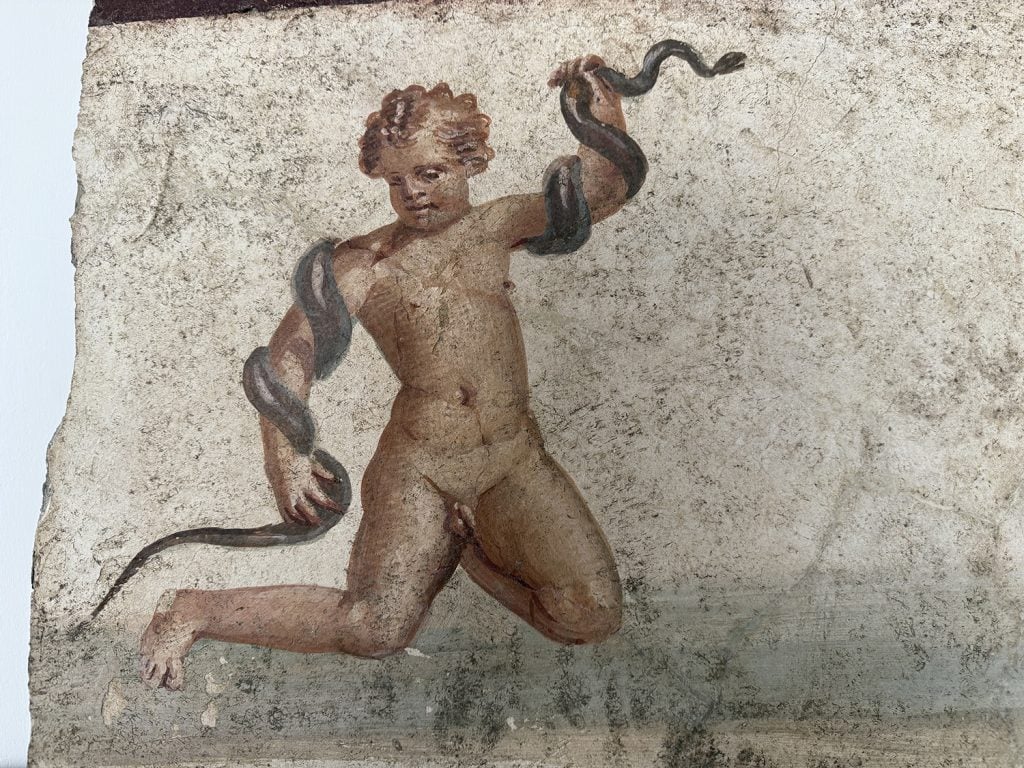
Archaeologists at Pompeii have identified the original location of a looted fresco fragment depicting the infant Hercules strangling serpents, solving a mystery that began when the artwork was stolen years ago from a Roman villa. The fragment, which returned to Italy in 2023 from a private American collection, once decorated the sacred chapel of the suburban villa of Civita Giuliana, just north of ancient Pompeii.
Excavations conducted between 2023 and 2024 revealed a rectangular room with ritual functions, interpreted as a sacellum or private chapel. Inside sat a quadrangular base, probably intended to support a statue. The room had been stripped almost completely of its original decoration through clandestine removal, including twelve figured panels and the upper frescoed lunette from which the Hercules fragment came. Officials at the Archaeological Park of Pompeii now trace the fragment with certainty to that lunette on the back wall. The discovery means the long-lost treasure can finally return to its proper context.
The villa of Civita Giuliana has suffered systematic looting for years. Tomb raiders weakened the area with a network of illegal tunnels, obscured from view by sheets of metal, dirt and plants. Since 2017, the Archaeological Park of Pompeii has worked with the Public Prosecutor’s Office of Torre Annunziata through a memorandum of understanding to halt the criminal activity and conduct scientific investigations. The collaboration has brought exceptional finds to light while recovering valuable historical evidence stolen from the site.
Gabriel Zuchtriegel, director of the Pompeii Archaeological Park, explained the stakes. An archaeological find possesses value not only for its materiality, but especially for what it can tell about the past. Every object found in an excavation is a valuable cultural-historical testimony because its meaning depends on the context in which it was found. When a find is stolen, this link with its original context is irreparably broken. Even if the object remains physically intact, it loses much of its scientific value. Without knowing where, how, and along with what it was discovered, the find can no longer contribute to historical reconstruction and becomes a mere isolated object, deprived of its testimonial function.

The stolen fresco fragment shows Hercules as a child choking snakes, a scene from Greek mythology depicting the hero’s first demonstration of supernatural strength. According to ancient sources, Hera sent serpents to destroy the infant Hercules as he slept in his cradle. Even as a baby, Hercules saved himself by grasping one snake in each hand and strangling them. The image could be read as an omen demonstrating Hercules’s unusual strength and ability to complete the twelve labors he would later undertake.
Evidence suggests twelve panels once lined the sacellum walls, all since looted. These panels may have contained frescoes depicting the canonical twelve labors of Hercules. If this theory proves correct, the fragment of infant Hercules fighting serpents fits well within the room’s overall scheme. An ongoing analysis of the fragment will provide more detail about how it connects to the rest of the room and its decorative program. Meanwhile, Pompeii officials continue to investigate the whereabouts of other frescoes stolen from the sacellum.
The fragment’s recovery in 2023 came through a criminal case coordinated by the Public Prosecutor’s Office at the Court of Rome. The operation involved collaboration between the Carabinieri Tutela Patrimonio Culturale Command in Rome and authorities in the United States. At the time of its return, officials had established the Pompeian provenance of the work but could not determine its original location. Subsequent investigations conducted by Pompeii Archaeological Park officials engaged in the extra-urban excavation, combined with information from judicial investigations, allowed the definitive identification.

Torre Annunziata Public Prosecutor Nunzio Fragliasso called the find further fruit of the synergistic collaboration between the Archaeological Park of Pompeii and his office. The partnership has proved an extraordinary tool not only in bringing archaeological finds of exceptional importance to light, but also in interrupting the criminal action of individuals who for years were the protagonists of systematic looting. The operation has recovered valuable historical evidence and returned it to the enjoyment of the community.
The villa of Civita Giuliana has yielded other significant discoveries in recent years. Excavations conducted in 2023-24 focused along the urban stretch of road, investigating for the first time an area between two already known sectors—the residential district to the north and the slave quarters to the south. Archaeologists found amphorae containing broad beans and a large basket of fruit in one of the rooms on the first floor of the slave quarters, providing insights into how enslaved workers were fed. The work was made possible by a subsidy as part of the “National campaign of excavations in Pompeii and other national parks,” funded with the 2024 Budget.
The investigations also revealed the careful organization of villa life. Estimates suggest that about 18,500 kilograms of flour a year would have been required for fifty workers, corresponding to the capacity of the slave quarters of Civita Giuliana, one of the largest known from the territory of ancient Pompeii. To obtain such a quantity, it was essential to cultivate at least 25 hectares of land. However, a diet based exclusively on grain would have exposed enslaved people to diseases related to malnutrition. Supplementing the diet with proteins and vitamins guaranteed not only survival but also full working efficiency.
Earlier finds at Civita Giuliana include three horses discovered in 2017 and 2018, still saddled and harnessed, and in 2021 a ceremonial chariot covered in intricate carvings. In 2020, archaeologists announced the discovery of two men who died side-by-side in Mount Vesuvius’s eruption: a wealthy man in his 30s or 40s and an 18- to 25-year-old man, likely a manual laborer enslaved by his older companion. The bodies were frozen in their final moments of agony.

The Hercules fragment represents one piece in a broader international effort to combat illicit trafficking of cultural property. In January 2023, Italian and U.S. officials displayed 60 ancient pieces illegally trafficked to the United States, including the Hercules fresco initially identified as coming from Herculaneum. The returned pieces had been sold by art dealers, ended up in private U.S. collections, and lacked documentation to prove they could be legally brought abroad from Italy. Under a 1909 Italian law, archaeological objects excavated in Italy cannot leave the country without permission unless taken abroad before the law was made.
Manhattan Assistant District Attorney Matthew Bogdanos, chief of that office’s unit combating illicit trafficking in antiquities, worked jointly with a specialized art squad branch of Italy’s paramilitary Carabinieri. For Italian antiquities alone, his office has executed 75 raids and recovered more than 500 priceless treasures valued at more than $55 million. Among the more precious pieces displayed in Rome was a B.C. kylix, or shallow two-handled drinking vessel, some 2,600 years old, and a sculpted marble head from the 2nd century B.C. depicting the goddess Athena. Italy said the returned works are worth more than $20 million overall.
The new identification means that the fragment will, from mid-January, be exhibited at the Antiquarium of Boscoreale, which already houses a room dedicated to the finds of Civita Giuliana. The exhibition will allow visitors to see the artwork in connection with other materials recovered from the villa, providing context that was lost when the piece was stolen. The display represents not just a physical return but a recomposition of meaning against those who attempted to shatter it.
The project “Demolition, excavation and enhancement in Civita Giuliana” financed with the Park’s ordinary funds is currently underway. The work involves the demolition of two buildings that stand on the slave quarters, only part of which is currently known. The excavation should make it possible to gain as complete and articulated a picture as possible of the plan and layout of the villa and its extension into the slave quarters. These elements are crucial for defining new strategies for preserving and enhancing the whole area.
Featured image: Detail of fresco in which baby Hercules wrestles a snake. Image courtesy the Archaeological Park of Pompeii.