
Skip to content
  • Home
  • Articles
    • Archaeology & Discoveries
    • Historical Events
    • Artifacts & Treasures
    • Ancient Civilizations
    • Unexplained Phenomena
    • Mythology
  • Subscribe
© Copyright AllThatHistory - 2025
Theme by ThemeinProgress
Proudly powered by WordPress
  • Home
  • Articles
    • Archaeology & Discoveries
    • Historical Events
    • Artifacts & Treasures
    • Ancient Civilizations
    • Unexplained Phenomena
    • Mythology
  • Subscribe
AllThatHistory
  • You are here :
  • Home
  • Historical Events
  • How One War Rewrote the English Language
Painting of “The Battle of Hastings in 1066” by François-Hyppolite Debon, Musee des Beaux-Arts, Caen (France). Source: Public Domain
Historical Events

How One War Rewrote the English Language

All That History June 30, 2025

On the crisp autumn day of October 14, 1066, a pivotal war unfolded in southern England. One that forever altered the course of English history, and also language.

Picture this scene: William the Conqueror, the audacious Duke of Normandy, locking horns with Harold Godwinson, the last Anglo-Saxon king. Their conflict, known as the Battle of Hastings, was about who could claim the throne of England and have dominion over its people.

Both men—certain of their divine right to rule—clashed with unyielding conviction. The outcome? A decisive Norman victory after Harold was killed, likely by an arrow to the eye or a fatal blow from Norman knights. This event toppled the Anglo-Saxon reign and set the stage for a linguistic revolution.

Just who were the Normans, and how did their culture reforge the English language as we know it?

Raiders to Royals to Shapers of English

Read moreInterested in the Killing: Jack Ketch’s Infamous Trade

See, the Normans weren’t just French. They were also descendants of Vikings who had once ravaged France. After much political maneuvering from the French side and securing allegiances, these Vikings settled in French soil for good. They then adopted French customs while also converting from Norse Paganism to Christianity. This blend gave rise to the Normans—a fascinating mix of Norse Viking heritage and French culture.

The Norman tongue was a dialect of Old French, enriched by both Old Norse and Latin influences. This was William’s mother-tongue, which he brought into England with sheer impact. After William’s victory, Norman French became the official language of the government and elite; while Latin remained the language of the church and scholars. However, Old English did not vanish overnight. It continued to live in the common folks’ lips while gradually evolving. 

Over time, the continuous blending of languages gave rise to Middle English. Norman French, along with its Latin roots, introduced a wealth of vocabulary, particularly in areas such as governance, art, literature, and cuisine. Words such as “court,” “judge,” “marriage,” “government,” “dinner,” “pork,” and “beef” became part of everyday language.

Meanwhile, Old Norse already flavored Old English with gems such as “sky,” “law,” “cake,” “egg,” “knife,” and “husband.” 
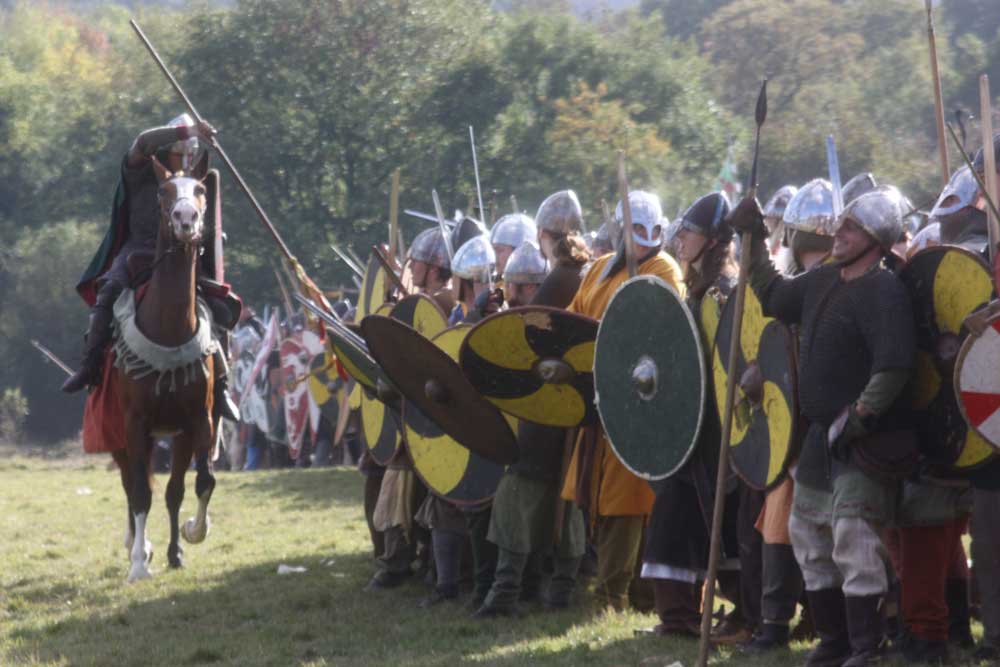
Battle of Hastings reenactment. War and the English language. Source: CC BY-SA 3.0

The Past and Future of the English Language

Read moreHengist and Horsa: Arthurian Myth or Saxon Reality?

The aftermath of the Battle of Hastings created a rich linguistic tapestry, blending Anglo-Saxon roots with Viking vigor, French flair, and Latin influences. This vibrant mix laid the groundwork for Modern English, transforming it into the eclectic language we enjoy today. Just as Old English evolved from a blend of different tongues, Modern English continues to evolve, incorporating words and expressions from a variety of cultures. This ongoing evolution gives rise to unique dialects and sounds, from the hip phrases of urban slang to the hybrid languages of Pidgin.

The Battle of Hastings wasn’t just a historic clash of swords; it was a monumental cultural showdown that sparked a revolution in language. This epic fusion of voices and civilizations created a dynamic, ever-changing mosaic of English that reflects the diverse influences shaping our world today. Whether through memes, trending hashtags, or the latest linguistic trends, English remains a living testament to our global and cultural interconnectedness. For the newer generations, this rich history adds depth to the everyday words and expressions we use. Celebrating a language that’s as manifold and evolving as we are.

Top Image: Painting of “The Battle of Hastings in 1066” by François-Hyppolite Debon, Musee des Beaux-Arts, Caen (France). Source: Public Domain

References

  1. Walker, Suzette. “How the Battle of Hastings Changed the English Language.” Owlcation, 24 Sept. 2023, updated. www.owlcation.com/humanities/The-Battle-of-Hastings-England-1066-and-its-effect-on-the-English-language.
  1. Johnson, Alex. “How a Beef Between Two Kings Changed the English Language Forever.” Museum Hack, 20 Nov. 2022, https://museumhack.com/english-language-changed/.
  1. Ikon London Reporter. “139 Viking Old Norse Words That Invaded The English Language.” Ikon London Magazine, 9 Dec. 2018, https://www.ikonlondonmagazine.com/the-vikings-are-coming-139-old-norse-words-that-invaded-the-english-language/.
You may also like

Were Wolves Kept and Nursed by Ancient Seal Hunters?

When Crocodiles Massacred Japanese Soldiers During WWII

Mike the Headless Chicken—The Rooster That Defied Death

Origins of the Cold War & Its Shadows on Modern Geopolitics

How the US Dollar Dominated Global Economy & Faces New Foes

Century-Old Swiss Lung Unlocks Spanish Flu Virus’s Secrets

Written by All That History

Tags: English, Europe, French, languages, literature, Norse, war

Leave a Reply Cancel reply

Your email address will not be published. Required fields are marked *

  • Ancient Rock Carvings Uncovered in Ecuador Point to Shared Amazonian Cultural Traditions
    Archaeologists have identified a panel containing approximately 30 ancient rock carvings in Santiago de Méndez canton, Morona Santiago province, marking
  • Stolen Hercules Fresco Finds Its Home After Decades in U.S. Collection
    Archaeologists at Pompeii have identified the original location of a looted fresco fragment depicting the infant Hercules strangling serpents, solving
  • Maya Medical Systems Used Living Organisms as Precision Surgical Tools
    Maya medical systems deployed living organisms as precision surgical tools centuries before germ theory existed. Recent archaeological evidence shows these
  • Ancient Rock Art in Texas-Mexico Borderlands Endured 4,000 Years
    Hunter-gatherers in what is now southwestern Texas and northern Mexico created rock art for more than 4,000 years, maintaining consistent
  • The Thermal Engineering Behind Tiwanaku’s Agricultural Success
    At nearly 3,850 meters above sea level, frost arrives almost nightly on Bolivia’s Altiplano. Modern visitors struggle to breathe. Yet
The Gnostic Gospels
Encounters at the Heart of the World: A History of the Mandan People
Substack Articles

Latest from AllThatHistory Weekly

A Fragment of the Iliad Found Inside a Mummy Rethinks How Greeks Were Used in Egyptian Burial Magic

A Fragment of the Iliad Found Inside a Mummy Rethinks How Greeks Were Used in Egyptian Burial Magic

A papyrus piece of Homer's Iliad discovered inside a Saqqara mummy reveals how ancient Greeks were used in Egyptian funerary magic.

Read More →
Troy Was Real. Here Is What the Archaeology Actually Shows.

Troy Was Real. Here Is What the Archaeology Actually Shows.

The debate over whether the Trojan War happened has run for centuries.

Read More →
550-Million-Year-Old Soft-Bodied Sponge Fossil Fills Critical Gap in Animal Evolutionary Record

550-Million-Year-Old Soft-Bodied Sponge Fossil Fills Critical Gap in Animal Evolutionary Record

A Precambrian sponge lacking hard skeletal structures suggests the 'missing years' of early animal evolution reflect a preservation gap, not an absence of life.

Read More →
What Sank to the Bottom of a Swiss Lake 2,000 Years Ago

What Sank to the Bottom of a Swiss Lake 2,000 Years Ago

In November 2024, the Cantonal Office of Archaeology of Neuchatel was conducting routine aerial monitoring of the lakebed when a photograph revealed something that did not belong there.

Read More →
13,000 Years Ago, Someone Painted a Bison in the Dark. We Just Found Out When.

13,000 Years Ago, Someone Painted a Bison in the Dark. We Just Found Out When.

The Font-de-Gaume cave sits in a limestone hillside near the town of Les Eyzies in the Dordogne region of southwestern France.

Read More →
The War Horn That Made Roman Soldiers Flinch

The War Horn That Made Roman Soldiers Flinch

In the summer of 2025, during a routine archaeological excavation ahead of a housing development in West Norfolk, England, a construction site turned up something unexpected.

Read More →
❮
❯

Subscribe to receive our newest archaeology articles, long-form investigations, and historical insights directly in your inbox.

© Copyright AllThatHistory - 2025