Pope Leo XIV’s Coat of Arms: Emblems of Faith and Unity
Pope Leo XIV’s coat of arms and motto reflect St. Augustine’s ideals of unity and humility, shaping his papacy’s mission.


Pope Leo XIV’s coat of arms and motto were revealed by the Vatican this May 2025, as is customary in heraldry for Popes to signal their main interests. According to Leo, all three order symbols, the fleur-de-lis, the pierced heart and the motto In Illo Uno Unum, are rooted in the life of St. Augustine, a fourth-century Italian theologian and bishop. Based on what an art historian might say, these choices highlight humility, unity and devotion which both represent the pope’s Augustinian background and explain what he hoped for in the Church. How do objects and places from history and theology underline the Pope’s challenge in today’s environment?
The Heraldic Shield
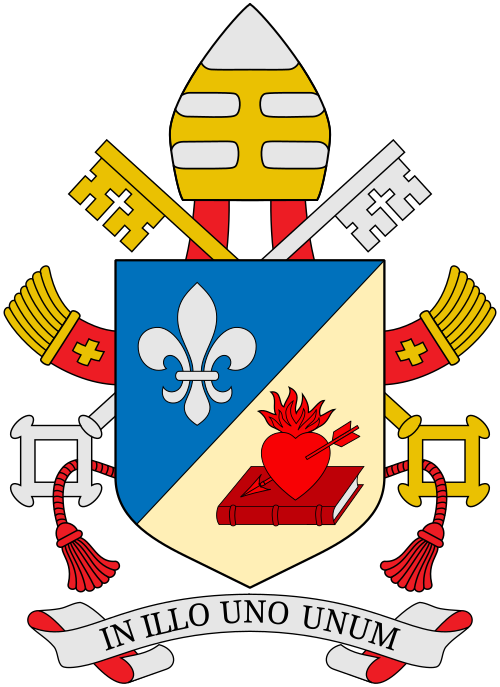
The diagonally divided coat of arms of Pope Leo XIV is full of both symbolic and balanced elements. In the upper half, you’ll see the Virgin Mary’s purity represented with a silver fleur-de-lis on a blue field. The three petals of the fleur-de-lis, like the Holy Trinity, were discussed at length by St. Augustine in On the Trinity. Fr. Pompili of the Italian Heraldic-Genealogical Institute explains that the Marian symbol is a proof of Leo’s strong commitment to his faith.
In the lower area, the emblem of the Order of St. Augustine is displayed: a red heart on fire, hurt by an arrow and sitting on a closed book. It is inspired by Saint Augustine, who wrote in his Confessions that God’s Word had pierced his heart. The Bible, the basis of Augustine’s change, features on the cover, with the heart showing his strong love for Christ and others. Rafael Nieto, an Augustinian Recollect, states that a heart like this is a proof of humility and celebration of God’s grace.
At the top of the shield, the keys are crossed to suggest papal powers, with a gold key and a silver one and a plain mitre replaces the traditional tiara, another point about humility. Some people researching heraldry online have mentioned that this symbol’s lower field could be ivory or argent, as its use receives international attention.
Call to Unity
To these words, In Illo Uno Unum or “In the One, we are one,” St. Augustine refers to his Exposition on Psalm 127. It illustrates his view that the Church, amid its variety, is united as one in Christ. In Augustine’s words, “We are many, but we are one through Christ, the principle behind what Pope Leo XIV aims to achieve. He pointed out in a Vatican News interview in 2023 that unity is a main Augustinian value, saying, “Being part of the community guides my mission and my expectations for the Church.” Chosen by peers on May 8, 2025, Leo was named the 267th pope and wishes to unite the world despite its disagreements.
The saying also reveals Augustine’s humility, as we can see from a Holy Legend (1483). When puzzled by the Trinity, Augustine came across a child trying to put the sea into a tiny container. When asked about his behavior, the child said it wasn’t more pointless than Augustine’s quest to grasp the infinite. The artist Michael Pacher’s altarpiece from 1482 and Leo’s first Mass both show how human understanding has its borders—something Leo called attention to with his remark that being pope was both a burden and a source of joy.
Augustine in Art
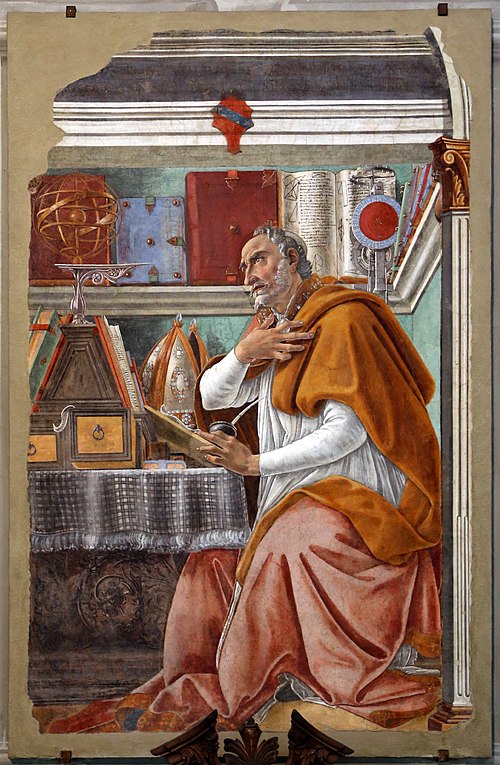
For 34 years as bishop of Hippo, St. Augustine greatly influenced both theology and the arts. His contributions, for example The Confessions and The City of God, influenced the thinking of the medieval and Renaissance ages. Many artists depicted Augustine with a pierced heart, as in a stained-glass window made by Tobias Müller in 1622 which while showing Augustine talking to a child, represents his humility. Painted in 1480 by Sandro Botticelli, Augustine is pictured working in a study filled with literature, rather than wearing his bishop’s hat. Underlying the current concept is a geocentric model that has now been replaced but still outlines the limitations of leading thinkers.
Pope Leo XIV is known for operating within the same tradition of community learning. He has previously taught canon law and early Christian theology at San Carlos y San Marcelo in Peru, giving his ministry an air of academic competence. Since his Augustinian background springs from a rule founded in 1244—‘Let everything be owned by all’—this explains why he stresses the importance of community in faith and service.
His symbol and motto, chosen by Pope Leo XIV, help guide him in his leadership. Benefiting from his past role as a missionary and bishop in Chiclayo, Peru, he now helps the Church by encouraging unity and outreach. At the time of his election, he made it clear that he wanted the Church to “pursue peace and justice together.” The fleur-de-lis and pierced heart mean that Louis appreciated both the Virgin Mary and the Catholic movement, while his motto encouraged unity during a difficult time.
Because social inequality, division among cultures and technology are current issues, Leo’s Augustinian perspective continues to be relevant. Do you think, like Augustine’s open heart, the Church is ready to be affected by God and its community? While scholars learn from his papal legacy and Peruvians fete their one-time bishop, Leo XIV’s images prompt us to be faithful, humble and united.