Skip to content
  • Home
  • Articles
    • Archaeology & Discoveries
    • Historical Events
    • Artifacts & Treasures
    • Ancient Civilizations
    • Unexplained Phenomena
    • Mythology
  • Subscribe
© Copyright AllThatHistory - 2025
Theme by ThemeinProgress
Proudly powered by WordPress
  • Home
  • Articles
    • Archaeology & Discoveries
    • Historical Events
    • Artifacts & Treasures
    • Ancient Civilizations
    • Unexplained Phenomena
    • Mythology
  • Subscribe
AllThatHistory
  • You are here :
  • Home
  • Archaeology & Discoveries
  • Prague Archaeologists Excavate Graves of Anti-Communist Resistance Fighters
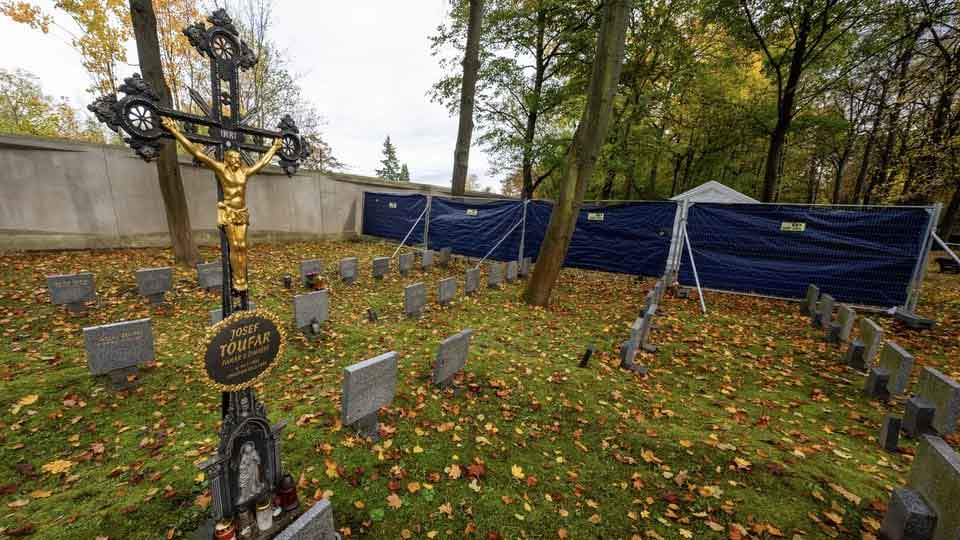
Cemetery in Prague-Ďáblice|Photo: Michal Růžička, MFDNES + LN / Profimedia
Archaeology & Discoveries

Prague Archaeologists Excavate Graves of Anti-Communist Resistance Fighters

Allthathistory November 5, 2025

Archaeologists in Prague are searching for the remains of three Czechoslovak soldiers executed by the Communist regime nearly 80 years ago, offering their families a chance for proper burial after decades of waiting. The excavation at Ďáblice Cemetery targets Vilém Sok, Miloslav Jebavý, and Karel Sabela—men who fought Nazis during World War II only to face execution for resisting communism after 1948.

The three soldiers were executed on July 18, 1949, after the Communist regime branded them enemies for their involvement in anti-Communist resistance. Ďáblice Cemetery, founded in Prague in 1914, became a burial ground for thousands killed under both Nazi and Communist rule. The Institute for the Study of Totalitarian Regimes estimates several thousand victims lie in the cemetery’s mass graves, though researchers have so far uncovered detailed information about only 120 individuals.

Martin Čechura, archaeologist at the Prague City Museum and head of the archaeological research, described the discovery of multiple coffins in a single grave shaft. “On the left, we can see pelvic bones and thigh bones. We have uncovered part of one shaft. There are four, almost five coffins visible, so half of the graves. Well, we know we have to get to the third layer,” he told Czech Radio. The excavation revealed layers of burials, with a third layer expected beneath the currently visible coffins.

Three key pieces of evidence guided archaeologists to this specific location. Investigations conducted in 1990 and 1991 provided initial leads, while photographs from 1968 documented an earlier investigation launched under pressure from relatives during the Communist era. The identification of Father Toufar’s grave supplied critical information about grave numbering in the cemetery. Jiří Línek, chairman of the Association of Former Political Prisoners, explained how these clues converged to pinpoint the soldiers’ burial site.
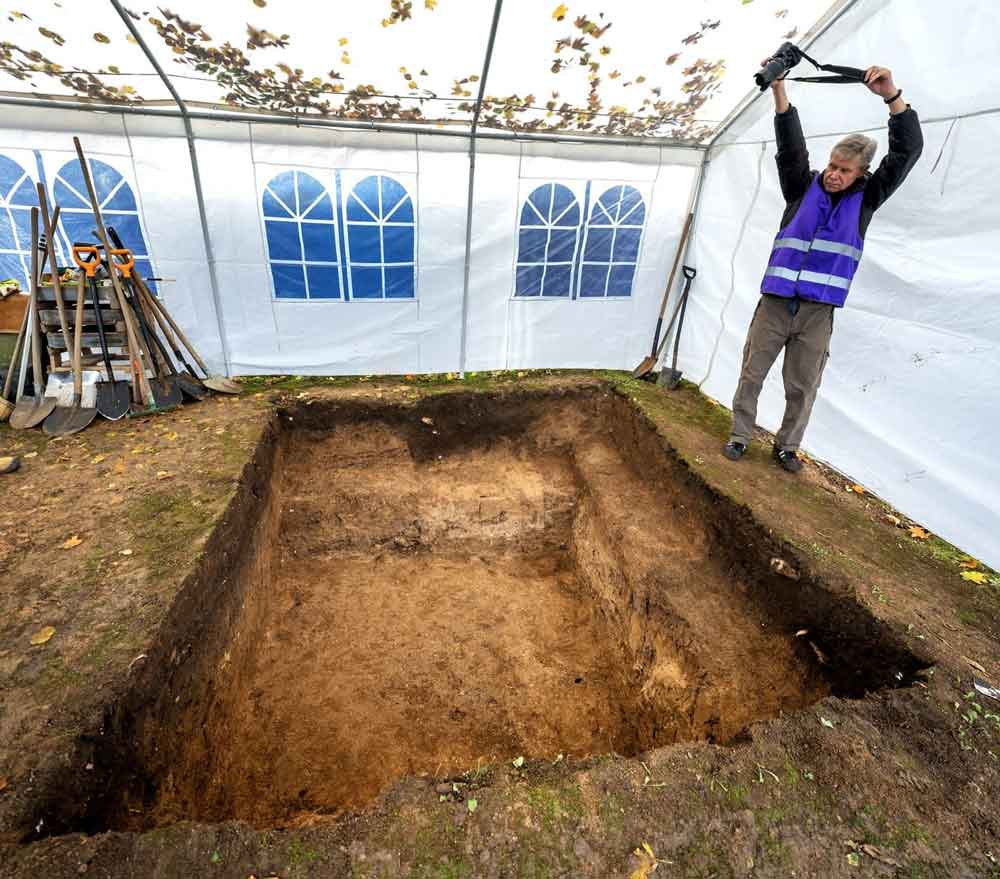
Cemetery in Prague-Ďáblice | Photo: Michal Růžička, MFDNES + LN / Profimedia
Read moreThe Cave of Hebron: Tomb of the Patriarchs?

DNA testing will determine whether the recovered remains belong to Sok, Jebavý, and Sabela. The Commission for Resolving Issues Related to Mass Graves at Ďáblice Cemetery, led by Jana Kotalíková, Head of the Office of the Government, coordinates efforts to identify victims and return them to families. “In the case of Mr. Sabela, for example, we are in contact with his son, who was very young when his father was murdered, and who has hoped his whole life that this moment would come,” Kotalíková said.

The soldiers’ stories illustrate the brutal continuity between Nazi and Communist oppression in Czechoslovakia. After distinguishing themselves fighting against Nazism during World War II, Sok, Jebavý, and Sabela found themselves targeted by a new totalitarian regime. The Communist government that seized power in 1948 viewed their wartime heroism as irrelevant compared to their opposition to Communist rule.

The excavation represents a broader effort to document and recover victims from both totalitarian regimes that controlled Czechoslovakia during the 20th century. Researchers aim to map all shaft graves at Ďáblice Cemetery and exhume as many victims as possible, providing closure for families who have waited generations for answers. The project acknowledges both the heroes who resisted tyranny and the victims who suffered under it, regardless of which regime perpetrated the violence.

For families like Sabela’s, the excavation offers something beyond historical documentation. After nearly eight decades, they may finally conduct dignified burials for men who sacrificed their lives fighting oppression twice over—first against fascism, then against communism.

Read more3,000 Year Old Sword of a Pharoah Discovered in Egypt

Feature image: Cemetery in Prague-Ďáblice | Photo: Michal Růžička, MFDNES + LN / Profimedia
You may also like

Ancient Rock Carvings Uncovered in Ecuador Point to Shared Amazonian Cultural Traditions

Stolen Hercules Fresco Finds Its Home After Decades in U.S. Collection

Maya Medical Systems Used Living Organisms as Precision Surgical Tools

Ancient Rock Art in Texas-Mexico Borderlands Endured 4,000 Years

Were Wolves Kept and Nursed by Ancient Seal Hunters?

Ancient Peruvians Survived Climate Catastrophe Through Adaptation, Not War

Allthathistory
Written by Allthathistory

Tags: archaeology, communism, Czechoslovakia, political-prisoners, Prague, WWII

Leave a Reply Cancel reply

Your email address will not be published. Required fields are marked *

  • Ancient Rock Carvings Uncovered in Ecuador Point to Shared Amazonian Cultural Traditions
    Archaeologists have identified a panel containing approximately 30 ancient rock carvings in Santiago de Méndez canton, Morona Santiago province, marking
  • Stolen Hercules Fresco Finds Its Home After Decades in U.S. Collection
    Archaeologists at Pompeii have identified the original location of a looted fresco fragment depicting the infant Hercules strangling serpents, solving
  • Maya Medical Systems Used Living Organisms as Precision Surgical Tools
    Maya medical systems deployed living organisms as precision surgical tools centuries before germ theory existed. Recent archaeological evidence shows these
  • Ancient Rock Art in Texas-Mexico Borderlands Endured 4,000 Years
    Hunter-gatherers in what is now southwestern Texas and northern Mexico created rock art for more than 4,000 years, maintaining consistent
  • The Thermal Engineering Behind Tiwanaku’s Agricultural Success
    At nearly 3,850 meters above sea level, frost arrives almost nightly on Bolivia’s Altiplano. Modern visitors struggle to breathe. Yet
The Gnostic Gospels
Encounters at the Heart of the World: A History of the Mandan People
Substack Articles

Latest from AllThatHistory Weekly

The Scripts We Cannot Read: Humanity’s Unbroken Codes

The Scripts We Cannot Read: Humanity’s Unbroken Codes

In 1952, a young British architect named Michael Ventris solved one of archaeology’s greatest puzzles.

Read More →
The Groom of the Stool: History’s Strangest Prestigious Job

The Groom of the Stool: History’s Strangest Prestigious Job

In Tudor England, one of the most trusted and prestigious positions at court was the Groom of the Stool.

Read More →
Professional Mourners: The Ancient Career of Grieving for Pay

Professional Mourners: The Ancient Career of Grieving for Pay

When an important person died in ancient Egypt, the family hired professionals.

Read More →
This Week in Archaeology: A Viking Giant, a Toddler from 9000 BC, and AI Cracks an Ancient Board Game

This Week in Archaeology: A Viking Giant, a Toddler from 9000 BC, and AI Cracks an Ancient Board Game

Every once in a while you get a week where every story makes you stop scrolling.

Read More →
The Tomb Raiders Who Became Archaeologists

The Tomb Raiders Who Became Archaeologists

How 19th-century treasure hunters transformed into the founders of a scientific discipline—and the messy ethics they left behind

Read More →
This Week in Archaeology: Swords, Silver, and Desert Engineering

This Week in Archaeology: Swords, Silver, and Desert Engineering

An Anglo-Saxon blade rivals Sutton Hoo, Moscow yields a Time of Troubles fortune, Petra’s water system surprises again, and Bavaria gets its oldest Mithraeum

Read More →
❮
❯

Subscribe to receive our newest archaeology articles, long-form investigations, and historical insights directly in your inbox.

© Copyright AllThatHistory - 2025