DNA from Napoleon’s Doomed Soldiers Reveals Killer Diseases
DNA from 1812 graves reveals paratyphoid fever & lice-borne relapsing fever in his doomed soldiers. Read more for the chilling truth.

Scientists probing the bones of Napoleon’s fallen troops have uncovered solid evidence of two brutal pathogens that turned the 1812 Russian retreat into a disaster. Researchers at the Institut Pasteur identified paratyphoid fever and louse-borne relapsing fever in soldiers interred in a mass grave. They shared preliminary findings on bioRxiv July 16, 2025, before publishing the complete study in Current Biology on October 24, 2025.
Why the Retreat Turned Into a Death March
Napoleon’s invasion of Russia began with a massive force—about 500,000 soldiers—but ended in a frozen graveyard. To assess the disease’s role in the collapse, experts from the Institut Pasteur’s Microbial Paleogenomics Unit joined forces with anthropologists from Aix-Marseille University. Their focus fell on 13 skeletons unearthed in Vilnius, Lithuania, during construction in 2002.
Advanced sequencing of the brittle ancient DNA fragments revealed two agents: Salmonella enterica Paratyphi C, which causes paratyphoid fever, and Borrelia recurrentis, the louse-vectored cause of relapsing fever. Both deliver crushing fevers, severe abdominal distress and total fatigue; the relapsing version alternates intense heat with short lulls before striking again. Combined with frostbite, hunger and squalid conditions, these infections created a perfect storm of suffering.
Straight from the Bones
Four of the 13 individuals tested positive for the paratyphoid strain whilst two carried the relapsing-fever bacterium. This marks the first genomic verification of these microbes in Napoleon’s ranks. Previous studies had already detected typhus (Rickettsia prowazekii) and trench fever (Bartonella quintana), both expected in overcrowded and parasite-ridden armies. The new data sharpens the image of an epidemic-plagued force.
The sample size remains small: 13 out of more than 3,000 bodies in the Vilnius pit, and a mere speck compared to the 500,000 troops who entered Russia—around 300,000 never returned. The pathogens were present, but their full toll across the army is still unclear.

Reading Yesterday’s Germs to Fight Tomorrow’s
Dr. Nicolás Rascovan, head of the Microbial Paleogenomics Unit and the study’s senior author, emphasizes that extracting pathogen genomes from historical remains tracks how diseases rose, spread and faded while revealing the social and environmental triggers. Such insights strengthen modern defenses against outbreaks.
The team collaborated with University of Tartu scientists in Estonia to devise a strict validation protocol: match every DNA scrap to phylogenetic trees of current microbes, exclude modern contaminants, and to then confirm identification only when multiple lines converge. The system succeeds even with scant and degraded material.
Rascovan notes that ancient pathogen DNA usually appears as tiny fragments, yet their approach reliably verifies the organism and occasionally pinpoints its lineage.
History Books Meet Lab Results
Contemporary accounts describe soldiers racked by chills, high fevers and digestive agony, with symptoms surging and receding in waves. The genetic evidence aligns precisely with those records. Pair infection with malnutrition, arctic temperatures and relentless marches, and the Grande Armée’s disintegration becomes inevitable.
Russian forces eventually expelled the French from Moscow and pressed the advantage. The retreat signaled the start of Napoleon’s unraveling.
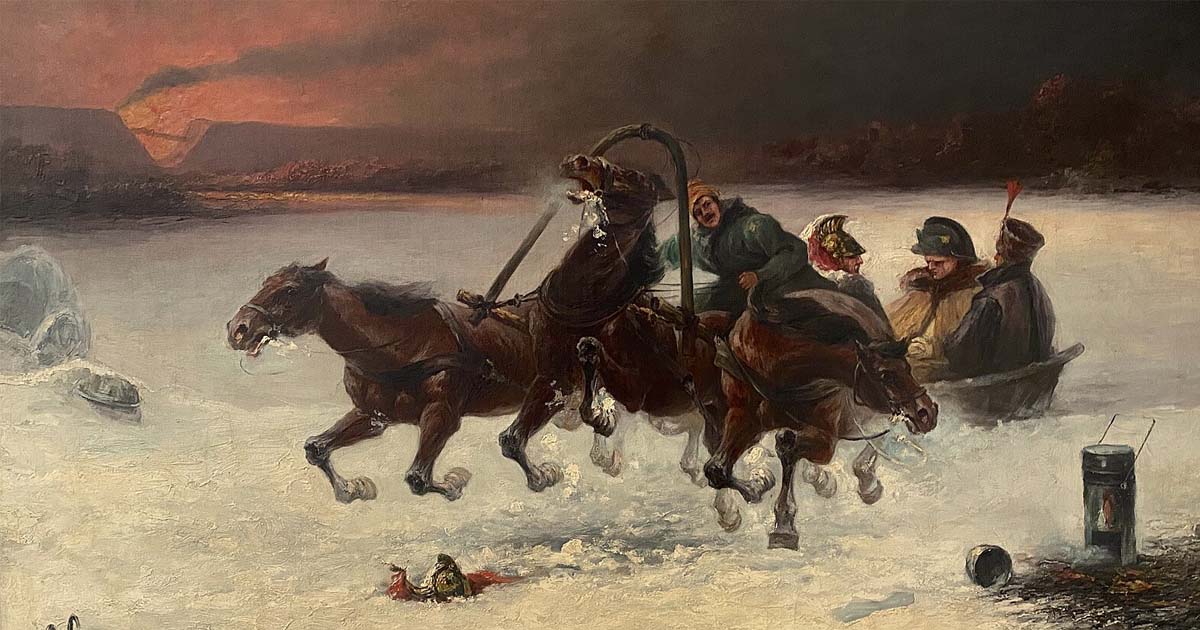
Top Image: “Napoleon Leaving Moscow” by Pjotr C. Stojanov (circa 1930). Source: CC BY-SA 4.0.
References:
Institut Pasteur. “Ancient DNA reveals the deadly diseases behind Napoleon’s defeat.” ScienceDaily. ScienceDaily, 26 October 2025. www.sciencedaily.com/releases/2025/10/251026021727.htm