Hippos didn’t rush out of Central Europe as the ice advanced. New tests on ancient bones reveal these huge semi-aquatic animals still wandered Germany’s Upper Rhine Valley between about 47,000 and 31,000 years ago. Deep into the last ice age. A global team led by scientists from the University of Potsdam and the Reiss-Engelhorn-Museen in Mannheim, working closely with the Curt-Engelhorn-Zentrum Archäometrie, shared the discovery in Current Biology. Rewinding the Exit Clock Standard thinking had common hippos (Hippopotamus amphibius) vanishing from Europe about 115,000 years ago, once the mild interglacial ended and harsh cold set in. This latest research, however, which involved specialists from ETH Zurich and other institutions, shows that a small group of H. amphibius held on in southwestern Germany for tens of thousands of years longer, enduring the Weichselian glaciation’s occasional warmer phases. The Upper Rhine Graben acts like a sealed vault. Rivers stacked gravel and sand over millennia, perfectly preserving animal remains. Dr. Ronny Friedrich–the age-dating expert at the Curt-Engelhorn-Zentrum Archäometrie–points out that many bones stayed in remarkably good shape, yielding samples ideal for testing even after such a vast stretch of time. DNA and Carbon Say the Same Thing The researchers used both ancient DNA sequencing and radiocarbon dating. Genetic results matched these Ice Age hippos to the same species still found in African waterways today. The carbon dates placed them in a short temperate window that kept the area livable long enough for hippos to persist. Closer genome inspection exposed very low diversity, indicating the European population was small and cut off from relatives farther south. Fossils also place these heat-loving giants alongside mammoths and woolly rhinos, underlining how unusually mixed and diverse Ice Age habitats could be. Time to Dust Off the Old Bones Lead author Dr. Patrick Arnold stresses that hippos did not disappear from central Europe at the close of the last interglacial as long thought to be believed, so every fossil previously assigned to that era deserves fresh scrutiny. Dr. Wilfried Rosendahl, director of the Reiss-Engelhorn-Museen and head of the Eiszeitfenster Oberrheingraben project, sees the ice age as far from uniform; local warm pockets created a patchwork environment. He views this finding as one fragment of a larger mosaic and urges similar re-examination of other warmth-dependent species once thought gone much earlier. The study falls under the Eiszeitfenster Oberrheingraben initiative, backed by the Klaus Tschira Stiftung in Heidelberg. Teams continue sifting the Reis collection of Ice Age bones kept at the Mannheim museum, steadily reshaping our picture of Europe’s ancient wildlife, bone by bone. Top Image: Hippopotami that thrive in present-day Africa once called Prehistoric Europe home. Source: Public Domain. References: University of Potsdam. “Hippos once roamed frozen Germany with mammoths.” ScienceDaily. ScienceDaily, 26 October 2025. www.sciencedaily.com/releases/2025/10/251026021740.htm
DNA from Napoleon’s Doomed Soldiers Reveals Killer Diseases
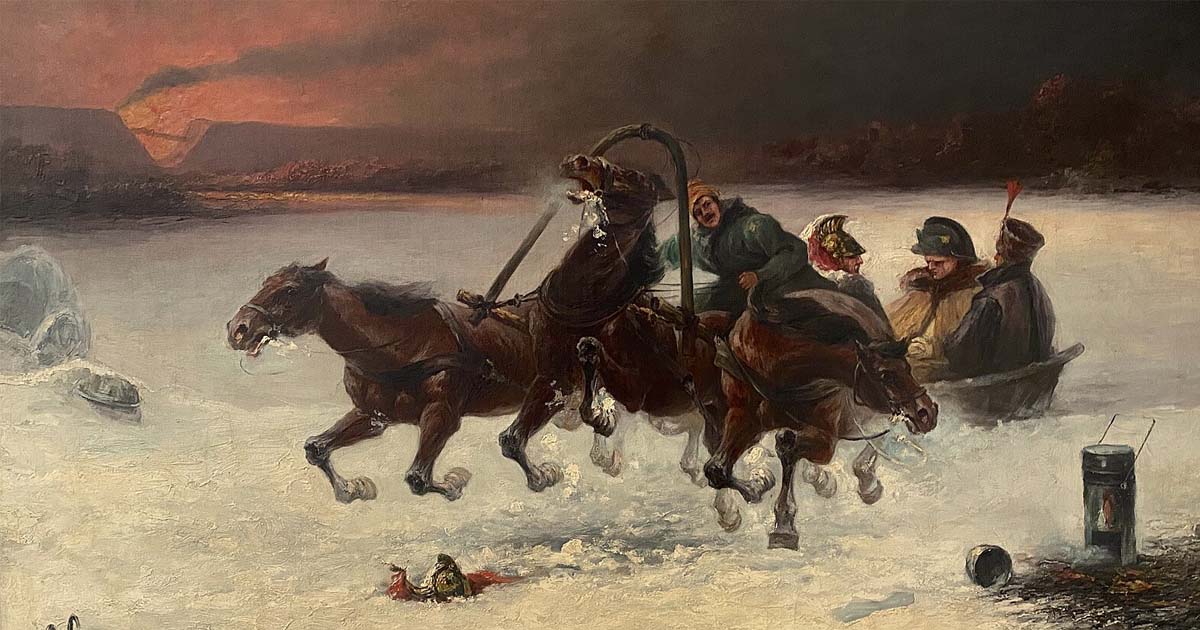
Scientists probing the bones of Napoleon’s fallen troops have uncovered solid evidence of two brutal pathogens that turned the 1812 Russian retreat into a disaster. Researchers at the Institut Pasteur identified paratyphoid fever and louse-borne relapsing fever in soldiers interred in a mass grave. They shared preliminary findings on bioRxiv July 16, 2025, before publishing the complete study in Current Biology on October 24, 2025. Why the Retreat Turned Into a Death March Napoleon’s invasion of Russia began with a massive force—about 500,000 soldiers—but ended in a frozen graveyard. To assess the disease’s role in the collapse, experts from the Institut Pasteur’s Microbial Paleogenomics Unit joined forces with anthropologists from Aix-Marseille University. Their focus fell on 13 skeletons unearthed in Vilnius, Lithuania, during construction in 2002. Advanced sequencing of the brittle ancient DNA fragments revealed two agents: Salmonella enterica Paratyphi C, which causes paratyphoid fever, and Borrelia recurrentis, the louse-vectored cause of relapsing fever. Both deliver crushing fevers, severe abdominal distress and total fatigue; the relapsing version alternates intense heat with short lulls before striking again. Combined with frostbite, hunger and squalid conditions, these infections created a perfect storm of suffering. Straight from the Bones Four of the 13 individuals tested positive for the paratyphoid strain whilst two carried the relapsing-fever bacterium. This marks the first genomic verification of these microbes in Napoleon’s ranks. Previous studies had already detected typhus (Rickettsia prowazekii) and trench fever (Bartonella quintana), both expected in overcrowded and parasite-ridden armies. The new data sharpens the image of an epidemic-plagued force. The sample size remains small: 13 out of more than 3,000 bodies in the Vilnius pit, and a mere speck compared to the 500,000 troops who entered Russia—around 300,000 never returned. The pathogens were present, but their full toll across the army is still unclear. Reading Yesterday’s Germs to Fight Tomorrow’s Dr. Nicolás Rascovan, head of the Microbial Paleogenomics Unit and the study’s senior author, emphasizes that extracting pathogen genomes from historical remains tracks how diseases rose, spread and faded while revealing the social and environmental triggers. Such insights strengthen modern defenses against outbreaks. The team collaborated with University of Tartu scientists in Estonia to devise a strict validation protocol: match every DNA scrap to phylogenetic trees of current microbes, exclude modern contaminants, and to then confirm identification only when multiple lines converge. The system succeeds even with scant and degraded material. Rascovan notes that ancient pathogen DNA usually appears as tiny fragments, yet their approach reliably verifies the organism and occasionally pinpoints its lineage. History Books Meet Lab Results Contemporary accounts describe soldiers racked by chills, high fevers and digestive agony, with symptoms surging and receding in waves. The genetic evidence aligns precisely with those records. Pair infection with malnutrition, arctic temperatures and relentless marches, and the Grande Armée’s disintegration becomes inevitable. Russian forces eventually expelled the French from Moscow and pressed the advantage. The retreat signaled the start of Napoleon’s unraveling. Top Image: “Napoleon Leaving Moscow” by Pjotr C. Stojanov (circa 1930). Source: CC BY-SA 4.0. References: Institut Pasteur. “Ancient DNA reveals the deadly diseases behind Napoleon’s defeat.” ScienceDaily. ScienceDaily, 26 October 2025. www.sciencedaily.com/releases/2025/10/251026021727.htm
Mexican Zapotec “Fortress” Revealed by LiDAR as a Large City
A new study of a Zapotec site in Mexico may have finally revealed its purpose. A team using LiDAR to analyze the complex have revealed a large post-classical city. The site of Guiengola is well known to Mexican archaeologists. Built by the Zapotec, an indigenous pre-Columbian culture who lived in the Valley of Oaxaca in Mexico since 600 BC, there has always been something special about the site. Guiengola was, unusually, never occupied and used by Spanish invaders in the 16th century. This means it offers an extremely well preserved example of a Zapotec site which has not been rebuilt in the Spanish style, albeit one built outside of their heartlands. But there is something unusual about Guiengola too. Much of the site was (and is) hidden beneath a dense forest canopy, with the only immediately obvious feature being a giant structure at the center of the complex. Some call this a “fortress,” others a “palace.” Colonial-era documents are dismissive of Guiengola, deciding that little mattered beyond this central structure and that the high population density here could be explained by a garrison housed there, part of the Zapotec’s push into foreign territory around the 13th century. But it has always been clear that this was not the full story of the site. Finds started to come out of the thick jungle, family tombs and ceremonial plazas flanked by temples. Such finds were only part of the picture, but with this study published in November 2024 by Cambridge University Press the use of airborne LiDAR has revealed the full extent of Guiengola for the first time. Stripping away the vegetation using laser imaging reveals an entire city at the site. Walled, fortified and served by an internal road network, the city covers some 360 hectares. There is also evidence of a hierarchy within the planning of the city, with buildings of differing forms and functions being built and residential areas being separated into neighborhoods built around families. There were different neighborhoods for ordinary and elite members of the population. Close analysis of the buildings, some 1,173 structures in all, suggests they are divided into monumental, military and residential. The monumental structures included those for ceremonial purposes: plazas, temples and ballcourts all hidden beneath the thick vegetation. The military structures are primarily associated with defense of the walls, which also run within the city, controlling access to elite areas. An intensive site survey of 90 of the buildings at Guiengola has produced some 2,292 artifacts which have allowed the research team to accurately date the city. We now know the Zapotec alone built it, from scratch, in the 13th century. The city seems to have had a public “epicenter” covering some 22 hectares, filled with public buildings and plazas. Some of the elite population lived here but it seems that the focus of the town was a space where the entire population could gather together. A series of interconnected structures here may also have been the seat of power and residence of whoever was in charge. The palace itself is revealed as vast and complex, with multiple auxiliary buildings and terraces surrounding the central residences, all within high defensive walls. Multiple other, previously unknown large structures have also been found across the site, their purpose at this moment uncertain. It is clear that there is far more here than a mere fortress garrison. And while some of the key buildings have been excavated, an entire lost city awaits discovery under the rainforest canopy. Header Image: The “epicenter” of Zapotec Guiengola, with the surrounding area being revealed by LiDAR as a vast walled city. Source: Cambridge University Press.