
Skip to content
  • Home
  • Articles
    • Archaeology & Discoveries
    • Historical Events
    • Artifacts & Treasures
    • Ancient Civilizations
    • Unexplained Phenomena
    • Mythology
  • Subscribe
© Copyright AllThatHistory - 2025
Theme by ThemeinProgress
Proudly powered by WordPress
  • Home
  • Articles
    • Archaeology & Discoveries
    • Historical Events
    • Artifacts & Treasures
    • Ancient Civilizations
    • Unexplained Phenomena
    • Mythology
  • Subscribe
AllThatHistory
  • You are here :
  • Home
  • Archaeology & Discoveries
  • Ancient Gold Brooch and Jade Stone Unearthed at Troy
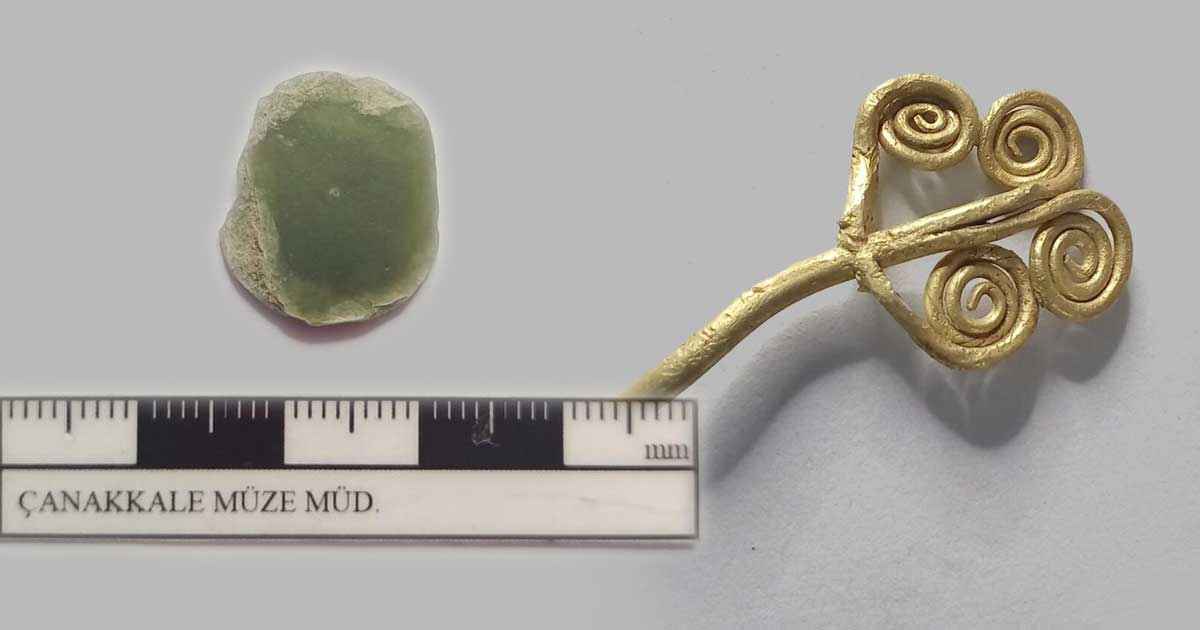
Jade and gold brooch. Source: Turkish Ministry of Culture and Tourism
Archaeology & Discoveries

Ancient Gold Brooch and Jade Stone Unearthed at Troy

Allthathistory October 6, 2025

Archaeologists working at the ancient city of Troy in northwestern Turkey have unearthed a 4,500-year-old gold brooch, a jade stone, and a bronze pin, findings that push the city’s known history several centuries further into the past. The discovery, made near the “6M Palace” structure in the Troy II layer, is considered one of the most significant at the site in a century.

The excavation forms part of Turkey’s “Heritage for the Future” initiative, overseen by the Ministry of Culture and Tourism. Minister Mehmet Nuri Ersoy described the find as “one of the most important discoveries at Troy in the last hundred years,” noting that the gold brooch is one of only three known examples worldwide.

The gold ring brooch, exceptionally well preserved after millennia, consists of four spiral coils joined by a long fastening pin. It likely served both practical and symbolic roles, securing garments while signaling status and wealth in Early Bronze Age Troy. The nearby bronze pin adds detail to what is known about the city’s metalworking and dress traditions.

The jade stone offers an even broader perspective. Since jade is not native to Anatolia, its presence indicates that Troy participated in long-distance trade networks reaching across the Near East, Central Asia, and possibly China. Researchers believe the stone was once part of a ring or pendant, showing a taste for imported luxury goods centuries before the events described in Homer’s Iliad.

Read moreThe Cave of Hebron: Tomb of the Patriarchs?

Finds from the Troy II levels suggest the settlement began around 2500 BCE, earlier than previously estimated. This revised dating places Troy among the earliest urban centers of the Early Bronze Age, alongside emerging cities in Anatolia and the Aegean.

The discovery underscores Troy’s early role as a commercial and cultural crossroads between East and West. Long before it became legendary in Greek epic, the city was already thriving as a center of trade, craftsmanship, and cultural exchange.

Excavations at Troy have continued for over 160 years, revealing nine major settlement layers spanning from the Early Bronze Age to the Byzantine era. The newly uncovered artifacts will soon go on display at the Troy Museum in Çanakkale, offering visitors a rare glimpse into the artistry and global connections of the city’s earliest inhabitants.

Header image: Jade and gold brooch. Source: Turkish Ministry of Culture and Tourism

You may also like

Ancient Rock Carvings Uncovered in Ecuador Point to Shared Amazonian Cultural Traditions

Stolen Hercules Fresco Finds Its Home After Decades in U.S. Collection

Maya Medical Systems Used Living Organisms as Precision Surgical Tools

Ancient Rock Art in Texas-Mexico Borderlands Endured 4,000 Years

Were Wolves Kept and Nursed by Ancient Seal Hunters?

Ancient Peruvians Survived Climate Catastrophe Through Adaptation, Not War

Allthathistory
Written by Allthathistory

Tags: Anatolia, ancient trade, archaeology, artifacts, Bronze Age, Troy

Leave a Reply Cancel reply

Your email address will not be published. Required fields are marked *

  • Ancient Rock Carvings Uncovered in Ecuador Point to Shared Amazonian Cultural Traditions
    Archaeologists have identified a panel containing approximately 30 ancient rock carvings in Santiago de Méndez canton, Morona Santiago province, marking
  • Stolen Hercules Fresco Finds Its Home After Decades in U.S. Collection
    Archaeologists at Pompeii have identified the original location of a looted fresco fragment depicting the infant Hercules strangling serpents, solving
  • Maya Medical Systems Used Living Organisms as Precision Surgical Tools
    Maya medical systems deployed living organisms as precision surgical tools centuries before germ theory existed. Recent archaeological evidence shows these
  • Ancient Rock Art in Texas-Mexico Borderlands Endured 4,000 Years
    Hunter-gatherers in what is now southwestern Texas and northern Mexico created rock art for more than 4,000 years, maintaining consistent
  • The Thermal Engineering Behind Tiwanaku’s Agricultural Success
    At nearly 3,850 meters above sea level, frost arrives almost nightly on Bolivia’s Altiplano. Modern visitors struggle to breathe. Yet
The Gnostic Gospels
Encounters at the Heart of the World: A History of the Mandan People
Substack Articles

Latest from AllThatHistory Weekly

Why the “Mad Artistic Genius” Myth Doesn’t Hold Up to Science

Why the “Mad Artistic Genius” Myth Doesn’t Hold Up to Science

By Daisy Fancourt

Read More →
Charlie Chaplin: The Man Who Inspired Mickey Mouse

Charlie Chaplin: The Man Who Inspired Mickey Mouse

Walt Disney and cartoonist Ub Iwerks introduced Mickey Mouse to the world through the animated short Steamboat Willie in 1928.

Read More →
This Week in Archaeology: A French Church’s Hidden Vault, Iron Age War Trumpet, and Roman Villa Beneath a Welsh Park

This Week in Archaeology: A French Church’s Hidden Vault, Iron Age War Trumpet, and Roman Villa Beneath a Welsh Park

Restoration work at a medieval French church turned into a time capsule expedition when crews uncovered burials spanning over a millennium.

Read More →
Slavery, Survival, and Stolen Art: The Dual Lives of Villa Giuliana

Slavery, Survival, and Stolen Art: The Dual Lives of Villa Giuliana

Villa Giuliana near Pompeii reveals an uncomfortable truth: the same household that commissioned Hercules art enslaved 50 workers fed calculated portions.

Read More →
How People in the Past Predicted the Future

How People in the Past Predicted the Future

For thousands of years, humans have tried to pierce the veil separating the present from what comes next.

Read More →
Maya Medical Systems Engineered Health Through Living Organisms, Not Ritual

Maya Medical Systems Engineered Health Through Living Organisms, Not Ritual

Ancient Maya healers managed wounds as ecosystems, using organisms as precision tools in ways modern medicine is only now rediscovering.

Read More →
❮
❯

Subscribe to receive our newest archaeology articles, long-form investigations, and historical insights directly in your inbox.

© Copyright AllThatHistory - 2025