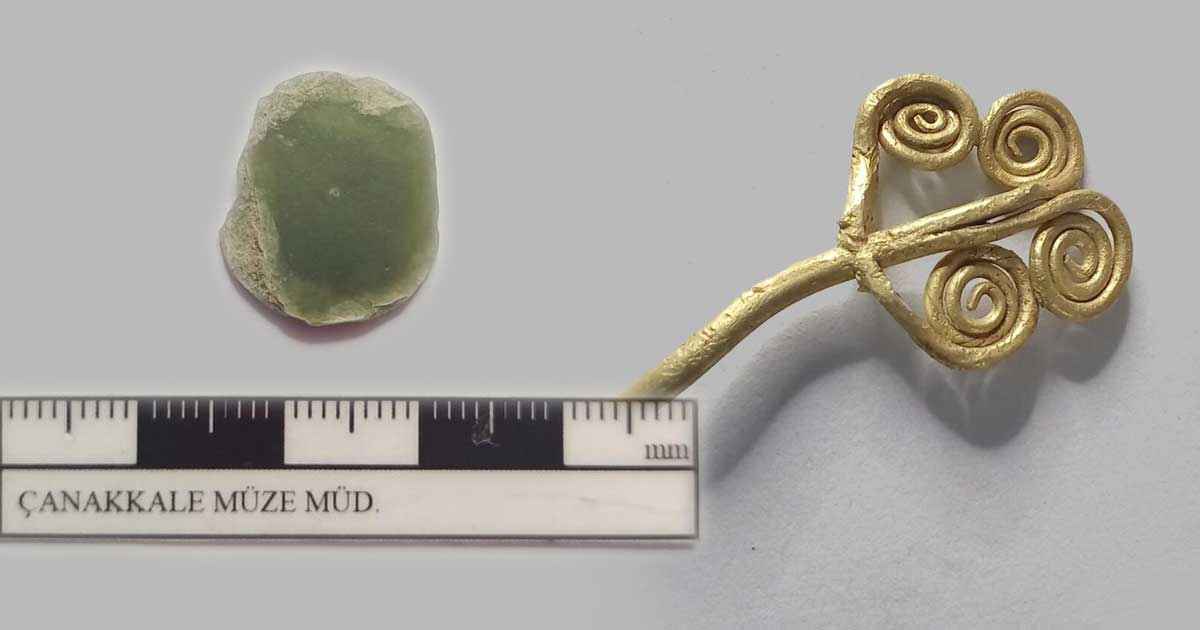
Archaeologists working at the ancient city of Troy in northwestern Turkey have unearthed a 4,500-year-old gold brooch, a jade stone, and a bronze pin, findings that push the city’s known history several centuries further into the past. The discovery, made near the “6M Palace” structure in the Troy II layer, is considered one of the most significant at the site in a century. The excavation forms part of Turkey’s “Heritage for the Future” initiative, overseen by the Ministry of Culture and Tourism. Minister Mehmet Nuri Ersoy described the find as “one of the most important discoveries at Troy in the last hundred years,” noting that the gold brooch is one of only three known examples worldwide. The gold ring brooch, exceptionally well preserved after millennia, consists of four spiral coils joined by a long fastening pin. It likely served both practical and symbolic roles, securing garments while signaling status and wealth in Early Bronze Age Troy. The nearby bronze pin adds detail to what is known about the city’s metalworking and dress traditions. The jade stone offers an even broader perspective. Since jade is not native to Anatolia, its presence indicates that Troy participated in long-distance trade networks reaching across the Near East, Central Asia, and possibly China. Researchers believe the stone was once part of a ring or pendant, showing a taste for imported luxury goods centuries before the events described in Homer’s Iliad. Finds from the Troy II levels suggest the settlement began around 2500 BCE, earlier than previously estimated. This revised dating places Troy among the earliest urban centers of the Early Bronze Age, alongside emerging cities in Anatolia and the Aegean. The discovery underscores Troy’s early role as a commercial and cultural crossroads between East and West. Long before it became legendary in Greek epic, the city was already thriving as a center of trade, craftsmanship, and cultural exchange. Excavations at Troy have continued for over 160 years, revealing nine major settlement layers spanning from the Early Bronze Age to the Byzantine era. The newly uncovered artifacts will soon go on display at the Troy Museum in Çanakkale, offering visitors a rare glimpse into the artistry and global connections of the city’s earliest inhabitants. Header image: Jade and gold brooch. Source: Turkish Ministry of Culture and Tourism