Skip to content
  • Home
  • Articles
    • Archaeology & Discoveries
    • Historical Events
    • Artifacts & Treasures
    • Ancient Civilizations
    • Unexplained Phenomena
    • Mythology
  • Subscribe
© Copyright AllThatHistory - 2025
Theme by ThemeinProgress
Proudly powered by WordPress
  • Home
  • Articles
    • Archaeology & Discoveries
    • Historical Events
    • Artifacts & Treasures
    • Ancient Civilizations
    • Unexplained Phenomena
    • Mythology
  • Subscribe
AllThatHistory
  • You are here :
  • Home
  • Archaeology & Discoveries
  • “We Saw the Stone, But Not the Circle”: Bronze Age Monument Found in England
“We Saw the Stone, But Not the Circle”: Bronze Age Monument Found in England
Archaeology & Discoveries

“We Saw the Stone, But Not the Circle”: Bronze Age Monument Found in England

Allthathistory March 24, 2025

Near the city of Matlock in Derbyshire lies Farley Wood, a sprawling mix of pine for logging amidst old growth harking back to an ancient time when dense forests covered the British Isles.

Locals have long known about the strange stone at the heart of the wood, standing straight upright like a pillar some two meters tall. It had always stood there, an isolated monument serving mute testament to our forgotten past.

At least, it was always thought to be an isolated monument. But, according to a report by the BBC, there is much more to Farley Stone than meets the eye.

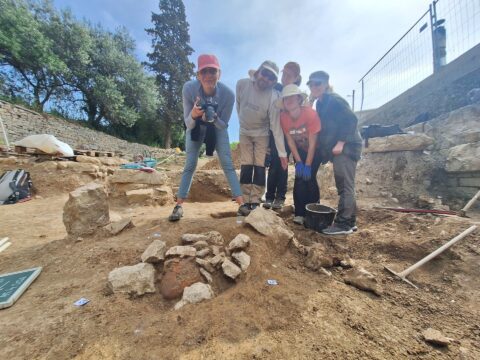
This is not some isolated standing stone, but part of a huge stone circle some 25 meters across, maybe a quarter of the diameter of the famous Stonehenge. Five other stones, half hidden by the vegetation, have been uncovered by Forestry England in association with Time Team, famous for their archeological work in the British Isles.

  • Ben Franklin, and All Those Bodies They Dug Out of his Basement
  • The Wendigo: Native American Stuff of Nightmares
Read moreThe Cave of Hebron: Tomb of the Patriarchs?

Together the stones show the outline of the circle. Further excavations have uncovered a ceremonial platform close by Farley Stone, and the monument is thought to be some 3,700 years old, dating back to the Bronze Age.

Not a lot survives from this era except the monumental archaeology which covers the British landscape. We know very little about the people, their rituals and their lives, except what can be found in their long barrows, their earthworks, and of course their ancient piles of rubbish.

It is currently thought that the oldest part of the monument is the ceremonial platform, suggesting that the site was used for hundreds of years, the stones being added later as it grew in importance. Dr Lawrence Shaw, Forestry England’s lead historic environment adviser, described it as “evidence of a much more complex ceremonial landscape, which the original standing stone is part of.”

But what is clear from this discovery is that we are only starting to understand the ancient ceremonial landscape in the area. The team intend to return in the future, firstly to fully explore and understand the newly discovered stone circle, and then to find out what else is hidden beneath the trees.

Read more3,000 Year Old Sword of a Pharoah Discovered in Egypt

In the meantime the site itself, although not officially yet a historic monument, will be protected as one. 
Header Image: Source: Time Team / BBC.

You may also like

Ancient Rock Carvings Uncovered in Ecuador Point to Shared Amazonian Cultural Traditions

Stolen Hercules Fresco Finds Its Home After Decades in U.S. Collection

Ancient Rock Art in Texas-Mexico Borderlands Endured 4,000 Years

Were Wolves Kept and Nursed by Ancient Seal Hunters?

Ancient Peruvians Survived Climate Catastrophe Through Adaptation, Not War

Peru’s Mysterious “Band of Holes” May Have Been Ancient Marketplace and Accounting System

Allthathistory
Written by Allthathistory

Tags: ceremony, Derbyshire, prehistoric, Stonehenge, Time Team, United Kingdom

Leave a Reply Cancel reply

Your email address will not be published. Required fields are marked *

  • Ancient Rock Carvings Uncovered in Ecuador Point to Shared Amazonian Cultural Traditions
    Archaeologists have identified a panel containing approximately 30 ancient rock carvings in Santiago de Méndez canton, Morona Santiago province, marking
  • Stolen Hercules Fresco Finds Its Home After Decades in U.S. Collection
    Archaeologists at Pompeii have identified the original location of a looted fresco fragment depicting the infant Hercules strangling serpents, solving
  • Maya Medical Systems Used Living Organisms as Precision Surgical Tools
    Maya medical systems deployed living organisms as precision surgical tools centuries before germ theory existed. Recent archaeological evidence shows these
  • Ancient Rock Art in Texas-Mexico Borderlands Endured 4,000 Years
    Hunter-gatherers in what is now southwestern Texas and northern Mexico created rock art for more than 4,000 years, maintaining consistent
  • The Thermal Engineering Behind Tiwanaku’s Agricultural Success
    At nearly 3,850 meters above sea level, frost arrives almost nightly on Bolivia’s Altiplano. Modern visitors struggle to breathe. Yet
The Gnostic Gospels
Encounters at the Heart of the World: A History of the Mandan People
Substack Articles

Latest from AllThatHistory Weekly

The Plague of Justinian: The Pandemic That Ended the Ancient World

The Plague of Justinian: The Pandemic That Ended the Ancient World

In 541 CE, bubonic plague arrived at an Egyptian port and spread across the known world. It killed perhaps a quarter of the Byzantine Empire’s population, ended Justinian’s reconquest of Rome, and created the conditions for the Arab conquests a century later. Ancient DNA confirmed the pathogen in 2013. This is the pandemic that built the medieval world.

Read More →
The Real Nazca Lines: What Mainstream Archaeology Won’t Commit To

The Real Nazca Lines: What Mainstream Archaeology Won’t Commit To

Everyone has heard of the Nazca Lines. Most people know the alien explanation is nonsense. But the real academic debate three competing theories, none of them fully supported by the evidence is far more interesting than the alternative history crowd wants you to know. The truth is messier, and better.

Read More →
Who Was Cleopatra?

Who Was Cleopatra?

Most of what people know about Cleopatra came from her enemies.

Read More →
Stonehenge’s Bones: The Burial Site That Rewrites What We Thought We Knew

Stonehenge’s Bones: The Burial Site That Rewrites What We Thought We Knew

New isotope analysis of human remains at Stonehenge shows that many of the people buried there in its earliest phase came from Wales the same place as the bluestones. Some of them may have been descendants of the communities that quarried and transported the stones 300 kilometers to Salisbury Plain. The stones and the dead may have been making the…

Read More →
Who Built Gobekli Tepe and Why Did They Bury It?

Who Built Gobekli Tepe and Why Did They Bury It?

Gobekli Tepe was built 12,000 years ago at least 1,000 years before the first evidence of agriculture anywhere in the world. It required coordinating hundreds of workers, quarrying 20-ton limestone pillars, and sustaining organized construction over generations. The people who built it were hunter gatherers. Then they deliberately buried the entire site. This is one of archaeology’s most important unsolved…

Read More →
What Happened to the Maya Civilization?

What Happened to the Maya Civilization?

Between 800 and 1000 AD, dozens of major Maya cities in the southern lowlands went quiet.

Read More →
❮
❯

Subscribe to receive our newest archaeology articles, long-form investigations, and historical insights directly in your inbox.

© Copyright AllThatHistory - 2025