
Were Wolves Kept and Nursed by Ancient Seal Hunters?
On this windswept island in the middle of the Baltic Sea called Stora Karlsö, archaeologists digging in a cave have made an unexpected find. It turns out that the archaeologists have unearthed the bones of two gray wolves that died there roughly five thousand years ago. First of all, Stora Karlsö isn’t known for having any native land mammals. Second, this island is a small and rocky location pretty far from the Swedish mainland. The only logical way those wolves could’ve gotten there was if people loaded them up onto boats and brought them along.

Back then during the late Neolithic and early Bronze Age, the island was a busy seasonal camp for seal hunters and fishermen who came in for the rich summer haul. When scientists looked closer, the wolves turned out to be nothing like the big wild packs that once roamed the Scandinavian forests. These animals were noticeably smaller. Their teeth and bones carried chemical signatures showing they had been eating almost nothing but seal meat and fish—exactly the same food the human hunters were pulling from the sea.
One of the wolves had suffered a nasty break in its upper front leg. Eventually the injury had healed, but badly enough that the animal could never have hunted properly again. It must have been fed and protected by people for months or maybe even years. The other wolf showed unusually low genetic variation in its DNA, the kind of pattern you see when a small group of animals is cut off from the wider population or deliberately managed over generations. Nothing in the evidence proves these wolves were fully domesticated or even tame in the way we think of pets. Yet everything points to the same conclusion: some of those ancient seal hunters figured out how to keep live wolves around their camps, cared for them when they were hurt, and apparently saw enough value in having them nearby to go to the trouble of ferrying them across open water.
It’s a glimpse of an experiment in living alongside wolves that happened thousands of years before the domestic dog became a fixture across the ancient world—one that unfolded on a lonely Baltic island where people and predators briefly shared the same small piece of stone.
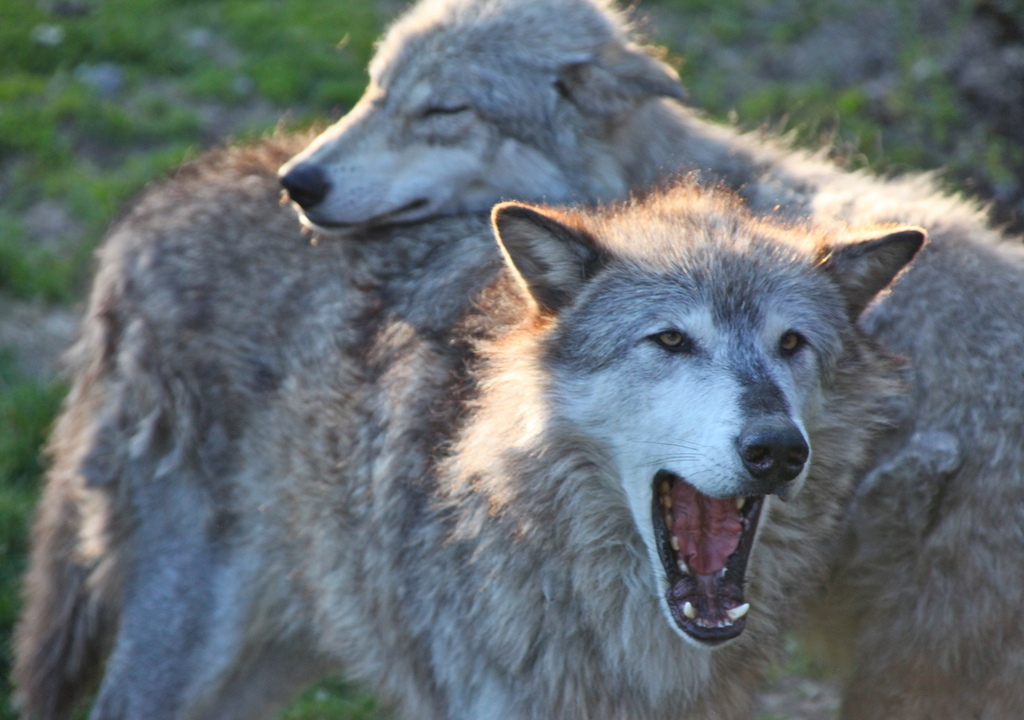
Top Image: Pair of grey wolves (Canis lupus). Source: Public Domain.
References:
- L. Girdland-Flink, A. Bergström, J. Storå, E. Ersmark, J. Apel, M. Krzewińska, L. Dalén, A. Götherström, & P. Skoglund, Gray wolves in an anthropogenic context on a small island in prehistoric Scandinavia, Proc. Natl. Acad. Sci. U.S.A. 122 (48) e2421759122, https://doi.org/10.1073/pnas.2421759122 (2025).
- Storå, Jan. “Were Ancient Eurasian Wolves Tame?” Archaeology Magazine, 26 Nov. 2025, https://archaeology.org/news/2025/11/26/were-ancient-eurasian-wolves-tame/. . Accessed 30 Nov. 2025.


Leave a Reply