
Skip to content
  • Home
  • Articles
    • Archaeology & Discoveries
    • Historical Events
    • Artifacts & Treasures
    • Ancient Civilizations
    • Unexplained Phenomena
    • Mythology
  • Subscribe
© Copyright AllThatHistory - 2025
Theme by ThemeinProgress
Proudly powered by WordPress
  • Home
  • Articles
    • Archaeology & Discoveries
    • Historical Events
    • Artifacts & Treasures
    • Ancient Civilizations
    • Unexplained Phenomena
    • Mythology
  • Subscribe
AllThatHistory
  • You are here :
  • Home
  • Archaeology & Discoveries
  • DNA from Napoleon’s Doomed Soldiers Reveals Killer Diseases
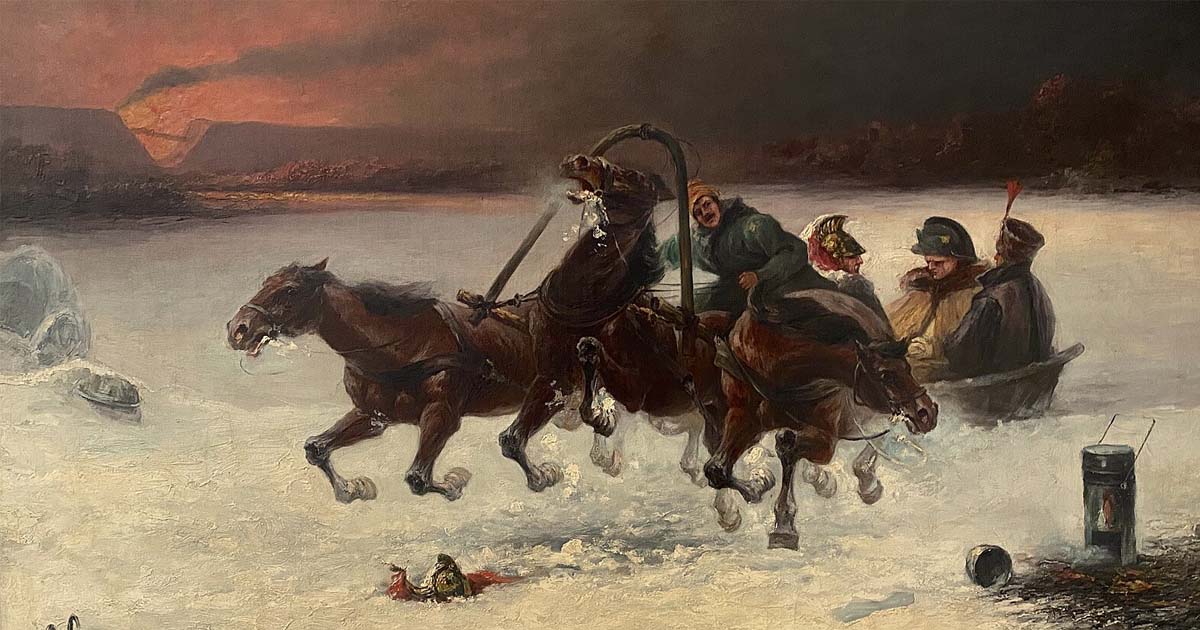
“Napoleon Leaving Moscow” by Pjotr C. Stojanov (circa 1930). Source: CC BY-SA 4.0.
Archaeology & Discoveries

DNA from Napoleon’s Doomed Soldiers Reveals Killer Diseases

Zeffs Amman October 28, 2025

Scientists probing the bones of Napoleon’s fallen troops have uncovered solid evidence of two brutal pathogens that turned the 1812 Russian retreat into a disaster. Researchers at the Institut Pasteur identified paratyphoid fever and louse-borne relapsing fever in soldiers interred in a mass grave. They shared preliminary findings on bioRxiv July 16, 2025, before publishing the complete study in Current Biology on October 24, 2025.

Why the Retreat Turned Into a Death March

Napoleon’s invasion of Russia began with a massive force—about 500,000 soldiers—but ended in a frozen graveyard. To assess the disease’s role in the collapse, experts from the Institut Pasteur’s Microbial Paleogenomics Unit joined forces with anthropologists from Aix-Marseille University. Their focus fell on 13 skeletons unearthed in Vilnius, Lithuania, during construction in 2002.

Advanced sequencing of the brittle ancient DNA fragments revealed two agents: Salmonella enterica Paratyphi C, which causes paratyphoid fever, and Borrelia recurrentis, the louse-vectored cause of relapsing fever. Both deliver crushing fevers, severe abdominal distress and total fatigue; the relapsing version alternates intense heat with short lulls before striking again. Combined with frostbite, hunger and squalid conditions, these infections created a perfect storm of suffering.

Straight from the Bones

Four of the 13 individuals tested positive for the paratyphoid strain whilst two carried the relapsing-fever bacterium. This marks the first genomic verification of these microbes in Napoleon’s ranks. Previous studies had already detected typhus (Rickettsia prowazekii) and trench fever (Bartonella quintana), both expected in overcrowded and parasite-ridden armies. The new data sharpens the image of an epidemic-plagued force.

Read moreThe Cave of Hebron: Tomb of the Patriarchs?

The sample size remains small: 13 out of more than 3,000 bodies in the Vilnius pit, and a mere speck compared to the 500,000 troops who entered Russia—around 300,000 never returned. The pathogens were present, but their full toll across the army is still unclear.

Napoleon and his forces retreating from Moscow. Painting by Adolph Northen (1828–1876).  Source: Public Domain.

Reading Yesterday’s Germs to Fight Tomorrow’s

Dr. Nicolás Rascovan, head of the Microbial Paleogenomics Unit and the study’s senior author, emphasizes that extracting pathogen genomes from historical remains tracks how diseases rose, spread and faded while revealing the social and environmental triggers. Such insights strengthen modern defenses against outbreaks.

The team collaborated with University of Tartu scientists in Estonia to devise a strict validation protocol: match every DNA scrap to phylogenetic trees of current microbes, exclude modern contaminants, and to then confirm identification only when multiple lines converge. The system succeeds even with scant and degraded material.

Rascovan notes that ancient pathogen DNA usually appears as tiny fragments, yet their approach reliably verifies the organism and occasionally pinpoints its lineage.

History Books Meet Lab Results

Read more3,000 Year Old Sword of a Pharoah Discovered in Egypt

Contemporary accounts describe soldiers racked by chills, high fevers and digestive agony, with symptoms surging and receding in waves. The genetic evidence aligns precisely with those records. Pair infection with malnutrition, arctic temperatures and relentless marches, and the Grande Armée’s disintegration becomes inevitable.

Russian forces eventually expelled the French from Moscow and pressed the advantage. The retreat signaled the start of Napoleon’s unraveling.

Top Image: “Napoleon Leaving Moscow” by Pjotr C. Stojanov (circa 1930). Source: CC BY-SA 4.0.

References:

Institut Pasteur. “Ancient DNA reveals the deadly diseases behind Napoleon’s defeat.” ScienceDaily. ScienceDaily, 26 October 2025. www.sciencedaily.com/releases/2025/10/251026021727.htm

You may also like

Ancient Rock Carvings Uncovered in Ecuador Point to Shared Amazonian Cultural Traditions

Stolen Hercules Fresco Finds Its Home After Decades in U.S. Collection

Ancient Rock Art in Texas-Mexico Borderlands Endured 4,000 Years

Were Wolves Kept and Nursed by Ancient Seal Hunters?

Ancient Peruvians Survived Climate Catastrophe Through Adaptation, Not War

Peru’s Mysterious “Band of Holes” May Have Been Ancient Marketplace and Accounting System

Zeffs Amman
Written by Zeffs Amman

Zeffs Amman, our resident writer and globetrotter at AllThatHistory! Having grown up in five different cultural landscapes and lived in multiple countries, Zeffs brings forth a wide collection of intercontinental knowledge to activate readers' minds. His treasure trove of experiences spans roles as a historian, herbalist, perfumer, critic, entrepreneur and even mythographer to better grasp the supernatural world. Zeff's journey across the planet has equipped him with the ability to bridge gaps between different people, ideas, generations, and religions. His hands-on approach to learning through in-depth insights offers readers the tools to better perceive the complex, interconnected world we live in. At AllThatHistory, Zeffs brings the world to you — inspiring a deeper understanding of our shared planet.

Tags: diseases, invasion, military, Napoleon, Russia, troops

Leave a Reply Cancel reply

Your email address will not be published. Required fields are marked *

  • Ancient Rock Carvings Uncovered in Ecuador Point to Shared Amazonian Cultural Traditions
    Archaeologists have identified a panel containing approximately 30 ancient rock carvings in Santiago de Méndez canton, Morona Santiago province, marking
  • Stolen Hercules Fresco Finds Its Home After Decades in U.S. Collection
    Archaeologists at Pompeii have identified the original location of a looted fresco fragment depicting the infant Hercules strangling serpents, solving
  • Maya Medical Systems Used Living Organisms as Precision Surgical Tools
    Maya medical systems deployed living organisms as precision surgical tools centuries before germ theory existed. Recent archaeological evidence shows these
  • Ancient Rock Art in Texas-Mexico Borderlands Endured 4,000 Years
    Hunter-gatherers in what is now southwestern Texas and northern Mexico created rock art for more than 4,000 years, maintaining consistent
  • The Thermal Engineering Behind Tiwanaku’s Agricultural Success
    At nearly 3,850 meters above sea level, frost arrives almost nightly on Bolivia’s Altiplano. Modern visitors struggle to breathe. Yet
The Gnostic Gospels
Encounters at the Heart of the World: A History of the Mandan People
Substack Articles

Latest from AllThatHistory Weekly

Ireland Had a City Long Before the Vikings Arrived

Ireland Had a City Long Before the Vikings Arrived

Walk into any introductory lecture on Irish history and you will likely hear the same claim: that the Vikings founded Ireland’s first towns.

Read More →
A Fragment of the Iliad Found Inside a Mummy Rethinks How Greeks Were Used in Egyptian Burial Magic

A Fragment of the Iliad Found Inside a Mummy Rethinks How Greeks Were Used in Egyptian Burial Magic

A papyrus piece of Homer's Iliad discovered inside a Saqqara mummy reveals how ancient Greeks were used in Egyptian funerary magic.

Read More →
Troy Was Real. Here Is What the Archaeology Actually Shows.

Troy Was Real. Here Is What the Archaeology Actually Shows.

The debate over whether the Trojan War happened has run for centuries.

Read More →
550-Million-Year-Old Soft-Bodied Sponge Fossil Fills Critical Gap in Animal Evolutionary Record

550-Million-Year-Old Soft-Bodied Sponge Fossil Fills Critical Gap in Animal Evolutionary Record

A Precambrian sponge lacking hard skeletal structures suggests the 'missing years' of early animal evolution reflect a preservation gap, not an absence of life.

Read More →
What Sank to the Bottom of a Swiss Lake 2,000 Years Ago

What Sank to the Bottom of a Swiss Lake 2,000 Years Ago

In November 2024, the Cantonal Office of Archaeology of Neuchatel was conducting routine aerial monitoring of the lakebed when a photograph revealed something that did not belong there.

Read More →
13,000 Years Ago, Someone Painted a Bison in the Dark. We Just Found Out When.

13,000 Years Ago, Someone Painted a Bison in the Dark. We Just Found Out When.

The Font-de-Gaume cave sits in a limestone hillside near the town of Les Eyzies in the Dordogne region of southwestern France.

Read More →
❮
❯

Subscribe to receive our newest archaeology articles, long-form investigations, and historical insights directly in your inbox.

© Copyright AllThatHistory - 2025