
Skip to content
  • Home
  • Articles
    • Archaeology & Discoveries
    • Historical Events
    • Artifacts & Treasures
    • Ancient Civilizations
    • Unexplained Phenomena
    • Mythology
  • Subscribe
© Copyright AllThatHistory - 2025
Theme by ThemeinProgress
Proudly powered by WordPress
  • Home
  • Articles
    • Archaeology & Discoveries
    • Historical Events
    • Artifacts & Treasures
    • Ancient Civilizations
    • Unexplained Phenomena
    • Mythology
  • Subscribe
AllThatHistory
  • You are here :
  • Home
  • Archaeology & Discoveries
  • Mars Mystery Solved? MIT May Have Found Its Lost Atmosphere
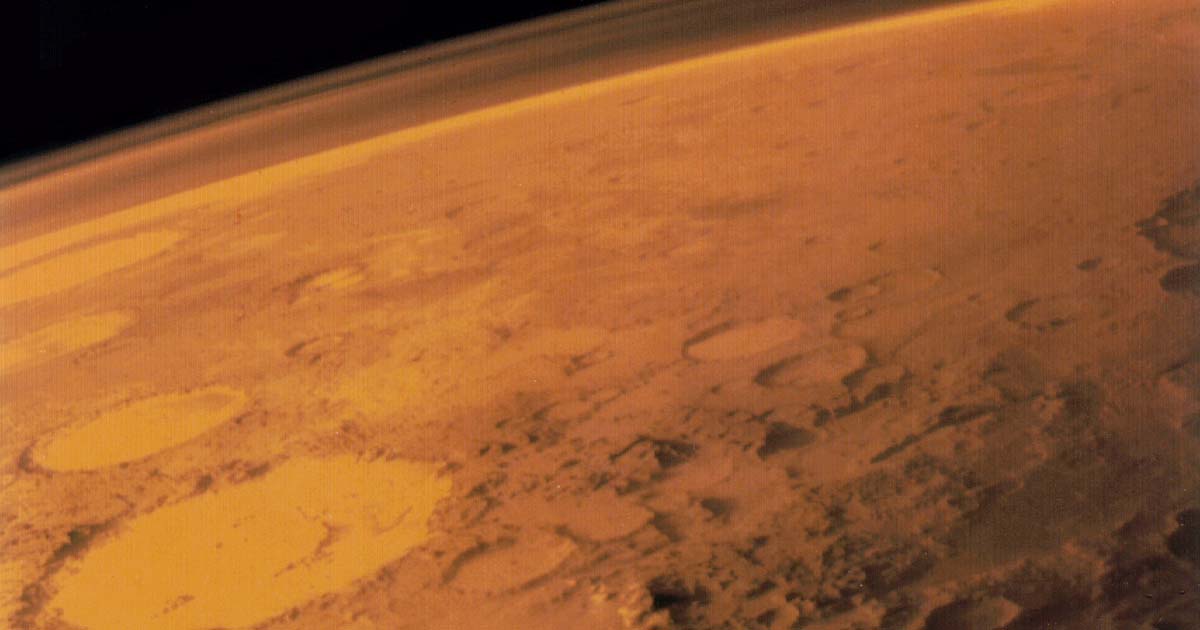
The thin remnant atmosphere that currently covers the red planet. Researchers at MIT have now found out what happened to the carbon dioxide atmosphere that once covered Mars. Source: NASA / Public Domain.
Archaeology & Discoveries

Mars Mystery Solved? MIT May Have Found Its Lost Atmosphere

Allthathistory October 23, 2024

Mars has fascinated mankind for much of its history. Unusually and distinctively red even when viewed with the naked eye, it was watched as it traced its unusual path across the sky by the great lost civilizations of old.

Both the ancient Egyptians and ancient Chinese have records of Mars in their astronomical notes. The Babylonians calculated how to predict where it would be in the sky, and the Greeks tied themselves in knots trying to explain how it moved if (as was obvious to them) the Earth was at the center of the universe.

Our understanding of the planet only became sharper when Galileo Galilei first pointed a telescope at Mars in 1610, uncovering a wealth of strange and unexplained features on the surface. Chief among these features are probably the Martian “canals” which were thought to be artificial: for much of our recent past we believed with sincerity that there was life out there, another alien intellect looking back at us.

  • Searching for the Lost Treasure of Alaric the Visigoth
  • The Cadaver Synod, when a Dead Pope Stood Trial

But now we are fairly sure that Mars is a dead planet, at least on the surface. What little atmosphere it has is thin and unable to sustain life as we know it, and our repeated robotic trips there have so far only confirmed this assessment.

Read moreThe Cave of Hebron: Tomb of the Patriarchs?

But in this we face a mystery. There is plenty of evidence in the geology that Mars was not always this cold and dead: there was once running water on the surface and a dense carbon dioxide atmosphere.

Something happened around 3.5 billion years ago which caused the atmosphere to disappear and the water to dry up. And, in a new paper published last month in Science Advances, researchers think they have found the solution to where this atmosphere went.

In the paper, MIT scientists modelled the effect of water reacting chemically with the surface geology, specifically what they call “ultramafic rocks” which are abundant in the surface layer of Mars. 

These Marian surface clays formed during Mars’s early geologic period, are thought to have absorbed up to 80% of Mars’s atmospheric carbon in the process known as “abiotic methanogenesis” which essentially means “turned into methane in a process which doesn’t involve life.”

Read more3,000 Year Old Sword of a Pharoah Discovered in Egypt

This methane can be stable for millions of years, and there is increasing evidence of carbon stored in the crust which points to this being the truth. So far, so research paper, and a good question should be why anyone would get excited about a lifeless process on a dead planet.

Well, aside from the fact that we know something new about a planet millions of kilometers away and billions of years in the past, this trapped carbon may be extremely useful to anyone who wants to visit the red planet in the future. Specifically, the carbon dioxide could again be released from the methane, and used as an energy source for longer term space missions.

Put simply, this might mean that the surface of Mars is, through a geological process a billion years in the making, covered in a fuel source for our interplanetary craft. Mars could become a staging post for subsequent missions, both within the Solar System and out into the depths of space beyond.

There are other, loftier possibilities offered by this research as well. Such trapped carbon could be extremely useful for any attempts to terraform the planet and transform Mars into a planet with a breathable atmosphere. And while such dreams are firmly in the realms of fiction at this point, it seems that another piece of the puzzle may just have fallen into place.

Header Image: The thin remnant atmosphere that currently covers the red planet. Researchers at MIT have now found out what happened to the carbon dioxide atmosphere that once covered Mars. Source: NASA / Public Domain.

You may also like

Ancient Rock Carvings Uncovered in Ecuador Point to Shared Amazonian Cultural Traditions

Stolen Hercules Fresco Finds Its Home After Decades in U.S. Collection

Ancient Rock Art in Texas-Mexico Borderlands Endured 4,000 Years

Were Wolves Kept and Nursed by Ancient Seal Hunters?

Ancient Peruvians Survived Climate Catastrophe Through Adaptation, Not War

Peru’s Mysterious “Band of Holes” May Have Been Ancient Marketplace and Accounting System

Allthathistory
Written by Allthathistory

Tags: carbon dioxide, MIT, NASA, planet, space, United States

Leave a Reply Cancel reply

Your email address will not be published. Required fields are marked *

  • Ancient Rock Carvings Uncovered in Ecuador Point to Shared Amazonian Cultural Traditions
    Archaeologists have identified a panel containing approximately 30 ancient rock carvings in Santiago de Méndez canton, Morona Santiago province, marking
  • Stolen Hercules Fresco Finds Its Home After Decades in U.S. Collection
    Archaeologists at Pompeii have identified the original location of a looted fresco fragment depicting the infant Hercules strangling serpents, solving
  • Maya Medical Systems Used Living Organisms as Precision Surgical Tools
    Maya medical systems deployed living organisms as precision surgical tools centuries before germ theory existed. Recent archaeological evidence shows these
  • Ancient Rock Art in Texas-Mexico Borderlands Endured 4,000 Years
    Hunter-gatherers in what is now southwestern Texas and northern Mexico created rock art for more than 4,000 years, maintaining consistent
  • The Thermal Engineering Behind Tiwanaku’s Agricultural Success
    At nearly 3,850 meters above sea level, frost arrives almost nightly on Bolivia’s Altiplano. Modern visitors struggle to breathe. Yet
The Gnostic Gospels
Encounters at the Heart of the World: A History of the Mandan People
Substack Articles

Latest from AllThatHistory Weekly

The Silk Road’s Forgotten Travelers: Women, Merchants, and Diplomats History Ignored

The Silk Road’s Forgotten Travelers: Women, Merchants, and Diplomats History Ignored

The standard image of the Silk Road is male adventurers hauling silk and spices across deserts. New DNA and isotope analysis of Central Asian cemeteries is telling a different story: women traveled these routes in comparable numbers to men, traded independently, wrote letters from foreign cities, and served as diplomatic intermediaries between empires. A 1,700 year old letter from a…

Read More →
Did Aliens Build the Pyramids?

Did Aliens Build the Pyramids?

At 481 feet tall and built from roughly 2.3 million stone blocks, some weighing 80 tons, the Great Pyramid held the record as the tallest structure on Earth for nearly 4,000 years.

Read More →
The Phaistos Disk: The Undeciphered Message Nobody Can Agree On

The Phaistos Disk: The Undeciphered Message Nobody Can Agree On

In 1908, an Italian archaeologist named Luigi Pernier was excavating the Bronze Age palace of Phaistos on the island of Crete when he found something that has baffled researchers ever since.

Read More →
Why Did the Bronze Age Collapse? The Theory That Changes Everything

Why Did the Bronze Age Collapse? The Theory That Changes Everything

Around 1200 BCE, nearly every civilization in the Mediterranean collapsed within a generation. The Sea Peoples get the blame but new research points to something more interesting, and more unsettling.

Read More →
What Sank to the Bottom of a Swiss Lake 2,000 Years Ago

What Sank to the Bottom of a Swiss Lake 2,000 Years Ago

A Roman cargo just came up from the bottom of a Swiss lake. Plates stacked exactly as they were loaded 2,000 years ago. Two gladii, one still in its scabbard. Spanish olive oil. The ship is gone but the cargo is intact. This one is extraordinary.

Read More →
He Was Attacked by a Lion 6,200 Years Ago. His Community Kept Him Alive.

He Was Attacked by a Lion 6,200 Years Ago. His Community Kept Him Alive.

Near the Black Sea coast of eastern Bulgaria, in a Late Eneolithic cemetery known as Kozareva Mogila, or Goat Mound, archaeologists excavated a burial that has taken years to fully understand.

Read More →
❮
❯

Subscribe to receive our newest archaeology articles, long-form investigations, and historical insights directly in your inbox.

© Copyright AllThatHistory - 2025