
Maya Astronomers Predicted Solar Eclipses 700 Years in Advance Without Telescopes
New research has decoded how Maya astronomers forecasted solar eclipses with remarkable precision more than a millennium ago, revealing a self-correcting system that maintained accuracy across multiple generations. The study, published in Science Advances by John Justeson from the University at Albany and Justin Lowry from SUNY, analyzes the eclipse table in the Dresden Codex, a 12th-century manuscript that preserves centuries of astronomical knowledge.
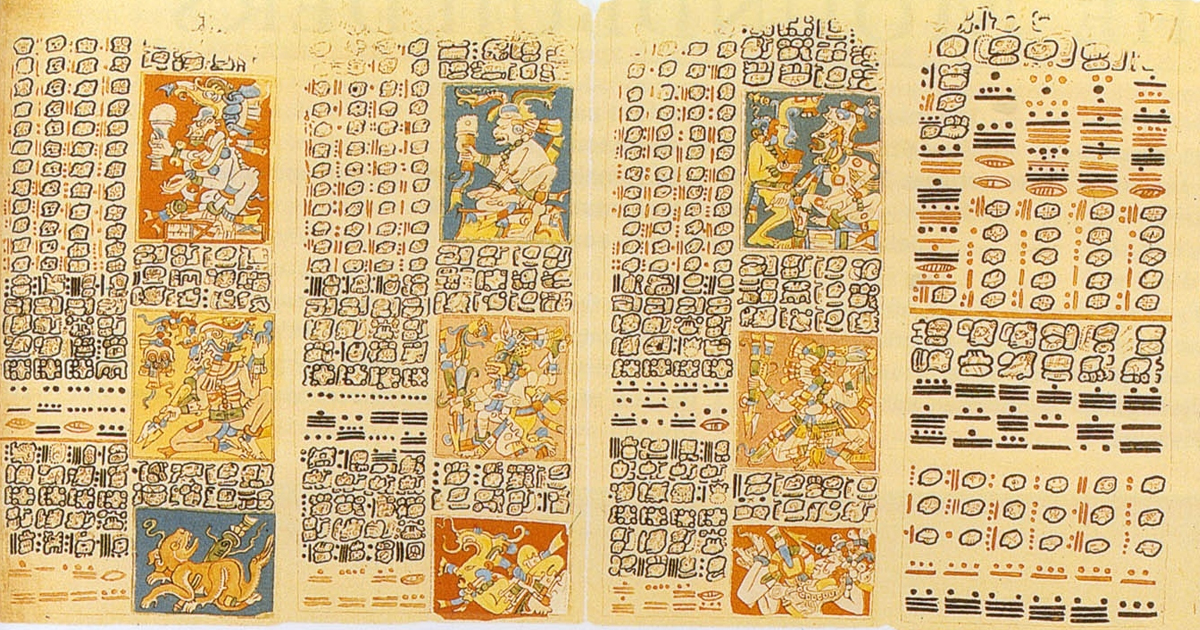
The Dresden Codex stands as one of only a few surviving pre-Columbian American books. Its eclipse table spans 405 lunar months, containing 69 stations marking new moons, moments when the sun could potentially be obscured. Scholars had long assumed this 405-month cycle was designed exclusively for eclipse prediction. The new analysis overturns that interpretation entirely.


Justeson and Lowry determined the table originated as a lunar calendar, later adapted to track solar eclipses by synchronizing it with the Maya 260-day ritual calendar used for divination and prophecy. Mathematical modeling revealed that the table’s 11,960-day duration matches exactly 46 cycles of the 260-day calendar. This alignment enabled Maya daykeepers to predict when eclipses would coincide with specific ritual dates, merging scientific observation with spiritual practice.
The 405-month span correlates almost perfectly with the lunar cycle, missing the true lunar average by merely 0.11 days. Within the table, 44 months fall just one day short of five cycles of 260 days, 88 months miss ten cycles by a single day, and the 405th month lands precisely on the 46th ritual cycle. These numerical relationships would have allowed priests and astronomers to anticipate lunar phases and eclipses with minimal calculation.
Most stations in the eight-page table are spaced six lunar months apart, roughly 177 days. The interval required for the moon to return to the same alignment with Earth and sun. Occasionally the sequence jumps 11 or 17 months, small adjustments that compensated for variations in the moon’s orbital behavior. These modifications kept predictions aligned with the lunar nodes where eclipses occur.
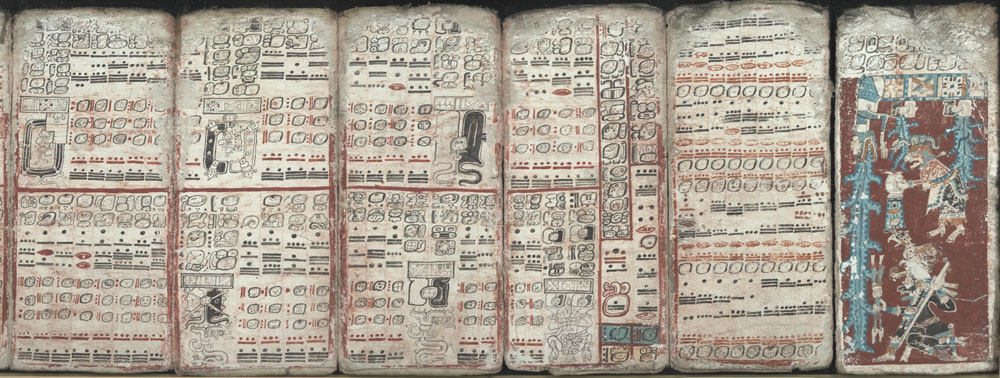
Pages from the Dresden Codex illustrating eclipses, mathematical tables, and the great flood. (Public Domain)
Earlier theories suggested Maya astronomers simply restarted the table when it reached completion. The researchers discovered something far more sophisticated. Maya daykeepers reset their tables at intervals of 223 or 358 lunar months, periods corresponding to what modern astronomy calls the saros and inex eclipse cycles. These strategic reset points corrected tiny discrepancies that accumulated over time.
By combining four resets at 358 months for every one at 223 months, Maya astronomers created a master cycle of 1,655 lunar months, or approximately 48,873 days. This system anticipated every solar eclipse visible in the Maya region between 350 and 1150 CE. When researchers compared the codex data against modern databases of historical eclipses, the alignment proved strikingly accurate.
The 358-month reset fell at the midpoint of a seven-station cycle, while the 223-month reset provided correction when the system began drifting. This design never required complete overhaul. Following these measured intervals, Maya astronomers could forecast centuries of eclipses without losing accuracy, an achievement unmatched in the premodern world.
Historical context supports the table’s practical use during the late Classic and early Postclassic periods, approximately 1083 to 1148 CE, likely in northern Yucatán. Each cycle recorded in the Dresden Codex begins and ends with eclipses actually visible in Maya territory, confirming the system was both observationally grounded and mathematically sound.
Maya lunar observations date back to at least 361 CE. Within a century, daykeepers would have accumulated sufficient data to calibrate a predictive table. By 550 CE, the foundation of this system was likely established. The sophistication didn’t emerge overnight but developed through generations of careful sky-watching and pattern recognition.
To the Maya, eclipses carried profound meaning, cosmic events signaling divine displeasure or renewal, moments when the sun’s light was devoured. Yet beneath these mythological interpretations lay rigorous data collection and mathematical reasoning comparable to ancient Babylon or Greece. The study notes that if continuously updated following Maya methods, the Dresden Codex system could still predict eclipses over Mexico today.
This research repositions Maya civilization not as mystics guessing at celestial patterns but as careful scientists refining their craft through sustained observation. Their ability to chart lunar cycles and anticipate eclipses demonstrates a sophisticated understanding of motion and time, accomplished without telescopes, metal instruments, or written algebraic formulas. Each entry in the Dresden Codex represents mathematical ingenuity and a civilization’s determination to harmonize celestial events with sacred calendars.
Featured image: First publication in 1810 by Humboldt. (Public domain)


Leave a Reply