
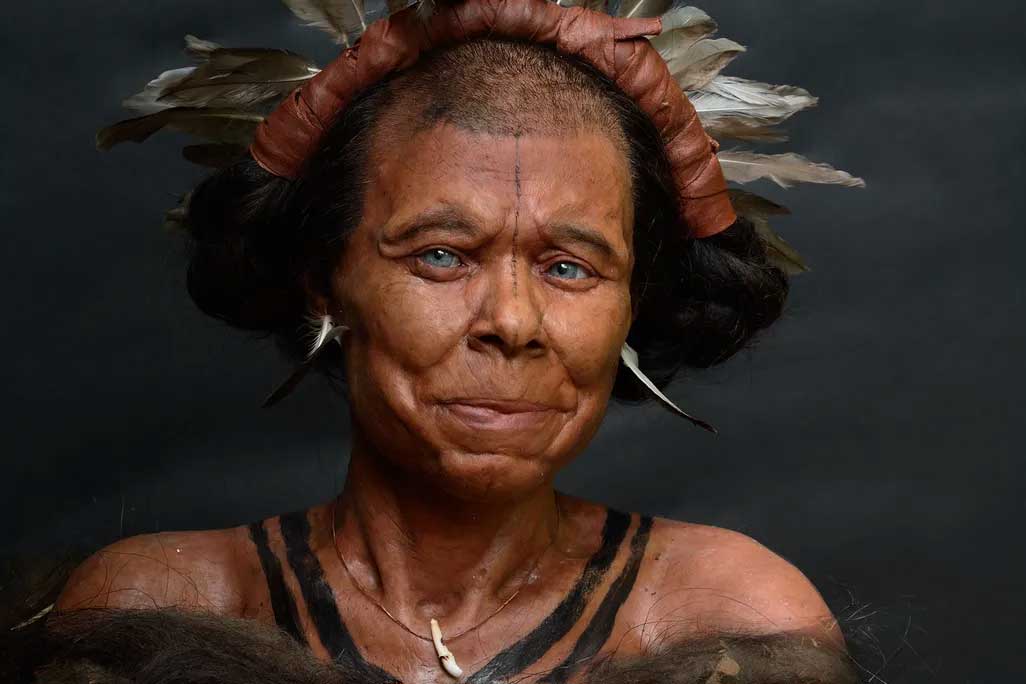
Scientists Reconstruct Blue-Eyed Hunter-Gatherer Who Lived 10,500 Years Ago
A woman’s remains discovered decades ago in a Belgian cave have finally received a face, a name, and recognition for challenging what researchers thought they knew about ancient Europeans. Mos’anne lived roughly 10,500 years ago along the Meuse River, hunting and gathering during a time when ice sheets had retreated but farming hadn’t yet arrived.
The Margaux Cave near Dinant yielded her bones in 1988, along with remains from six to nine other adult women. Scientists working within the ROAM project have now combined bone analysis, genetic sequencing, and artistic reconstruction to bring Mos’anne back to life.
Maïté Rivollat from Ghent University spearheaded the genetic analysis that revealed surprising details about Mos’anne’s appearance. The international team includes archaeologists, bioanthropologists, and artists who study human diversity following the last Ice Age. Their work demonstrates how multiple scientific disciplines can overturn long-held assumptions about prehistoric populations.
The reconstruction process began with 3D scanning of Mos’anne’s skull. Artists then built layers of muscle, fat, and skin using demographic averages for middle-aged women. The 2011 study that first described these remains estimated her age between 35 and 60 years old. Dense petrous bone from inside her skull provided the genetic material needed for DNA extraction, since this tissue preserves ancient genetic information better than other skeletal elements.
What emerged challenged expectations about Mesolithic Europeans. “We know that she had blue eyes and an average skin color. That’s striking; until now, most finds from that time indicated darker skin,” Professor Isabelle De Groote of Ghent University explained. This combination mirrors findings from Spain, where researchers discovered a hunter-gatherer man with blue eyes who still carried genes for darker ancestral skin pigmentation.
The genetic analysis placed Mos’anne among the Western Hunter-Gatherers, the same population that includes England’s famous Cheddar Man. Rather than confirming a uniform appearance across this group, Mos’anne’s features suggest significant variation existed within these ancient communities. Her DNA reveals that skin color shifts didn’t happen uniformly across Europe, and early populations displayed more diversity than previously recognized.

Archaeological evidence fills gaps around the facial reconstruction. The Meuse Valley during Mos’anne’s lifetime supported small bands who moved seasonally between river terraces, upland forests, and temporary camps. Excavations recovered shells, pigments, stone tools, and evidence of sophisticated hunting strategies. Red ochre and charcoal frequently appear in regional burials from this period, suggesting these materials held cultural significance.
The artistic team incorporated these archaeological finds into Mos’anne’s appearance. Her reconstructed necklace features a deer tooth pierced with stone tools and strung on plant fiber, directly based on artifacts recovered from the site. Ochre-dyed leather binds her hair, while charcoal traces create simple geometric patterns on her skin. Every decorative element reflects physical evidence rather than artistic speculation.
The Margaux Cave burials reveal intriguing social patterns. All recovered remains belonged to adult women, a distribution that suggests specific cultural rules governed who received cave burial. Cut marks on one skull indicate postmortem handling, probably connected to ritual practices. Pigment traces around cranial bones show that bodies were prepared with considerable care before burial.
Burial practices hint at a community where personal adornment, symbolic behavior, and death rituals intertwined in complex ways. Distinctive sex patterning across burials signals social rules about memory and status that archaeologists are still working to understand. Evidence suggests hunter-gatherer communities possessed rich cultural traditions that went far beyond simple survival.
Genetic predictions about ancient appearance carry important limitations. Skin color results from multiple genes, dietary factors, and sunlight exposure, none of which shifted uniformly across prehistoric Europe. Statistical models used for eye, hair, and skin color predictions rely on data from living populations, and ancient genomes don’t always contain identical gene combinations or produce similar effects.
Face shape reconstructions depend on averages from modern samples matched by sex and age, while details like hairstyles and ornaments represent informed choices rather than certain facts. “Until now, the phenotypic diversity among European hunter-gatherers was only known from a small number of fossils and was thought to be fairly homogeneous,” Dr. Rivollat noted. Mos’anne’s reconstruction demonstrates that variation already existed before Near Eastern farmers spread agriculture into Western Europe.
The scientific value extends beyond creating an attractive museum display. Facial reconstructions serve as testable hypotheses that can be revised as new evidence emerges and methods improve. They transform anonymous skeletal remains into specific individuals, encouraging researchers to ask better questions about health, diet, social relationships, and daily life.
Stable isotope analysis of bone and teeth could reveal where Mos’anne grew up and what she ate throughout different seasons. These chemical signatures, combined with tool residues and pollen evidence, might place her within more precise geographical and temporal contexts. Broader sampling across the Meuse River burials could illuminate kinship patterns, social structures, and whether these women shared distinctive diets, travel routes, or health challenges that distinguished them from neighboring groups.
Museums benefit from facial reconstructions because they provide concrete ways to communicate scientific uncertainty to public audiences. Visitors can better understand how evidence, interpretation, and artistic skill combine to create these glimpses into the past. The reconstructions also serve as living documents that can be updated as archaeological and genetic techniques advance.
Mos’anne represents far more than a single prehistoric individual. Her reconstruction illustrates how modern science can recover specific human stories from fragmentary ancient remains. The project demonstrates that European hunter-gatherers possessed greater physical and cultural diversity than simple narratives suggest, and that careful interdisciplinary collaboration can challenge long-standing assumptions about the past.
The research team published their findings in the American Journal of Physical Anthropology, contributing to growing evidence that prehistoric European populations were more complex and varied than researchers previously recognized.
Featured image: A reconstruction of the environment that the Margaux woman once inhabited in what is now Belgium’s Meuse Valley region. She lived around 10,500 years ago, during the Mesolithic period. (Image credit: ©2025 Kennis en Kennis)


Leave a Reply