
Old Kingdom Tomb of Royal Chamberlain Unearthed at Saqqara
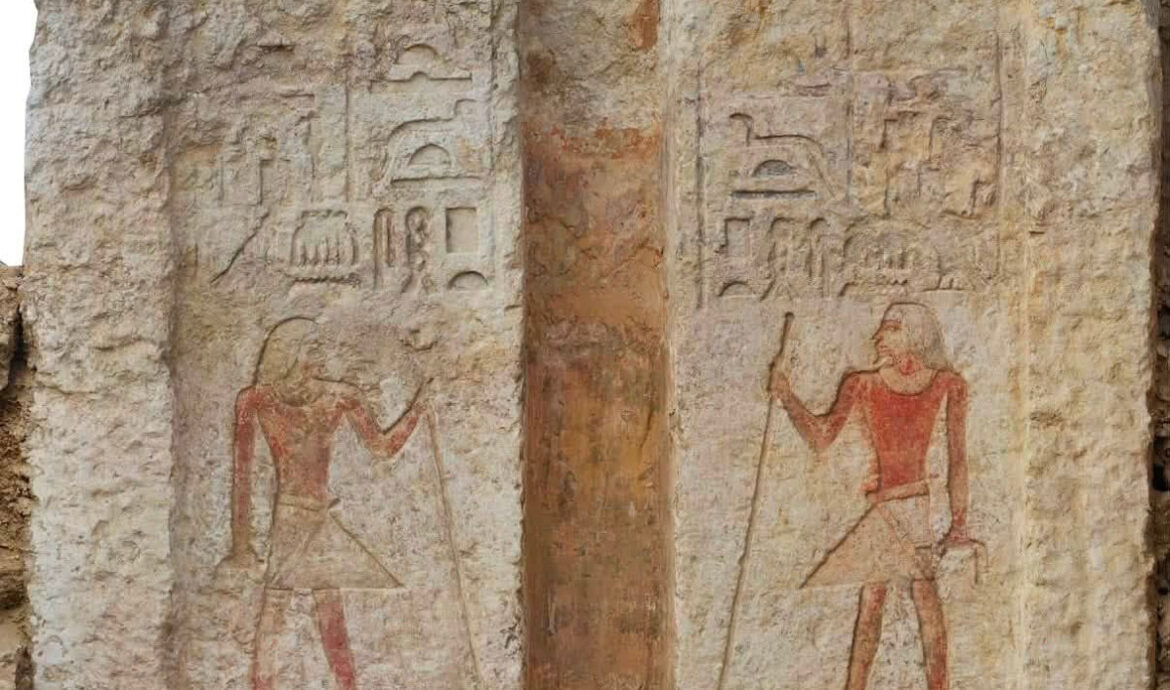
An Egyptian archaeological mission has uncovered the tomb of Sekhentio-Ptah, a high-ranking official whose titles included Royal Chamberlain, Overseer of All the Works of the King, and Keeper of the Secrets of Royal Decrees. The find was made during the mission’s first excavation season in Sector A, west of the Bubasteion Necropolis at Saqqara.
The Supreme Council of Antiquities (Ahram Online) says the tomb preserves the remains of a funerary chapel and a false door in its original position. In front of the door, archaeologists found a complete assemblage of alabaster funerary equipment: an offering table, an offering slab, a purification basin, and a basin. Hieroglyphic inscriptions on the door and objects identify the owner and record his offices.
A false door was a symbolic architectural feature in an ancient Egyptian tomb. It was understood as a threshold through which the deceased could receive offerings and interact with the world of the living. The survival of the door and ritual objects together, in their archaeological context, gives researchers a rare opportunity to study how an Old Kingdom funerary chapel was equipped and used.
The inscriptions also name Sekhentio-Ptah as Priest of the Goddess Maat and Overseer of the Scribes. Taken together, the titles point to a senior role in the royal administration. The spelling of the official’s name varies slightly across early reports; this draft follows Sekhentio-Ptah.
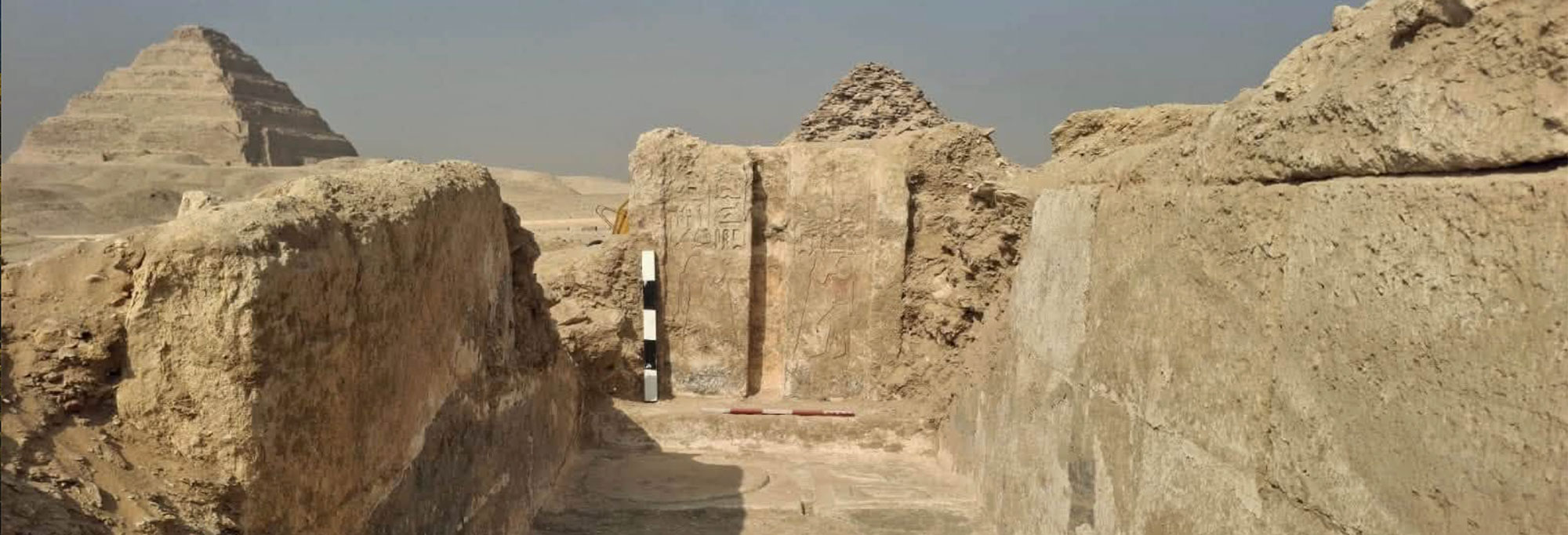
Beyond the chapel, the team uncovered an interconnected system of burial shafts containing numerous human burials. Finds from the shafts include painted funerary cartonnage, more than 100 faience ushabti figurines, pottery, a wooden falcon statue, and three stone sarcophagi described as sealed and intact in their original condition. The objects come from a burial complex that appears to have been used and reused over more than one period.
Some of the shafts show openings made by tomb robbers, suggesting that parts of the complex were looted in antiquity. This does not mean every burial or object was disturbed: the mission reported that several sarcophagi and the chapel’s ritual group survived in place. Further excavation and conservation will be needed to establish the condition and relationships of each burial.
The Archaeological Institute of America’s Archaeology Magazine (Archaeology Magazine) describes the monument as an Old Kingdom tomb, conventionally dated to about 2649–2150 B.C. Live Science (Live Science) reports that the design of the false doors may point more narrowly to the late Fifth or early Sixth Dynasty, around 4,350 years ago — that narrower date is provisional. The “4,000-year-old” wording used in some headlines is broad shorthand, not a final date.
Hisham El-Leithy, secretary-general of Egypts Supreme Council of Antiquities, said the excavation combined stratigraphic recording with architectural, photographic, and digital documentation, as well as archaeological and linguistic study. The mission is continuing its analysis.
The discovery adds a well-documented Old Kingdom official’s chapel to Saqqara’s already layered funerary landscape — the false door, inscribed equipment, and associated shafts studied as a complex shaped by royal service, ritual practice, later burial, and ancient disturbance.


Leave a Reply