Skip to content
  • Home
  • Articles
    • Archaeology & Discoveries
    • Historical Events
    • Artifacts & Treasures
    • Ancient Civilizations
    • Unexplained Phenomena
    • Mythology
  • Subscribe
© Copyright AllThatHistory - 2025
Theme by ThemeinProgress
Proudly powered by WordPress
  • Home
  • Articles
    • Archaeology & Discoveries
    • Historical Events
    • Artifacts & Treasures
    • Ancient Civilizations
    • Unexplained Phenomena
    • Mythology
  • Subscribe
AllThatHistory
  • You are here :
  • Home
  • Archaeology & Discoveries
  • Reconstructing Roman Southwark: A Monumental Fresco Discovery in London
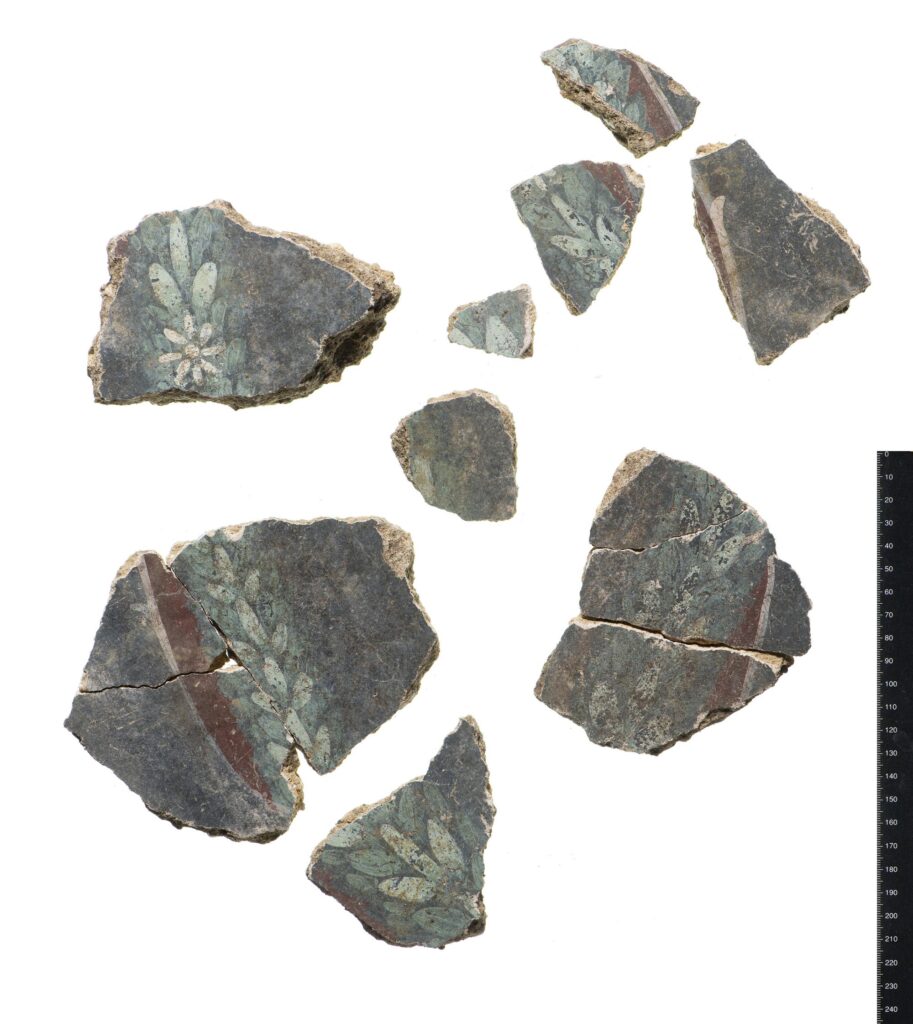
While panel designs were common during the Roman period, yellow panels were not, having only been identified at only a few sites across the country. (MOLA)
Archaeology & Discoveries

Reconstructing Roman Southwark: A Monumental Fresco Discovery in London

Allthathistory June 19, 2025

In 2021, archaeological excavations in Southwark, London, uncovered one of the most significant finds of Roman wall paintings in Britain. Conducted by the Museum of London Archaeology (MOLA) ahead of the Liberty of Southwark development, the discovery revealed thousands of plaster fragments from a high-status Roman building, demolished before AD 200. These fragments, painstakingly reassembled by Senior Building Material Specialist Han Li, form one of the largest collections of Roman frescoes ever found in London.

The excavation, part of a collaborative project with Landsec, Transport for London, and Southwark Council, focused on a site near London Bridge already known for a well-preserved Roman mosaic and a rare mausoleum.

The newly discovered plaster fragments, dated between AD 40 and 150, were found in a large pit, likely discarded during the building’s demolition. This structure, possibly a wealthy residence or commercial property, featured frescoes across at least 20 internal walls, an extraordinary scale for Roman London.
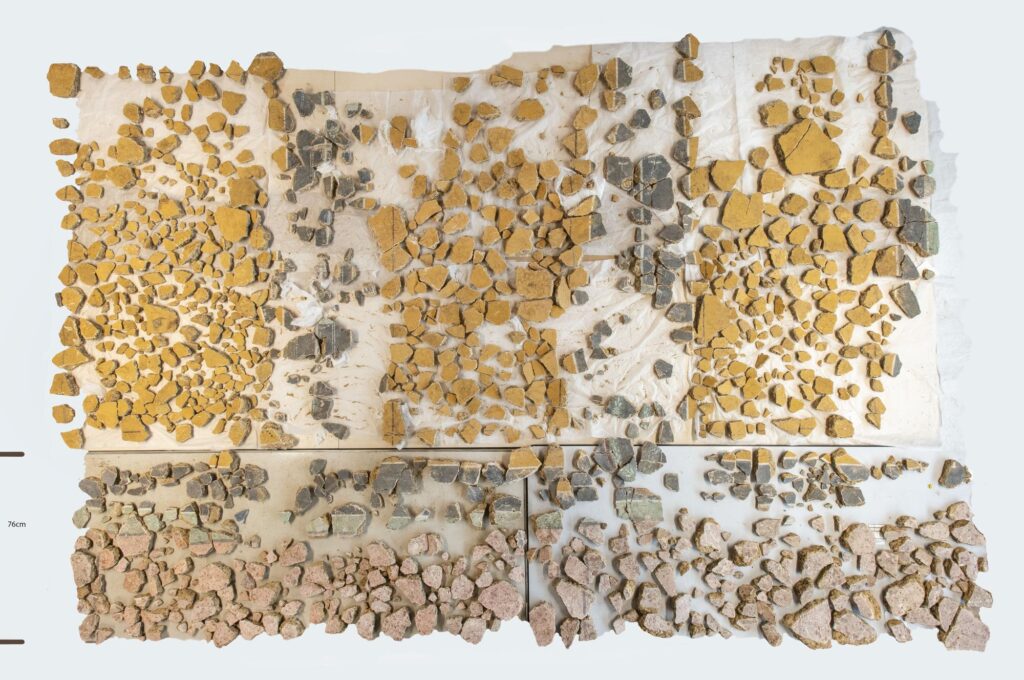
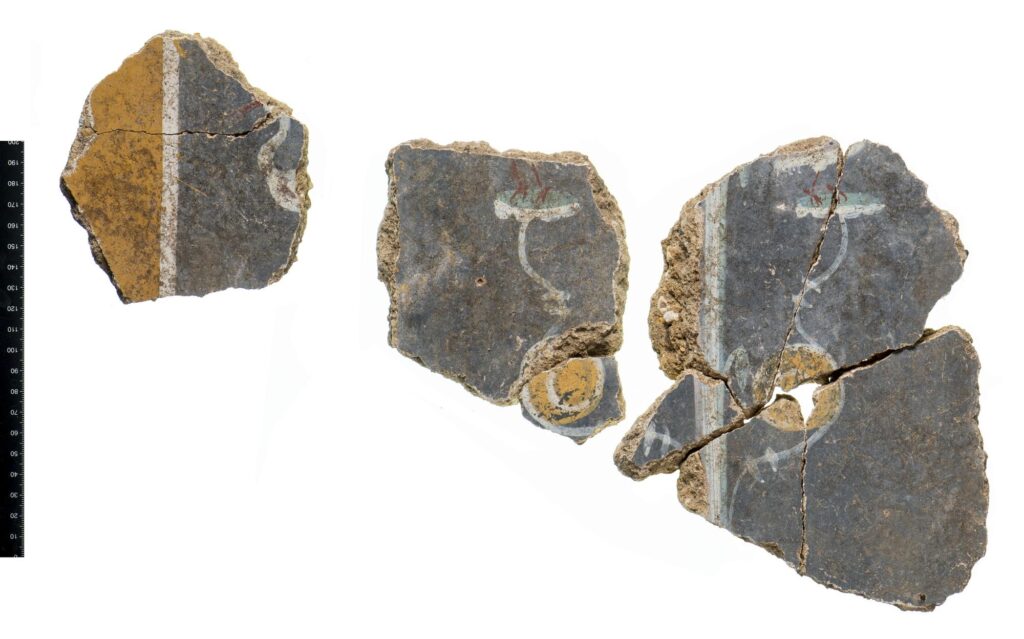
Han Li led the meticulous task of sorting and reconstructing the fragments, a process he described as uniquely challenging due to their fragility and intermingled state. Over three months, with input from specialists like Ian Betts and the British School at Rome, patterns emerged: vivid yellow panels with black borders, depicting birds, fruits, and lyres—stringed instruments associated with Roman elite culture. These designs, rare in Britain, align with those at Fishbourne Roman Palace and sites in Pompeii, Colchester, and Roman Germany, suggesting a sophisticated aesthetic influenced by the broader Roman world.

Artistic and Cultural Insights

Read moreThe Cave of Hebron: Tomb of the Patriarchs?

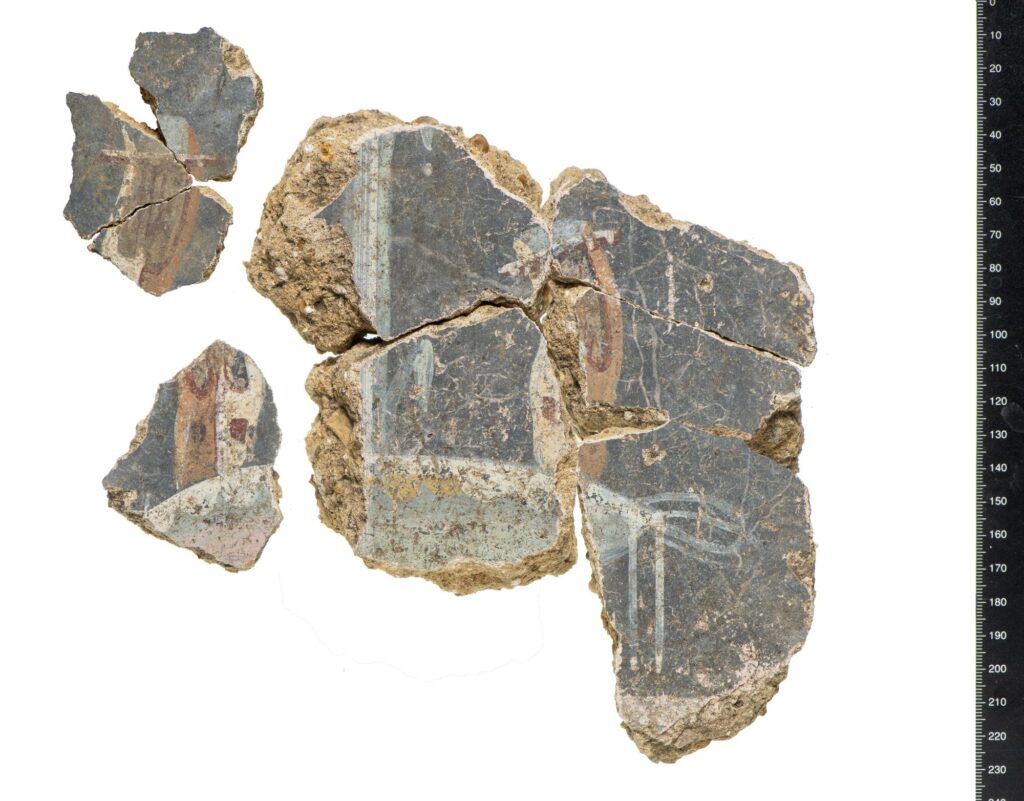
The frescoes reveal a deliberate display of wealth and status. Some fragments imitate luxurious materials, such as red Egyptian porphyry and yellow African giallo antico marble, a decorative choice seen in high-status sites across the Roman Empire. The yellow panel scheme, uncommon in Britain, underscores the building’s prestige, drawing parallels with elite residences like Fishbourne. A particularly remarkable find is a tabula ansata—a decorative tablet—bearing the Latin word Fecit (“has made this”), marking the first known artist’s signature in Roman Britain. Unfortunately, the fragment breaks where the painter’s name would appear, leaving their identity unknown.
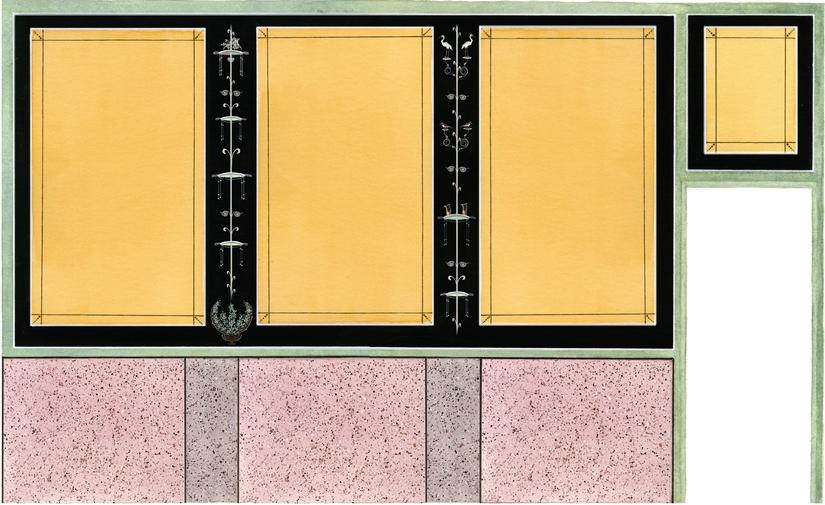
Reconstruction painting of the wall plaster, Faith Vardy (MOLA)

Graffiti on the plaster provides further insight into the building’s use. A near-complete Greek alphabet, the only such example from Roman Britain, suggests a practical function, possibly as a tally or reference for commercial activities. The precise lettering indicates a skilled scribe, potentially linked to trade, as the building may have served as a hub for storing or distributing goods shipped to Londinium. Other graffiti includes a depiction of a woman with a Flavian-era hairstyle (AD 69–96) and what appears to be tears, alongside a painter’s guideline for an unpainted petalled flower, suggesting an abandoned design.

Southwark’s Role in Roman Londinium

This discovery reframes Southwark’s significance in Roman Londinium. Established in AD 43, Londinium was a burgeoning trade center, and Southwark, south of the Thames, served as a vibrant suburb. The frescoes’ cosmopolitan style, echoing designs from Xanten, Cologne, and Lyon, highlights Southwark’s integration into the Roman Empire’s cultural network. The building’s early demolition raises questions about urban development in Roman London—possibly reflecting economic shifts or redevelopment pressures.

MOLA’s ongoing analysis, including comparisons with frescoes from Britain and beyond, aims to clarify the building’s function and the circumstances of its destruction. The fragments will be archived for future study, with plans for public display to share this find with a wider audience.

Read more3,000 Year Old Sword of a Pharoah Discovered in Egypt

Header Image: While panel designs were common during the Roman period, yellow panels were not, having only been identified at only a few sites across the country. (MOLA)

Source

The World’s Most Difficult Jigsaw Puzzle: A Once in a Lifetime Discovery from Roman Southwark – [https://www.mola.org.uk/discoveries/news/worlds-most-difficult-jigsaw-puzzle-once-lifetime-discovery-roman-southwark]: MOLA’s press release on the fresco discovery and excavation details.
You may also like

Ancient Rock Carvings Uncovered in Ecuador Point to Shared Amazonian Cultural Traditions

Stolen Hercules Fresco Finds Its Home After Decades in U.S. Collection

Maya Medical Systems Used Living Organisms as Precision Surgical Tools

Ancient Rock Art in Texas-Mexico Borderlands Endured 4,000 Years

Were Wolves Kept and Nursed by Ancient Seal Hunters?

Ancient Peruvians Survived Climate Catastrophe Through Adaptation, Not War

Allthathistory
Written by Allthathistory

Tags: ancient art, archaeology, Londinium, MOLA, Roman Britain, Roman frescoes, Southwark

Leave a Reply Cancel reply

Your email address will not be published. Required fields are marked *

  • Ancient Rock Carvings Uncovered in Ecuador Point to Shared Amazonian Cultural Traditions
    Archaeologists have identified a panel containing approximately 30 ancient rock carvings in Santiago de Méndez canton, Morona Santiago province, marking
  • Stolen Hercules Fresco Finds Its Home After Decades in U.S. Collection
    Archaeologists at Pompeii have identified the original location of a looted fresco fragment depicting the infant Hercules strangling serpents, solving
  • Maya Medical Systems Used Living Organisms as Precision Surgical Tools
    Maya medical systems deployed living organisms as precision surgical tools centuries before germ theory existed. Recent archaeological evidence shows these
  • Ancient Rock Art in Texas-Mexico Borderlands Endured 4,000 Years
    Hunter-gatherers in what is now southwestern Texas and northern Mexico created rock art for more than 4,000 years, maintaining consistent
  • The Thermal Engineering Behind Tiwanaku’s Agricultural Success
    At nearly 3,850 meters above sea level, frost arrives almost nightly on Bolivia’s Altiplano. Modern visitors struggle to breathe. Yet
The Gnostic Gospels
Encounters at the Heart of the World: A History of the Mandan People
Substack Articles

Latest from AllThatHistory Weekly

A Fragment of the Iliad Found Inside a Mummy Rethinks How Greeks Were Used in Egyptian Burial Magic

A Fragment of the Iliad Found Inside a Mummy Rethinks How Greeks Were Used in Egyptian Burial Magic

A papyrus piece of Homer's Iliad discovered inside a Saqqara mummy reveals how ancient Greeks were used in Egyptian funerary magic.

Read More →
Troy Was Real. Here Is What the Archaeology Actually Shows.

Troy Was Real. Here Is What the Archaeology Actually Shows.

The debate over whether the Trojan War happened has run for centuries.

Read More →
550-Million-Year-Old Soft-Bodied Sponge Fossil Fills Critical Gap in Animal Evolutionary Record

550-Million-Year-Old Soft-Bodied Sponge Fossil Fills Critical Gap in Animal Evolutionary Record

A Precambrian sponge lacking hard skeletal structures suggests the 'missing years' of early animal evolution reflect a preservation gap, not an absence of life.

Read More →
What Sank to the Bottom of a Swiss Lake 2,000 Years Ago

What Sank to the Bottom of a Swiss Lake 2,000 Years Ago

In November 2024, the Cantonal Office of Archaeology of Neuchatel was conducting routine aerial monitoring of the lakebed when a photograph revealed something that did not belong there.

Read More →
13,000 Years Ago, Someone Painted a Bison in the Dark. We Just Found Out When.

13,000 Years Ago, Someone Painted a Bison in the Dark. We Just Found Out When.

The Font-de-Gaume cave sits in a limestone hillside near the town of Les Eyzies in the Dordogne region of southwestern France.

Read More →
The War Horn That Made Roman Soldiers Flinch

The War Horn That Made Roman Soldiers Flinch

In the summer of 2025, during a routine archaeological excavation ahead of a housing development in West Norfolk, England, a construction site turned up something unexpected.

Read More →
❮
❯

Subscribe to receive our newest archaeology articles, long-form investigations, and historical insights directly in your inbox.

© Copyright AllThatHistory - 2025