Skip to content
  • Home
  • Articles
    • Archaeology & Discoveries
    • Historical Events
    • Artifacts & Treasures
    • Ancient Civilizations
    • Unexplained Phenomena
    • Mythology
  • Subscribe
© Copyright AllThatHistory - 2025
Theme by ThemeinProgress
Proudly powered by WordPress
  • Home
  • Articles
    • Archaeology & Discoveries
    • Historical Events
    • Artifacts & Treasures
    • Ancient Civilizations
    • Unexplained Phenomena
    • Mythology
  • Subscribe
AllThatHistory
  • You are here :
  • Home
  • Archaeology & Discoveries
  • Prado Vargas Neanderthal Camp Expands to 140 m² at Ojo Guareña
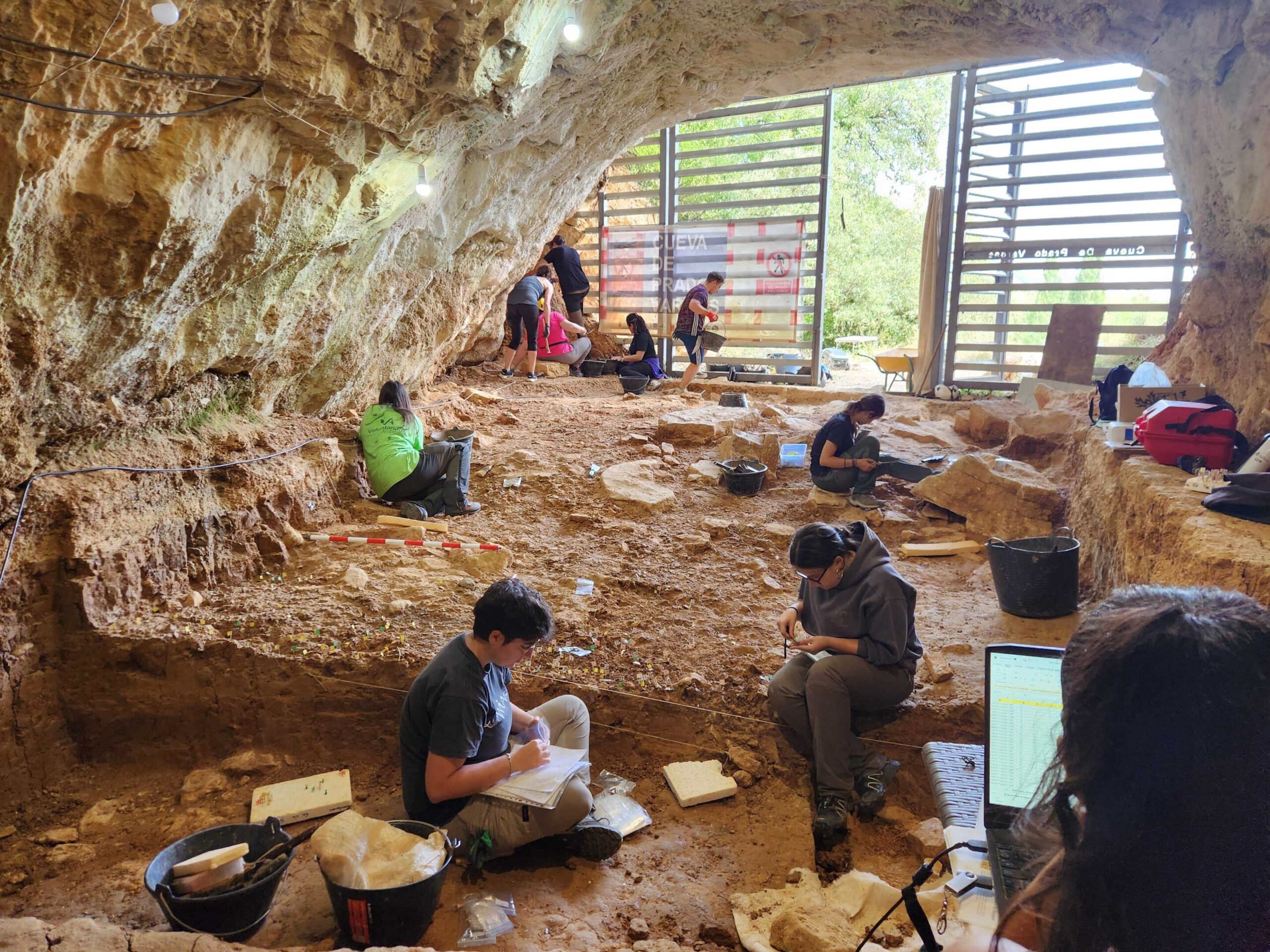
Archaeologists excavating Neanderthal sublevel 4D at Prado Vargas Cave, Ojo Guareña, Burgos
Archaeology & Discoveries

Prado Vargas Neanderthal Camp Expands to 140 m² at Ojo Guareña

Allthathistory September 8, 2026

The Prado Vargas Neanderthal camp in Cornejo, northern Burgos—part of the vast Ojo Guareña karst—has become one of the most extensively excavated Neanderthal cave occupations known. The eleventh systematic campaign ended on 23 August 2026. Co-directors Alfonso Benito Calvo (CENIEH), Marta Navazo (University of Burgos), and Rodrigo Alonso (Museum of Human Evolution) led roughly twenty archaeologists and students working at the cave entrance.

After finishing the younger Upper Palaeolithic sublevels (4A–AB), the team opened another 32 m² of Neanderthal sublevel 4D, bringing the total exposed area to 140 m². Spanish and international coverage, including Provisional dating: Sublevel 4D carries a mean age of about 46,000 years (~46 kya)—a working mean from ongoing research, not a single sealed calendar date. A fireplace found in 2025 in the Upper Palaeolithic sequence has a preliminary age of about 35,000 years; that figure remains provisional pending further study of associated materials.

Among the season’s standout finds are additional bone retouchers—fragments of large mammal long bones used to refresh stone edges. Together with earlier campaigns they now total around 100 at the site, making Prado Vargas a key locality for studying how Neanderthals maintained stone toolkits. Taken with the dense debris field and repeated butcher marks, the pattern supports a large seasonal camp used mainly from spring through late autumn across multiple generations, rather than a fleeting hunting stopover.

Community outreach ran in parallel: about fifty volunteers washed roughly half a tonne of sediment on the Trema River (10–14 August), recovering microfauna such as voles useful for Late Pleistocene climate reconstruction, and an open day on 22 August drew 72 local visitors. Co-directors also presented the latest results on 11 August in Puente Viesgo’s Prehistory lecture series. Further Spanish context appears in El Correo de Burgos.
View of work at the Prado Vargas Neanderthal camp in Burgos, Spain
Fieldwork at Prado Vargas Cave in the Ojo Guareña system. Credit: CENIEH, via Knowridge. Source
Read moreThe Cave of Hebron: Tomb of the Patriarchs?

Supporters named by the excavators include the Burgos Provincial Council, Merindad de Sotoscueva Town Council, the Junta de Castilla y León culture ministry, Fundación Palarq, the Ojo Guareña Natural Monument visitor centre, and local partners at Cornejo and Quisicedo. For readers following Iberian Middle Palaeolithic research, the Prado Vargas Neanderthal camp now offers an unusually broad spatial window on how Neanderthal groups organized a long-used home base deep in Burgos’ Ojo Guareña system.

The same 2026 season closed excavation of the Upper Palaeolithic layers linked to early Homo sapiens in inland Iberia. Studying finds around the ~35 kya fireplace should clarify how modern humans later used Ojo Guareña and the Trema valley after Neanderthal occupation ended—confirming that Prado Vargas sheltered both groups at different times. Field crews came chiefly from the universities of Burgos, Cantabria, and Complutense Madrid, with participants from Austral University of Chile and Chile’s Natural History Museum.

This season alone yielded more than 1,500 animal remains and stone artefacts. Faunal bones and teeth include wild boar, horse, steppe bison, aurochs, fallow deer, and red deer. Many show cut marks and percussion stigmata on limb bones—clear evidence that Neanderthals butchered carcasses inside the cave and opened long bones for marrow. Lithics are dominated by flint (~95%), with quartzite and quartz pebbles making up the rest. Simple sharp flakes predominate, alongside scrapers, notches, and denticulates.

=”_blank” rel=”noopener”>phys.org, Knowridge, and Diario de Castilla y León, frame that footprint as among the largest Neanderthal cave surfaces excavated worldwide.
You may also like

Ireland Ice Age Cave Art May Rewrite the Island’s First Human Story

Old Kingdom Tomb of Royal Chamberlain Unearthed at Saqqara

Stone Age burial with 42-tooth necklace found near Żórawina, Poland

Roman private bath found inside palace tower at Vrelo–Šarkamen

Ancient Rock Carvings Uncovered in Ecuador Point to Shared Amazonian Cultural Traditions

Stolen Hercules Fresco Finds Its Home After Decades in U.S. Collection

Allthathistory
Written by Allthathistory

Tags: neanderthal, Ojo Guareña, Prado Vargas, Spain

Leave a Reply Cancel reply

Your email address will not be published. Required fields are marked *

  • Prado Vargas Neanderthal Camp Expands to 140 m² at Ojo Guareña
    The Prado Vargas Neanderthal camp in Cornejo, northern Burgos—part of the vast Ojo Guareña karst—has become one of the most
  • Ireland Ice Age Cave Art May Rewrite the Island’s First Human Story
    Researchers with the Lost Land Bridge Project say they have identified prehistoric rock art in eight caves in south-west Ireland
  • Old Kingdom Tomb of Royal Chamberlain Unearthed at Saqqara
    An Egyptian archaeological mission has uncovered the tomb of Sekhentio-Ptah, a high-ranking official whose titles included Royal Chamberlain, Overseer of
  • Stone Age burial with 42-tooth necklace found near Żórawina, Poland
    Archaeologists digging a Roman-period cemetery near Żórawina in southwestern Poland have uncovered a much older burial: an adult man laid
  • Roman private bath found inside palace tower at Vrelo–Šarkamen
    Archaeologists excavating the fortified imperialRoman private bath found inside palace tower at Vrelo–Šarkamen residence at Vrelo–Šarkamen in eastern Serbia have
The Gnostic Gospels
Encounters at the Heart of the World: A History of the Mandan People
Substack Articles

Latest from AllThatHistory Weekly

Is the Shroud of Turin Real, or a Medieval Forgery?

Is the Shroud of Turin Real, or a Medieval Forgery?

Lab tests and believers have been arguing over one linen cloth for almost 40 years.

Read More →
The 1957 Flu Killed 116,000 Americans, and Most People Have Never Heard of It

The 1957 Flu Killed 116,000 Americans, and Most People Have Never Heard of It

A fast vaccine response may be exactly why it disappeared from memory.

Read More →
The Inscription That Reveals How Christianity Closed Down Its Biggest Rival Religion

The Inscription That Reveals How Christianity Closed Down Its Biggest Rival Religion

A newly deciphered Aramaic text found in a Turkish desert fortress documents the exact moment one of Rome’s most popular cults was shut down for good.

Read More →
Was King Arthur a Real Person?

Was King Arthur a Real Person?

Camelot and Excalibur came centuries later. Historians are still arguing over what, if anything, came first.

Read More →
The Women Pharaohs History Keeps Forgetting

The Women Pharaohs History Keeps Forgetting

Everyone knows Hatshepsut and Cleopatra. But Egypt had other female pharaohs that history keeps glossing over including possibly the very first ruler of unified Egypt, a woman whose tomb was larger than the first pharaoh’s. The pattern of female rule appearing in succession crises, followed by deliberate erasure, runs through 3,000 years of Egyptian history.

Read More →
Three Different Human Species Were Living Side by Side, and Nobody Told the Textbooks

Three Different Human Species Were Living Side by Side, and Nobody Told the Textbooks

A small-brained cousin, early Homo sapiens, and a genetic ghost population may have shared the same landscape for tens of thousands of years.

Read More →
❮
❯

Subscribe to receive our newest archaeology articles, long-form investigations, and historical insights directly in your inbox.

© Copyright AllThatHistory - 2025