Proposed Huayang Qin mausoleum fills gap in Xianyang’s late Qin royal cemeteries
Chinese archaeologists have outlined a late Warring States Qin royal cemetery on the Xianyang plain that researchers say Huayang Qin mausoleum debates have long needed: a…

Chinese archaeologists have outlined a late Warring States Qin royal cemetery on the Xianyang plain that researchers say Huayang Qin mausoleum debates have long needed: a well-planned “double-ring” burial landscape whose scale matches monarch-rank Qin practice—and which may belong to Queen Dowager Huayang, the influential adoptive grandmother of Qin Shi Huang. The identification is a scholarly proposal, not a confirmed name on the main tomb.
In mid-to-late September 2026, the Shaanxi Academy of Archaeology results were carried by provincial and national outlets including Xinhua and summarized in English by the Global Times. The complex—named the Shangzhaoyao Qin Mausoleum (上召窑秦陵) after a former village in Weicheng District, Xianyang, Shaanxi—was first flagged in 2018 during cultural-heritage work ahead of the Xi’an Xianyang International Airport expansion. Systematic excavation and supplementary survey from 2022 clarified the cemetery’s full layout.
Archaeologists describe a nearly square funerary enclosure arranged in a nested, “回”-shaped or double-ring plan: outer and inner boundary ditches, an inner enclosure wall, a central main tomb, accessory and affiliated burials, and sacrificial pits. Global Times reporting puts the overall footprint at roughly 600 meters north–south by 580 meters east–west. Gate openings preserve traces of structured entrances and watchtower- or gate-tower foundations.
Inside the inner enclosure, on the cemetery’s north–south axis, stands a ya-shaped (亚) main tomb beneath a truncated-pyramid earthen mound about 10 meters high. Four sloping passages approach a roughly square burial chamber on the order of 56–60 meters on a side and more than 26 meters deep; including the passages, the monument stretches about 200 meters east–west and about 188.5 meters north–south, according to academy figures relayed by archaeology.wiki and Chinese press.
A royal landscape—with an open name
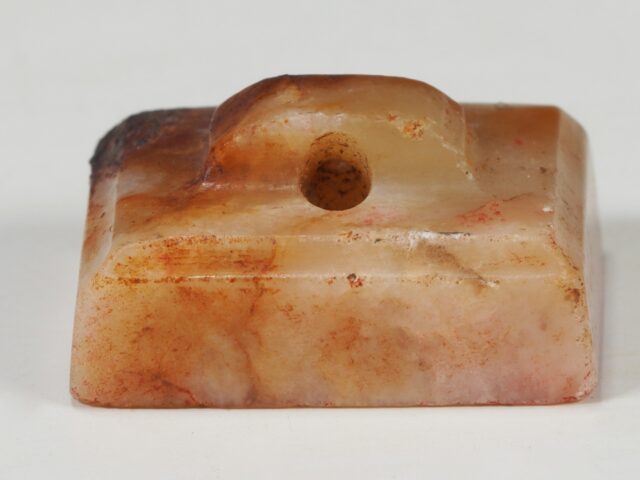
Field counts emphasize how completely the hinterland of the main tomb was organized. Researchers report 45 accessory tombs neatly arranged in the northern outer cemetery and 15 affiliated burials, five of them with chariot-and-horse pits and seven with their own ditches. Sixty-two sacrificial pits occupy the northwest sector in a standardized ritual zone; Sanqin’s account notes those pits lacked recovered physical offerings. Eight further pits cluster around the principal tomb. Excavation has yielded 258 sets or groups of finds—pottery, bronze, iron, jade, agate, glass, and other materials. Gray clay ritual and daily vessels dominate; some carry stamped workshop-style marks. A bronze ding from an affiliated tomb is inscribed with a “Song clan” (宋氏) reference.
Radiocarbon dates on human bone from the accompanying graves fall between about 389 and 208 BC. Combined with architecture and artifact typology, academy researcher Zhao Hanqing has classified Shangzhaoyao as a late Warring States cemetery of Qin monarch rank. It is the fourth such Qin mausoleum complex recognized on the wider Xianyang plain, after Zhoulingzhen, Yangjiagou (严家沟), and Sijiazhuang. Shangzhaoyao’s plan closely echoes nearby Sijiazhuang—about 2.3 kilometers to the southwest—suggesting roughly contemporary construction and a close political or kinship link between their occupants.
That pairing underpins the Huayang hypothesis. Historical sources remember Huayang, a Chu noble of the Mi clan, as the principal wife of King Xiaowen of Qin, adoptive mother of King Zhuangxiang, and adoptive grandmother of the First Emperor; tradition places her death around 230 BC and, in the Records of the Grand Historian, her burial in association with Xiaowen at Shou Mausoleum. Zhao and colleagues argue that “joint burial” need not mean a shared chamber: separate but neighboring royal gardens could fit the Sijiazhuang–Shangzhaoyao duo, with Shangzhaoyao the stronger candidate for a late Qin queen dowager—and Huayang the most likely named figure.
Even so, the academy’s own framing stays conditional. English coverage stresses that the Huayang attribution “has not been conclusively established,” and Chinese reporting likewise treats the name as inference pending further work and clearer epigraphic proof from the main burial. For archaeology readers, Shangzhaoyao’s secure contribution is the cemetery itself: a dated, double-ring Qin royal landscape that tightens the Xianyang sequence and sharpens questions about how late Qin kings and dowagers shared—or divided—the plain.