Bir El-Shaghala Pyramid Tomb: Roman-Era Burial Holds a Greek Elegy
Egypt's Bir El-Shaghala pyramid tomb, a Roman-era burial in Dakhla Oasis, held a 19-line Greek elegy, a rare Amduat scene and a coin of Constantine.

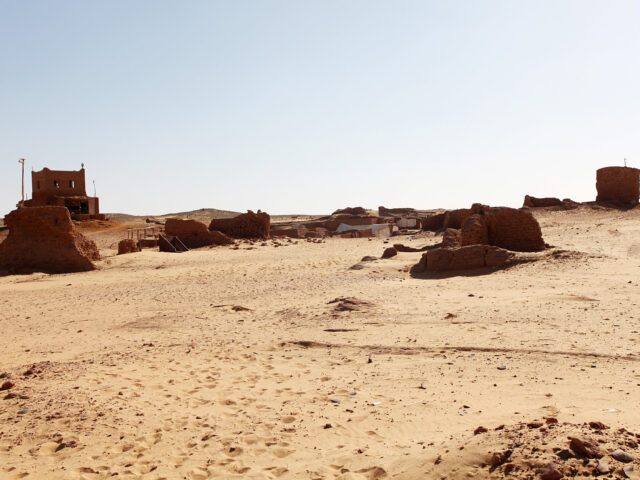
Near Mut, the capital of Egypt’s Dakhla Oasis, archaeologists have uncovered a Roman-era tomb that mixes pharaonic religion with Greek poetry. The Bir El-Shaghala pyramid tomb, announced in September 2026 by Egypt’s Ministry of Tourism and Antiquities, is a mud-brick burial with a pyramid-shaped superstructure that officials say was built for a man and his wife. Its finds include a stone stela carrying a 19-line funerary elegy in ancient Greek, a rare scene from an Egyptian book of the afterlife, and a bronze coin bearing the image of a Roman emperor named Constantine.
The excavation was carried out by an Egyptian archaeological mission of the Supreme Council of Antiquities (SCA) working at Bir El-Shaghala in the New Valley governorate; no foreign partner is named in the announcement. Details come from the ministry’s press statement as reported by Ahram Online, SEE News, and the Arabic daily Youm7. Minister Sherif Fathy said the find reflects the archaeological richness of Egypt’s oases, while SCA Secretary-General Hisham El-Leithy said its architecture and texts shed light on funerary practice and religious life in Roman-era Dakhla.
A stone doorway in the Egyptian style
According to Mohamed Abdel Badie, head of the SCA’s Egyptian Antiquities Sector, the tomb is reached by a staircase of 14 steps leading down to a sandstone entrance built in traditional Egyptian style. Its hieroglyphic inscriptions, cut in sunk relief, contain protective spells and funerary recitations. Above the door runs an Egyptian cornice decorated with a winged sun disk flanked by two cobras, followed by an architectural element shaped like a bundle of reeds. Officials call the stone entrance unique within the cemetery.
The doorway was found sealed by a stone slab bearing an Osiris-like figure surrounded by spells. Behind it lies a transverse mud-brick hall with a vaulted roof, part of which has collapsed on its western side. Two plastered mud-brick burial chambers open to the right of the hall, and the tomb’s pyramid-shaped superstructure rises above them.
The seventh hour of the Amduat
The most unusual decoration sits on the upper lintel of the entrance: a funerary scene representing the seventh hour of the Amduat. The Amduat—roughly “That Which Is in the Underworld”—is one of ancient Egypt’s books of the afterlife. It follows the sun god’s night voyage through the twelve hours of the underworld until his rebirth at dawn, a journey the dead hoped to share. In the traditional version, the seventh hour is the dangerous stage in which the chaos serpent Apophis threatens the sun god’s boat and is overcome.
Officials say this is the first time such a scene has been found in the tombs of the Bir El-Shaghala necropolis. Inscriptions on either side relate to the tomb’s two owners, whom the announcement does not name.
A Greek elegy for Pesikhtis
Sami Dardiri, head of the Central Administration for Middle Egypt Antiquities, singled out the stela. The rectangular stone slab was fixed to the southern wall of the pyramid structure; its top ends in a gable centred on a sun disk carved in raised relief. On its face, written in red ink, is a funerary elegy—a poem of mourning for the dead—composed in ancient Greek and running to 19 lines.
The poem was written for a man named Pesikhtis (Ahram Online spells the name Pisechtes). Preliminary study suggests he may have served as a judge. The text is provisionally dated to the late third or early fourth century AD, and officials present it as evidence of flourishing literary life in the oasis under Roman rule. The announcement does not state whether Pesikhtis was the man for whom the tomb was originally built.
A coin, an offering table, and signs of reuse
Mohamed Ibrahim, director-general of New Valley Antiquities, said the mission also recovered a sandstone offering table set above a sandstone purification basin, a varied group of pottery vessels, and a bronze coin bearing a relief image of the Roman emperor Constantine. Officials did not say which emperor of that name appears on the coin; Constantine the Great, the best-known, reigned from AD 306 to 337.
The tomb may also have been reused later: in its upper part, excavators found a mud-brick chapel above the main entrance, fronted by a funerary shrine with four square mud-brick columns. The announcement does not assign dates to the separate phases, so how the elegy and coin relate to the original burial remains to be clarified.
A cemetery for the elite of ancient Mothis
Bir El-Shaghala is one of the cemeteries of Mut, known in Greek as Mothis, the capital of the oasis in the Ptolemaic and Roman periods; the modern name comes from a local water well. SCA excavations there began in 2002 and have revealed tombs with open courtyards, altars for outdoor rites, and upper-level shrines topped by pyramids, their chambers mixing Egyptian afterlife imagery with Greek and Roman elements. Officials suggest the necropolis may have served the oasis capital’s elite.
Earlier research published in the Bulletin de l’Institut français d’archéologie orientale places the site about three kilometres west of Mut and documents other pyramid-topped tombs there. No scholarly publication of the new tomb or a full edition of the Greek poem has yet been announced.
Sources and further reading: SEE News; Youm7 (Arabic); Ahram Online; El Watan (Arabic); BIFAO 123 (2023), Tomb 5 at Bir el-Shaghala (site background).