Abqaa Egyptian Horse Burial: New Kingdom Fort Yields Ceremonial Steed
The Abqaa Egyptian horse burial inside a New Kingdom western Delta fortress—plus a stela of a bound Meshwesh prisoner—sheds light on frontier military life ~3,000 years ago.

Inside a New Kingdom frontier fortress on Egypt’s western Nile Delta, archaeologists have documented what ministry coverage frames as an intentional burial of a young male horse—roughly three millennia oldtogether with fittings that may belong to a chariot harness and a limestone carving of a bound Libyan captive. The Abqaa Egyptian horse burial, announced by Egypt’s Ministry of Tourism and Antiquities in mid-September, sits at Tell el-Abqain (also rendered Tell Al-Abqain or Abqaa’) in Beheira Governorate, a stronghold long tied to defending the Delta against pressure from Libyan groups to the west.
English reporting from Live Science, CBS News, Luxor Times, and Archaeology Newsroom converges on the same ministry outline. Minister Sherif Fathy cast the finds as adding depth to Egypt’s New Kingdom border fortification system; SCA Secretary-General Hisham El-Leithy stressed careful planning inside the walls, not walls alone.
A carefully placed horse—and possible harness fittings
Preliminary studies described by Mohamed Abdel Badie, head of the Egyptian Antiquities Sector, identify a complete skeleton of a young male of medium build, marked by speed and agility. Ministry briefings suggest such animals could have been used for training, other military tasks, or pulling chariots in the New Kingdom. The orderly position of the body and the orientation of the head, they argue, point to a deliberate interment—sometimes called honorific or ceremonialrather than casual disposal.
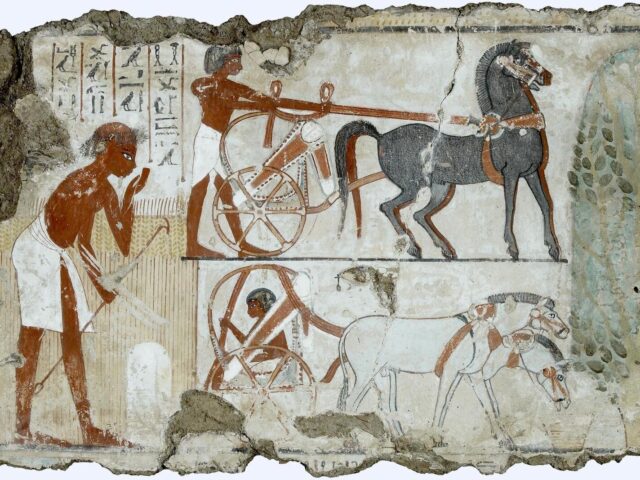
Only a short distance from the burial room, excavators recovered cylindrical pieces of alabaster and limestone thought to be decorative elements from a chariot horse’s harness. That pairing is what makes the find especially vivid for frontier military history: a valued animal carefully buried beside hardware that may have linked it to Egypt’s signature mobile platform of the age.
Independent specialists contacted by Live Science urged both excitement and caution. Lonneke Delpeut of the University of Vienna called the discovery “amazing because complete horse remains from Pharaonic Egypt are scarce, yet she advised against a firm “war horse label—Egyptology lacks an agreed definition of the term. In her view the animal was “certainly a chariot horse,” valuable enough that its careful burial makes sense. Carolyn Willekes of Mount Royal University likewise stressed how rare, well-preserved remains can illuminate one animal’s life and the wider equine–human relationship in ancient Egypt.
Streets, ovens, and wheat behind the walls
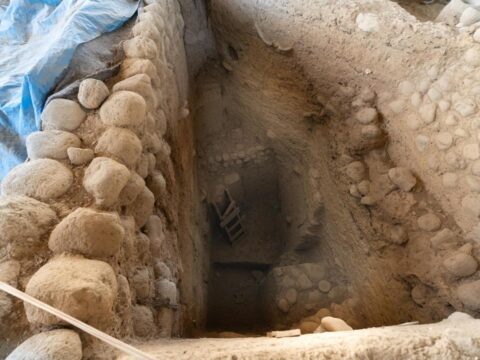
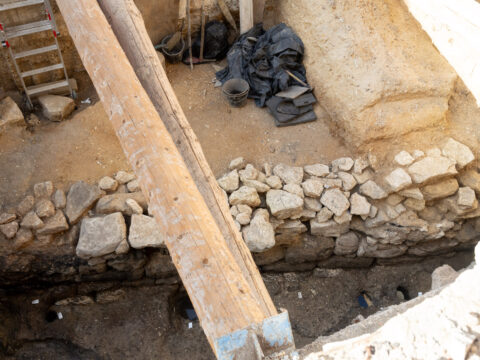
The horse did not turn up in isolation. El-Leithy’s briefings describe a large mudbrick residential complex whose northern side carries a main street about four metres wide, running east to west and crossed by a northsouth street, with a principal entrance linked to the fortresss southern limestone gate. Rooms held grain silos and cylindrical pottery ovens for food preparation. North of the main street, large jars still contained charred wheat—direct evidence of storage and provisioning. Further rooms cluster near wells in the southeastern corner, where earlier work had already recorded three stone wells bearing titles of Ramesses II.
Taken together, the architecture sketches a garrison that stored grain, baked bread, managed water, and organised streets—an everyday community wrapped inside a military shell.
Royal names and a Meshwesh prisoner
Written and pictorial finds anchor the fort in the late New Kingdom power struggle on the western frontier. For the first time in Beheira excavations, Khaled Abdel Ghani Farahat’s team reports a limestone stela fragment preserving hieratic text associated with Merneptah, comparing the king’s strength with the god Seth and also naming Ptah. Another limestone stela carries Ramesses IIs birth name, throne name, and Horus name. A separate carving shows a captive bent in submission with hands bound; clothing details identify him, according to the mission, as a Libyan prisoner of the Meshwesh—a group Egypt often fought in this period.
Scarabs naming Ramesses II and Seti I, others invoking Amun, Sekhmet, Ptah, and Seth, plus amulets shaped as fish, lotus, cobra, the nefer sign, and baboons, round out a picture of personal religion inside the fort. Pottery for storage, cooking, and oils, loom weights, grinding stones, jewellery, and even a flask linked with pilgrimage to Abydos fill in domestic and social life.
What remains secure for now is measured and still striking: about three thousand years ago, a western Delta fortress buried a young chariot-capable horse with care, kept harness-like fittings nearby, and carved the humiliation of a Meshwesh captive in stone—while its residents also baked grain, drew well water, and sought divine protection behind the same walls.