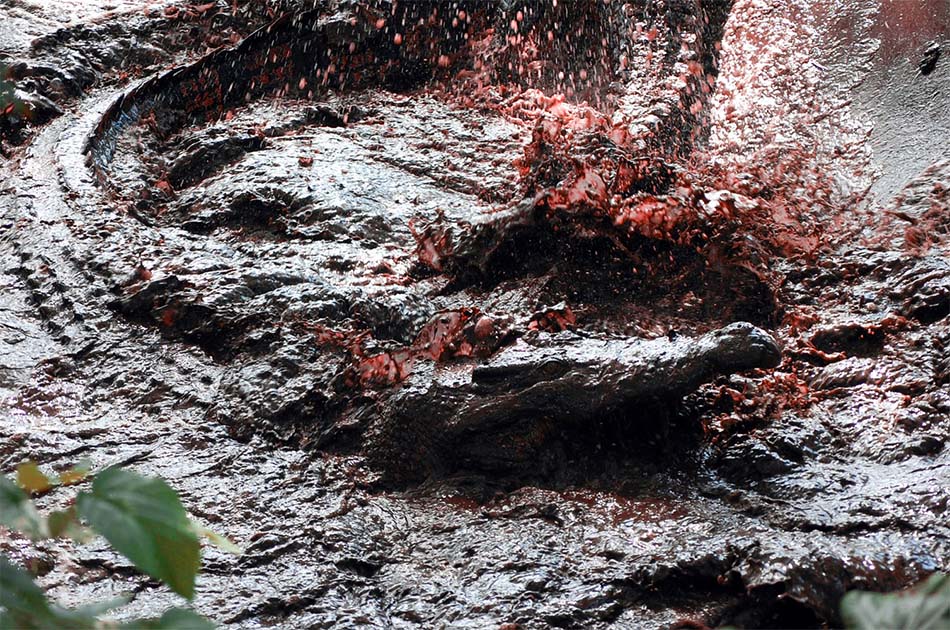
It was February 1945 in the mangrove morasses of Ramree Island along the coast of Burma. It was here where a dark page of World War II was written. When Japanese soldiers withdrew from a losing fight with Allied soldiers, they trudged into a labyrinth of mud and water that would spell doom into their lives. Turns out this muddy waterway is infested with saltwater crocodiles. The Battle of Ramree Island was a lesser battle of the Burma Campaign, and is remembered not for its implications on the battlefield but for a macabre anecdote: hundreds of Japanese soldiers reportedly were eaten by crocodiles in one evening. While this story was glamorized by the vivid prose of a Canadian naturalist, the modern legend has fascinated imaginations for decades; even though its authenticity is as murky as the wetlands themselves. This is the story of Ramree—where war, wildlife and myth meet. The Burma Campaign and Ramree’s Strategic Significance To fully comprehend the terror of Ramree, we must first turn back the clock to 1945 during which time the Pacific theater of World War II was a seething cauldron of desperation. The Burma Campaign, overshadowed by the wars in Europe and the Pacific Islands, was a brutal struggle to drive the Japanese from their grip on Burma (Myanmar). Ramree Island is a 520-square-mile spot in the chain of the Andaman and Nicobar Islands, and was strategically valuable in its location. Its low-lying terrain was appropriate for an airfield to support Allied action against the mainland, and it was a target that General William Slim’s Fourteenth Army wished to seize. The British XV Indian Corps carried out Operation Matador—a landing operation to take Ramree—during January 1945. The estimated 2,700-man Japanese garrison under General Toshinari Noda had occupied the island since 1942. Encircled and cut off from supplies, the Japanese fought bravely, using the dense jungles of the island and coastal defenses to slow the Allied advance. Intensive naval bombardment and ground assaults by early February shattered their lines. Between 900–1,000 Japanese soldiers, aware of their impending defeat, retreated eastward, with the hope of fighting their way through the mangrove swamps of the island to a more sizable force on the mainland. Little did they know, the Japanese forces would be moving into one of nature’s deadliest traps. Into the Mangroves: A Desperate Retreat Ramree is an environment of twisted roots where every step is in gooey, knee-deep mud. The air is heavily swarmed with mosquitoes that are also carriers of malaria and dengue. Scorpions and venomous snakes have their sanctuaries in the swamps, and the brackish water harbors a far more dangerous enemy. Saltwater crocodiles (Crocodylus porosus) lay dominion over Ramree’s waters, and are the largest modern-day reptiles on Earth growing up to 23 feet long (approx. 7 meters) with bone-crushing jaws. For the Japanese soldiers—exhausted, starving, and weighed down with guns and scarce ammunition—the swamps were a journey into doom. On February 19, 1945, the evening that the retreating Japanese charged through the darkness, the Allies closed in on them. British motor launches roamed up and down the coastal waterways, cutting off escape channels, while ground troops encircled the swamps, shooting stragglers. The soldiers, some of them injured, others dysentery-stricken, had a gauntlet to get through. Hunger clawed at them; the mud grabbed at their boots.. and then, as one version has it, the crocodiles struck. The Crocodile Massacre: Bruce Wright’s Account The most vivid account of the night was given by Bruce Stanley Wright, who was a Canadian naturalist and Royal Canadian Navy officer attached to the Burma Campaign. In his book Wildlife Sketches Near and Far, published in 1962, Wright recorded the terrible account through his following passage: “That night was the most horrible that any member of the M. L. [motor launch] crews ever experienced. The scattered rifle shots in the pitch-black swamp punctured by the screams of wounded men crushed in the jaws of huge reptiles, and the blurred worrying sound of spinning crocodiles made a cacophony of hell that has rarely been duplicated on earth. At dawn the vultures arrived to clean up what the crocodiles had left… Of about one thousand Japanese soldiers that entered the swamps of Ramree, only about twenty were found alive.” Wright’s vivid account, later echoed by conservationist Roger Caras and once featured in the Guinness Book of World Records, helped cement Ramree’s place in popular lore—even though his version was based on secondhand reports rather than direct observation. His description suggests a massacre on horrific scales: scores of men, stunned and caged, being torn limb from limb by crocodiles in a feeding frenzy. British soldiers on the motor launches, stationed at the perimeters of the swamps, heard cries and gunfire throughout the night. However, Wright was not part of the soldiers in the swamps. His evidence was hearsay from motor launch crews, hearing rather than seeing the chaos. The question arises here: did the Japanese really get massacred by crocodiles, or has time been subject to war inflation? Unraveling the Truth: Crocodiles or Pandemonium? Modern scholarship raises a healthy skepticism about how far the crocodile attacks went. In 2000, herpetologist Steven Platt interviewed several of the older Ramree Island residents who lived through the war. Their account, plus military records, shows a far less sensational truth. Platt estimated that only 10–15 soldiers likely died from being attacked by crocodiles, primarily as scavengers gnawed on bodies or isolated stragglers. Most of the Japanese dead—hundreds of the 900–1,000 who had entered the swamps—fell victim to more mundane but no less fatal processes. These included bullets from the Allies, drowning, starvation, malaria, dysentery, or snake and scorpion bites. Saltwater crocodiles are known to be strong, but some researchers and historians feel that the Ramree account had been exaggerated. Furthermore, the swamps themselves were a death sentence. The Japanese, cut off by Allied soldiers, had no access to food or fresh water. Some died in tidal creeks or were trapped in mud, unable to move.
Hidden Identity of the ‘Dragon’ Mummy Revealed At Last
On this year 2025’s Father’s Day weekend, the film live adaptation of How to Train Your Dragon has dazzled audiences everywhere. The movie’s cutting-edge visual effects conjures the amazing imagery and magic of dragons, which in turn, has renewed peoples’ deep fascination for these mythic creatures with fresh hot energy. The film even soared to box-office success, thus proving that our interest in dragons is as resilient as ever. Yet, beyond the silver screen lies a real-world mystery wrapped in centuries of folklore. While the movie gave us Hiccup and Toothless, our real-life world presents us with the Koryu dragon mummy hailing from Japan. The Koryu (Rainbow Dragon) mummy has been long revered for its unforgettable features and rumored magical powers since medieval Japan. It is important to note that the dragon mummy has been cherished as an iconic treasure in one of the country’s most sacred Buddhist temples – the Todaiji Temple. Having charmed scholars with its serpentine appearance for generations and was believed to hold cosmic weather-controlling powers of summoning rain during the Muromachi Period (Japan’s medieval ages). The most exciting news of all, however, is that this ancient relic has finally been unmasked by science… and my goodness, the data results present us with an unexpected identity of the creature. With that being said, let us now present to you the identity of the dragon mummy, shall we? When you’re ready to find out the mummy’s identity… just keep scrolling below. Lo, and behold: It turns out that the mummy’s in fact an adult female Japanese marten (Martes melampus). Cousins to weasels rather than being cousins to giant reptilian creatures of myths. Standing at about 40 centimeters long (approx. 15.75 inches), the Koryu mummy’s enigmatic aura earned itself a legendary status. However, its transformation from myth to zoological fact was solidified through recent breakthroughs. Scientists deployed X-ray imaging and radiocarbon dating, discovering that its teeth and head bones confirmed its mammalian origins rather than reptilian or supernatural. The dating pinpointed its age as between the 11th and 12th centuries. The intriguing history of the Koryu mummy bridges folklore with science too. The mummy’s first documented connection to dragon myths takes us to the year 1429. It was in this timeframe when the Muromachi shogun (commander-in-chiefs during medieval Japan) named Ashikaga Yoshinori would have his fateful encounter with the mummy during his visit to Todaiji Temple in Nara – one of Japan’s oldest cities. Nara’s Todaiji Temple contains a storehouse called the Shōsōin Repository where prized religious artifacts and treasures were kept, such as the valuable Ranjatai agarwood and of course.. the enigmatic Koryu mummy. When Ashikaga Yoshinori visited the repository in 1429 to handle relics such as the Ranjatai, he would eventually encounter the Koryu mummy by chance with the assistance of the temple monks. Its dried, dragon-like appearance captivated the shogun’s first sight. After gazing into the mummy and marveling at its otherworldly looks, the shogun likened it to a mythical Koryu – rainbow or flood dragons of East Asia – thus sparking the mummy’s association with these legendary creatures in historical records. Diaries from Todaiji Temple’s monks during that time period have recorded the shogun’s visit, and ever since then, the dragon mummy became further entwined with local folklore. That was when the citizens of Nara believed the mummy’s presence could summon rain whenever the repository was opened, as Eastern dragons were associated with both the weather and water; in contrast to the Western dragon’s fiery nature. While skeptics might assume this marten to have simply wandered into the repository and succumbed to its death either by old age or starvation, researchers have speculated that the temple’s monks may have intentionally preserved or assembled these displays. Then, there’s more: the marten wasn’t the only ‘dragon’ mummy found in the storehouse. Fragmented parts of other so-called ‘Koryu’ mummies were also unveiled from Todaiji Temple. These parts have been revealed to be mole legs and bird bones. This additional find has led researchers to hypothesize that monks might have curated these relics to craft fantastical displays, possibly to captivate or inspire awe among the local community. However, this remains speculative and not definitively proven (as of June 2025). To further add mystery to this whole discovery, the research team reported an uncanny alignment with the past. Listen to this: during preparations for the investigation of the Koryu mummies, heavy rain popped up out of the blue. This heavy rain disrupted the team’s plans and gave them quite a memorable experience. One could say that this was a playful nod to the Koryu dragon’s legendary status as a rain-bringer. Coincidence perhaps? Who knows. From myth to marten, the Koryu embodies a beautiful tapestry of history, natural science, and human imagination. While its identity has now been demystified, its story continues to enchant us, reminding us of the treasures hidden at the crossroads of fact and folklore. Even though its true nature has been revealed, the Koryu remains cherished to the city of Nara and its people. For in the creative minds of mankind, the symbolism of dragons still endures and captivates our imaginations in its supernatural form. Look no further than the movie How to Train Your Dragon, which continues to win the box office as its story rekindles humanity’s timeless dream of dragons. Header Image: Zoomed in photograph of the dragon mummy. From the No. 47 Bulletin of Office of the Shōsōin Treasure House. References: 1. Imai, Kunihiko. “Experts Identify the Species of Shosoin’s Famed ‘Dragon’ Mummy.” Asahi Shimbun, 24 Apr. 2025, www.asahi.com/ajw/articles/15723856. 2. Odeen-Isbister, Sara. “Mystery of 600-Year-Old Mummified ‘Dragon’ Solved.” MSN News, www.msn.com/en-sg/news/other/mystery-of-600-year-old-mummified-dragon-solved/ar-AA1GFoH3. 3. Margolis, Andrea. “Experts Solve Mystery of Ancient ‘Mummified Dragon’ Discovered by Japanese Shogun.” Fox News, 27 May 2025, www.foxnews.com/travel/experts-solve-mystery-ancient-mummified-dragon-discovered-japanese-shogun.