
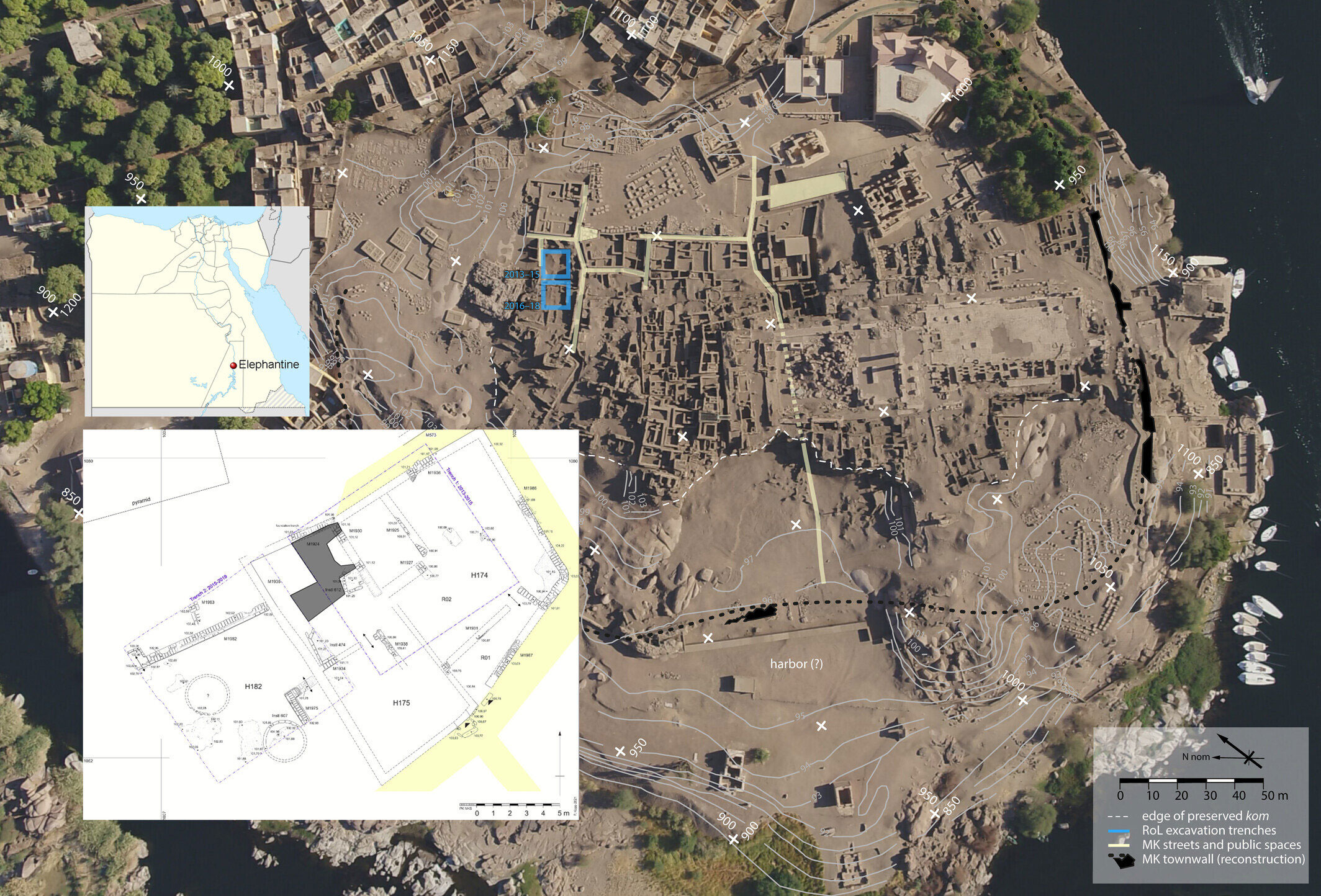
The background shows an aerial orthophotograph of the southern part of Elephantine Island with the Realities of life excavation squares highlighted in blue, south-east of the Dynasty 3 granite pyramid. Credit: Archaeometry (2025). DOI: 10.1111/arcm.70008

Ancient Egyptians Deliberately Produced Arsenical Bronze 4,000 Years Ago on Elephantine Island

Metalworkers on Elephantine Island near Aswan were deliberately producing arsenical bronze nearly 4,000 years ago using sophisticated alloying techniques, according to new research published in Archaeometry. The discovery overturns long-held assumptions about ancient Egyptian metallurgy and reveals technological innovation far ahead of what scholars previously credited to Middle Kingdom craftsmen. The study, led by Ing.

How the divination spoon functioned is not known, but it was believed to be used to see the future. Source: Manx National Heritage.

Extremely Rare Divination Spoon Found on Isle of Man was used for Prophecy

A 2,000 year old metal spoon has been found on the Isle of Man in the United Kingdom. Dating from the Iron Age, it is believed that this bronze spoon may be something very unusual. It is thought that this is a so-called “divination spoon” used for telling the future. Only 28 such examples have

A new discovery in central Germany has been found under a burial mound. Three graves, at least two of warriors, have been unearthed dating back to the Beaker Culture and the Copper Age, 4,500 years ago.

Ancient Warrior Burials from the Copper Age Bell Beaker Culture Found

Archaeologists in Germany have unearthed a series of burials near the village of Förderstedt, in Saxony-Anhalt. The graves are some 4,500 years old and contain warriors from the Copper Age. The brief period in our history marks the first use of metals as we moved out of the Stone Age. Over time our use of

A bronze cannon dating from the Coronado Expedition has been found in Arizona. The gun, dated to around 1540, is the oldest firearm ever found in the United States.

Oldest Firearm in US History Found in Arizona

Archaeologists in Arizona have uncovered a bronze cannon which dates back to the Coronado Expedition of the early 16th century. Francisco Vázquez de Coronado (1510 -1554), a Spanish nobleman and conquistador, led a sizeable expedition from what is now Mexico across the southwestern United States between 1540 and 1542. The cannon, according to the study

Roman orichalcum, which begs the question: how can we not know what this metal is? Well, it seems that perhaps the Romans didn’t know, either (Emanuele riela / CC BY-SA 4.0)

Orichalcum: A Lost Metal that we Never Lost?

The ancient Greek philosopher Plato, writing about Atlantis, made mention of a fabulous metal which he called “orichalcum”, literally “mountain copper”. This mysterious element was supposedly second only to gold in value, and was highly prized by the ancients for its beauty and its versatility. Plato was not the first to mention this precious metal.